To clean up a blood spill: close the area off, put on gloves, face protection and an apron away from the spill, absorb from the outside in, bag the absorbent, clean the surface, apply an EPA-registered disinfectant and leave it wet for the full dwell time on its label, bag and seal everything, remove PPE before you leave the area, wash, and write it down.
That is the sequence. What makes a real blood spill hard is not the sequence — it is the clock, and the conditions you are doing it under.
OSHA sets the deadline rather than the stopwatch. Under 29 CFR 1910.1030(d)(4)(ii)(A), contaminated work surfaces must be decontaminated with an appropriate disinfectant immediately or as soon as feasible when surfaces are overtly contaminated or after any spill of blood or other potentially infectious materials. That phrase is the whole timing rule, and everything below is about meeting it without cutting a step.
This article is the timed procedure. If you want the kit-contents and program side of it — what belongs in the box, which paragraph each item answers to, and the eleven-point audit checklist — read our blood spill kit guide instead. The two are built to sit next to each other.
How long do you actually have?
There is no number of minutes in the standard. There is a standard of promptness: immediately or as soon as feasible, at 1910.1030(d)(4)(ii)(A). In practice that means the cleanup starts as soon as the area is safe to work in, and it does not wait for a shift change, a manager, or the end of a lunch rush.
Here is the same sequence laid out against a clock, so you can see where the time actually goes. The timings are a realistic working estimate for a small spill on a hard, non-porous floor — not a regulatory requirement.
| Clock | What you are doing | What it satisfies |
|---|---|---|
| 0:00 – 1:00 | Close the area. Keep people out and keep footwear out of it. Send someone for the kit rather than leaving the spill unattended. | 1910.1030(d)(1) — universal precautions |
| 1:00 – 2:00 | Put PPE on away from the spill: gloves, face protection, apron, shoe covers. | (d)(3)(ix), (d)(3)(x), (d)(3)(xi) |
| 2:00 – 4:00 | Apply absorbent from the outside edge inward. Do not wipe outward. | CDC: remove visible organic matter first |
| 4:00 – 5:00 | Lift the bulk into a red bag with the scraper. Nothing goes in by hand. | (d)(4)(ii)(D), (d)(4)(iii)(B)(1) |
| 5:00 – 6:00 | Clean the surface. This is soil removal, not disinfection. | (d)(4)(ii)(A) |
| 6:00 + dwell time | Apply the disinfectant and leave the surface visibly wet for its full label dwell time. This is the step people skip. | (d)(4)(ii)(A) — appropriate disinfectant |
| After dwell | Bag and seal. If the outside of the bag is contaminated, it goes inside a second bag. | (d)(4)(iii)(B)(2) |
| Last two minutes | Remove PPE before leaving the area, gloves last, then wash hands. | (d)(3)(vii), (d)(3)(viii), (d)(2)(v) |
| Same shift | Decontaminate the bucket and cart, restock the kit, write the incident up. | (d)(4)(ii)(C), (d)(4)(i) |
Read down the right-hand column and one thing stands out: the dwell time is the only step with no paragraph telling you how long it lasts, because the answer is on the product label rather than in the regulation.
What has to happen in the first sixty seconds?
Three things, in this order: stop people walking through it, decide who is doing the cleanup, and do not touch anything until that person is dressed.

The reason the order matters is the rule the standard opens paragraph (d) with. At 1910.1030(d)(1): Universal precautions shall be observed to prevent contact with blood or other potentially infectious materials. Under circumstances in which differentiation between body fluid types is difficult or impossible, all body fluids shall be considered potentially infectious materials.
Universal precautions is not a mood. It is the instruction that nobody on your floor gets to assess whether this particular spill looks risky. The person who kneels down with a paper towel because it is only a little bit has made exactly the judgment call the sentence forbids.
The second sentence is the one that settles arguments in a restaurant or a care home. If you cannot tell whether what is on the floor contains blood, you treat it as though it does. For where that line sits between fluid types, our article on biohazard versus bodily fluid cleanup works through the scope question properly.
How long does the surface have to stay wet, and what do you use?
As long as the label says, and with a product that carries a bloodborne pathogen claim. The standard says appropriate disinfectant and stops there, which puts the dwell time on the manufacturer rather than on OSHA.
If you are diluting bleach instead, CDC's environmental services guidance describes sodium hypochlorite solutions from 5,000–6,150 ppm, which is roughly a 1:10 dilution of household bleach sold in the United States, down to 500–615 ppm at 1:100. EPA's register of products tested against HIV and hepatitis B and C is List S.
Two practical points that the timed table above makes visible. First, the dwell time is dead time — you cannot stand there wiping, and if you do, you have shortened it. Second, a dwell time of five or ten minutes is why the public-area version of this job is so much harder than the back-of-house version. We go deeper into disinfectant selection and contact time in the blood spill kit guide.
What changes when the spill is in a public area?
The procedure does not change. The sequencing of the people around it does.
A spill in a dining room, a shop floor, a school corridor or a hotel lobby adds three problems the textbook version ignores: an audience, a route that still has to function, and the temptation to rush the dwell time because customers are waiting.
- Close more than the spill. Close the walking route, not a one-metre circle. People step around barriers and then walk the contamination to the exit.
- Send one person for the kit and keep one person at the cordon. An unattended closed-off spill in a public area is not actually closed off.
- Do not shorten the dwell time for the audience. If the room needs to reopen sooner than the label allows, the room reopens later. There is no compliant version of a four-minute wait on a ten-minute product.
- Keep the waste out of sight and out of the public bin. Red-bagged waste carried through a dining room is a different problem from the spill itself.
- Brief the staff who are not cleaning. The most common failure in a public area is a second employee helpfully mopping the edges with no PPE on.
Where the waste goes after that is a separate question with three layers to it, and we work through it in the biohazard waste disposal rules.
What changes when the blood has already dried?
Quite a lot, and almost none of it in your favour. A dried spill is the case most procedures are not written for, because they assume somebody saw it happen.
Dried blood is still contaminated within the meaning of 1910.1030(b), which defines contaminated as the presence or the reasonably anticipated presence of blood or other potentially infectious materials on an item or surface. Age is not in that definition. CDC's clinical overview of hepatitis B notes that the virus is infectious for at least seven days on surfaces, which is the reason the definition does not carry a time limit.

What changes in practice:
- Wet it before you touch it. Scraping or brushing dry material moves flakes around the room instead of into the bag. Apply the disinfectant first and let it soften the deposit, then absorb.
- Assume there is glass until you can see there is not. Dried material hides what is set into it, and 1910.1030(d)(4)(ii)(D) is absolute: broken glassware which may be contaminated shall not be picked up directly with the hands. Use the scraper.
- Expect the waste call to be different. The federal test is releasability, not appearance — an item is regulated waste where it is caked with dried blood and capable of releasing it during handling.
- Check the whole route, not the patch. If it dried where it fell, it probably also dried where someone walked.
- Treat the find as an incident with no witness. You cannot say nobody was exposed if you do not know when it happened.
The absorbent behaves differently on a dried deposit too, and porous surfaces are their own problem — our absorbent powder guide covers how the chemistry and the outside-in application rule actually work.
What changes when you are the only person on shift?
This is the realistic case for a small business at 9pm, and the honest answer is that one person cannot do the first minute and the second minute at the same time.
Something has to give, so decide in advance which. The two defensible choices are to close the area and then fetch the kit, or to carry the kit to the spill and dress at the edge of it. The indefensible choice is to start cleaning in street clothes because fetching PPE felt like a delay.
| The problem when alone | What to do about it before it happens |
|---|---|
| You cannot guard the cordon and fetch the kit | Keep a kit in the area people are actually in, not only in the stockroom. PPE must be readily accessible under (d)(3)(iii) |
| You cannot wash your hands without walking out of the area in PPE | Antiseptic hand wipes in the kit, which is what (d)(2)(iv) exists for |
| Nobody can hold the bag open for you | Two bags per kit and a flat surface to stand one on |
| Nobody witnesses the incident | A report form in the kit, filled in the same shift rather than from memory |
| You have to reopen the area yourself | Know the dwell time before the night it matters |
None of that is a regulation. It is what the regulations look like when there is one of you.
What about the mop bucket, the cart and the surfaces you covered?
This is the part almost nobody does, and it is written down in plain language.
1910.1030(d)(4)(ii)(C): All bins, pails, cans, and similar receptacles intended for reuse which have a reasonable likelihood for becoming contaminated with blood or other potentially infectious materials shall be inspected and decontaminated on a regularly scheduled basis and cleaned and decontaminated immediately or as soon as feasible upon visible contamination.
A mop bucket used on a blood spill is a receptacle intended for reuse. So is the janitorial cart, the bin the bag went into, and the tray the kit lives on. Each one has two duties attached to it: a scheduled inspection, and immediate decontamination when you can see contamination on it.
The companion paragraph covers anything you laid down to protect a surface. (d)(4)(ii)(B): Protective coverings, such as plastic wrap, aluminum foil, or imperviously-backed absorbent paper used to cover equipment and environmental surfaces, shall be removed and replaced as soon as feasible when they become overtly contaminated or at the end of the workshift if they may have become contaminated during the shift.

Both paragraphs point the same way. The cleanup is not finished when the floor is clean — it is finished when the things you cleaned it with are clean too, and that part belongs on the written schedule your worksite keeps under (d)(4)(i).
Which mistakes turn a cleanup into an exposure incident?
Six, in rough order of how often they happen.
- Starting without PPE because it was only a small spill. The judgment call universal precautions exists to remove, at (d)(1).
- Wiping outward. It converts one contaminated patch into a larger one.
- Treating cleaning and disinfecting as one step. A disinfectant applied over soil has not disinfected the surface under it.
- Cutting the dwell time. The most common and the least visible failure, because the floor looks identical either way.
- Walking out of the area in PPE. All PPE must be removed prior to leaving the work area, (d)(3)(vii), and placed in a designated container, (d)(3)(viii). A gown carried to the break room moves the hazard rather than removing it.
- Picking glass up with gloved fingers. Nitrile does not stop a shard, and (d)(4)(ii)(D) is a prohibition rather than a recommendation.
If skin, eyes or mucous membranes do get contaminated, the standard is specific about the first action. Under (d)(2)(vi), employers must ensure employees wash hands and any other skin with soap and water, or flush mucous membranes with water, immediately or as soon as feasible following contact. Then treat it as an exposure incident: a confidential medical evaluation and follow-up must be made immediately available to the employee under (f)(3).
What do you write down, and when?
The same shift, while you can still remember the order things happened in. At minimum: the time, the location, who cleaned it, what PPE they wore, what product was used and for how long, where the waste went, and whether anyone had contact with the spill.

Two of those details matter more than they look. Recording the product and the dwell time is the only evidence that the step with no regulatory number was done properly. And recording whether anyone had contact is what decides whether this was a cleaning job or an exposure incident with obligations attached under (f)(3).
The cleaning itself also has to sit inside something written. Under (d)(4)(i) the employer determines and implements an appropriate written schedule for cleaning and method of decontamination, based on the location, the surface, the soil present and the tasks performed in the area. An incident record and a written schedule are different documents, and an inspector will ask for both — the full program picture is in our 1910.1030 kit requirements guide.
Frequently Asked Questions (FAQ)
How long do I have to clean up a blood spill?
OSHA does not give a number of minutes. 1910.1030(d)(4)(ii)(A) requires contaminated surfaces to be decontaminated immediately or as soon as feasible after any spill of blood or other potentially infectious materials. In practice that means the cleanup starts as soon as the area is safe to work in, and it does not wait for a manager or a shift change.
What is the correct bleach ratio for cleaning up blood?
CDC describes sodium hypochlorite solutions ranging from 5,000 to 6,150 ppm, which is about a 1:10 dilution of household bleach sold in the United States, down to 500 to 615 ppm at a 1:100 dilution. Freshly diluted bleach has to be mixed correctly every time by whoever is on shift, which is why most kits are built around a ready-to-use product instead.
Do I clean first or disinfect first?
Clean first. Disinfection only works on a surface the soil has already been removed from, so the order is absorb, then clean, then disinfect and leave the surface wet for the full dwell time on the product label.
Can I clean up a blood spill with just gloves on?
Not where splashes or spatter may be generated. 1910.1030(d)(3)(x) calls for masks in combination with eye protection, or chin-length face shields, in those circumstances, and (d)(3)(xi) adds gowns or aprons where the exposure warrants them.
What do I do about blood that has already dried?
Treat it as contaminated regardless of age, because 1910.1030(b) defines contaminated by presence rather than by freshness, and CDC notes hepatitis B virus remains infectious for at least seven days on surfaces. Wet the deposit with disinfectant before you disturb it, assume glass may be set into it, and use mechanical means rather than hands.
Does the mop bucket need cleaning after a blood spill?
Yes, and it is an explicit requirement. 1910.1030(d)(4)(ii)(C) requires bins, pails, cans and similar receptacles intended for reuse to be inspected and decontaminated on a regularly scheduled basis, and cleaned and decontaminated immediately or as soon as feasible upon visible contamination.
Who is allowed to clean up a blood spill at work?
Any employee the employer has trained and equipped under the bloodborne pathogens standard. Assigning cleanup to a host, a shift lead or a cleaner brings that person inside the scope of the standard whether or not it was written into a job description.
What happens if blood gets on someone's skin or in their eyes?
Wash the skin with soap and water or flush the mucous membranes with water immediately or as soon as feasible, which is the requirement at 1910.1030(d)(2)(vi). Then treat it as an exposure incident, because (f)(3) requires a confidential medical evaluation and follow-up to be made immediately available to that employee.
Get a kit one person can finish the job with
Every timing problem above comes back to the same thing: whether one person can complete the sequence without walking away from the spill. A kit that sends someone to a supply closet mid-procedure has turned a five-minute job into an uncontrolled area with nobody standing in front of it.
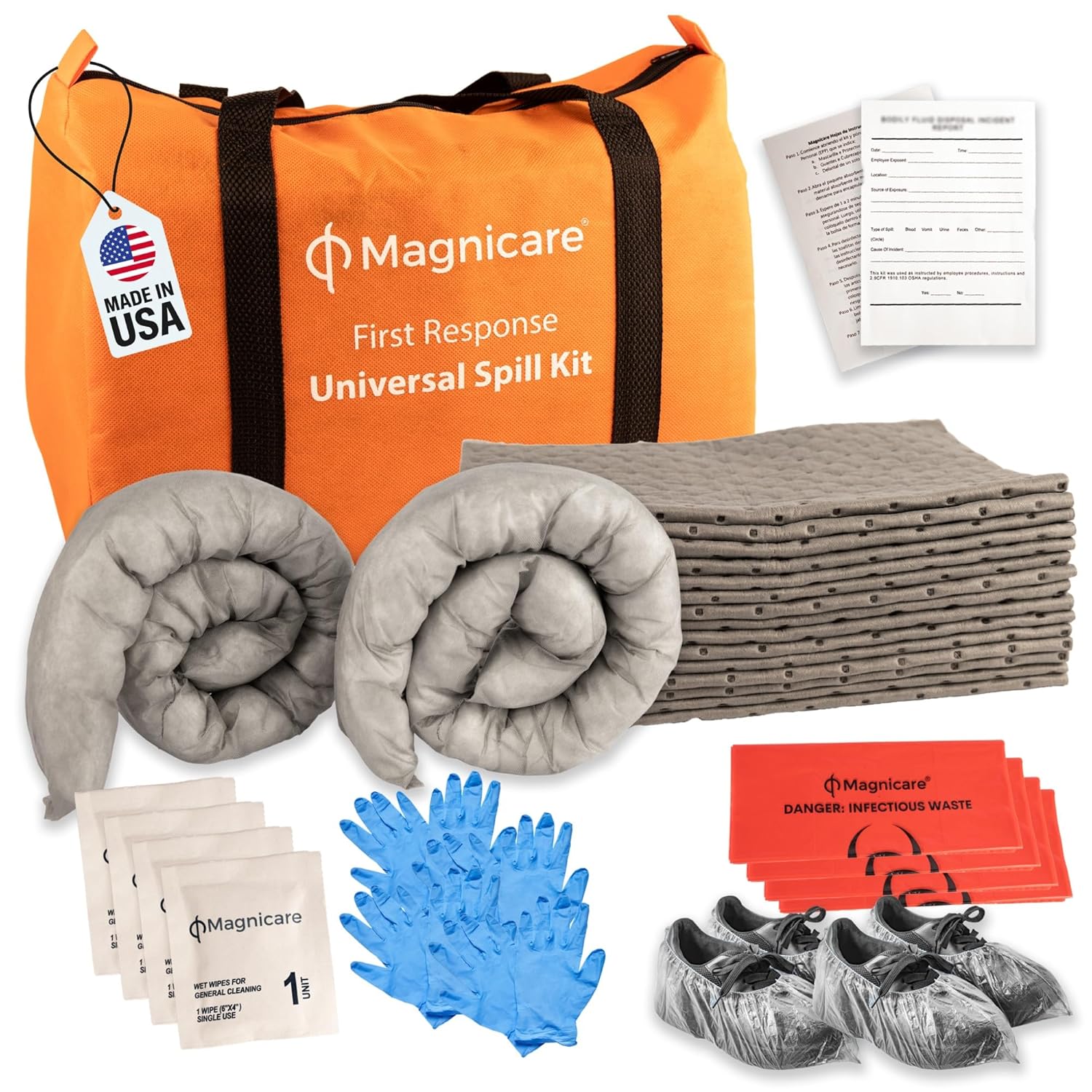
Magnicare's kits are assembled around that test. The Bloodborne Pathogen & Vomit Cleanup Kit (BAG) is the grab-and-go format for front-of-house, vehicles and carts. The Bodily Fluid Clean Up Kit (BOX) mounts on a wall where you want it audited at a glance. Both ship with absorbent powder, wipes, disposable gloves, masks with face shields, shoe covers and aprons, a scraper, biohazard bags, a bilingual instruction sheet and an incident report form — so the PPE step, the mechanical-means step and the paperwork step are all answered out of one container.
One thing to check against your own stock rather than assume: the disinfectant. The dwell time is the step with no regulatory number attached, so confirm you hold an EPA-registered product with a bloodborne pathogen claim and a printed contact time, and keep it where the kit is.
Stocking more than one location? Compare formats and multi-packs in the blood cleanup kits collection, and add a box of red biohazard bags so the second-container rule at (d)(4)(iii)(B)(2) never catches you short on the night it matters.
This article is general information about federal OSHA requirements, not legal advice. State plans and state medical-waste rules may impose stricter obligations than the federal standard. Verify the current text of any regulation at eCFR before relying on it.