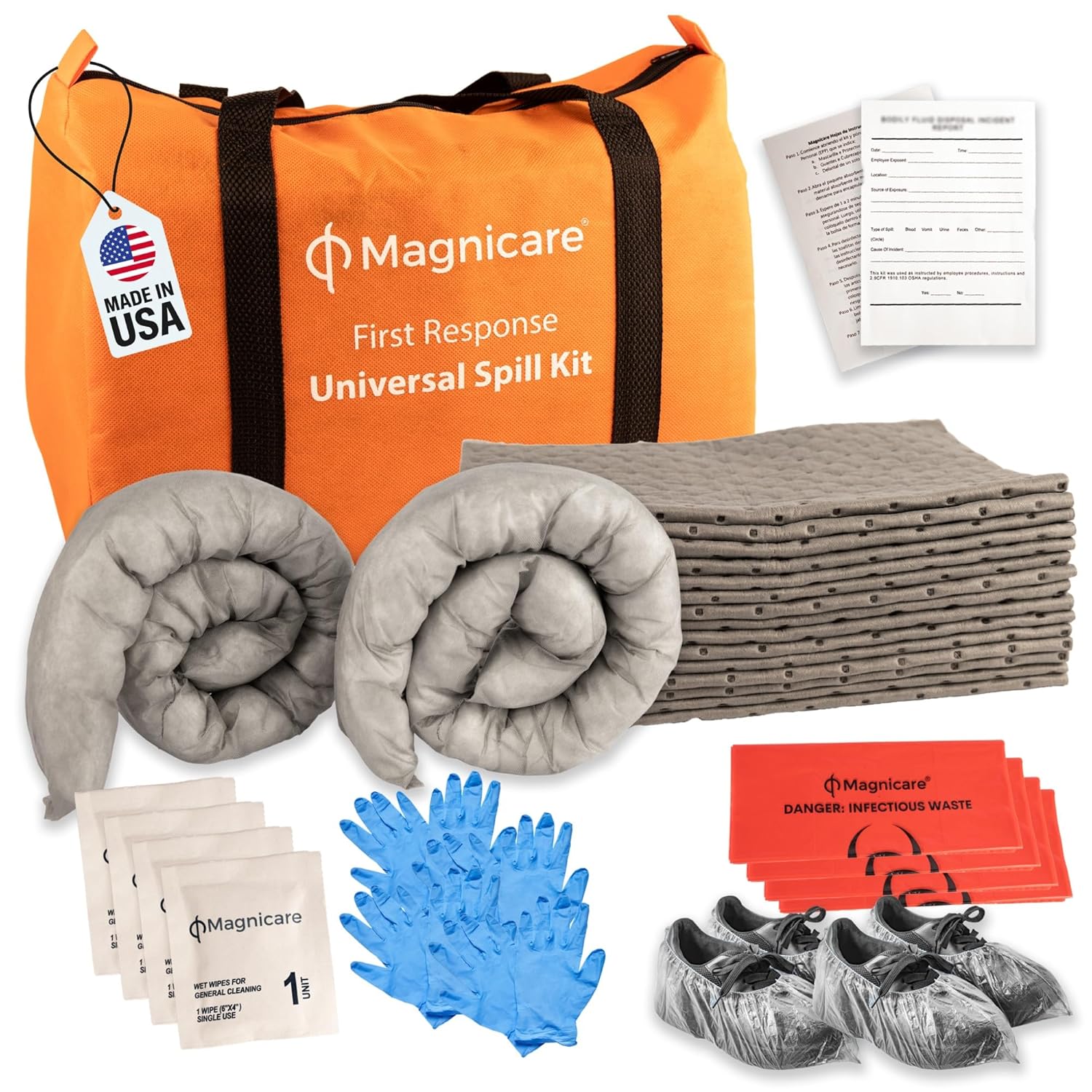
Is a biohazard cleanup kit the same thing as a bodily fluid kit?
Usually yes in the box, and never in the rulebook. “Biohazard clean up kit” is a marketing category; “bodily fluid kit” describes what is normally inside one. Neither phrase appears in any federal regulation. What does appear is a specific list of materials OSHA calls blood and other potentially infectious materials — and that list, not the label on the box, decides what your response has to look like.
So the useful question is not which kit has the better name. It is which regime governs the mess you are actually likely to face, and at what point the job stops being something your own staff may lawfully do at all.
That is what this article sorts out. It deliberately does not re-run the contents comparison — we did that in the bloodborne pathogen kit buyer’s guide — and it does not repeat the cleanup procedure, which lives in what happens once the kit is opened.
What does “biohazard” actually mean in a regulation?
In 29 CFR 1910.1030, “biohazard” is essentially a warning label, not a class of material. The standard requires biohazard labels on containers of regulated waste under (g)(1)(i), in fluorescent orange or orange-red under (g)(1)(i)(A), with red bags or red containers permitted as a substitute under (g)(1)(i)(E).
The material itself is defined elsewhere, and narrowly. The scope clause is a single sentence:
“This section applies to all occupational exposure to blood or other potentially infectious materials as defined by paragraph (b) of this section.” — 29 CFR 1910.1030(a)
Paragraph (b) then defines Blood as “human blood, human blood components, and products made from human blood,” and lists Other Potentially Infectious Materials (OPIM) as a closed set of fluids: “semen, vaginal secretions, cerebrospinal fluid, synovial fluid, pleural fluid, pericardial fluid, peritoneal fluid, amniotic fluid, saliva in dental procedures, any body fluid that is visibly contaminated with blood, and all body fluids in situations where it is difficult or impossible to differentiate between body fluids,” plus unfixed human tissue and certain HIV/HBV cultures.
Read that list twice, because two phrases in it do almost all the work in real workplaces. “Visibly contaminated with blood” and “difficult or impossible to differentiate between body fluids” are what pull an ordinary restroom or dining-room incident into the standard. Vomit, urine, feces and saliva are otherwise not on the list.
One more definition matters for scope, because it extends beyond wet material:
“Contaminated means the presence or the reasonably anticipated presence of blood or other potentially infectious materials on an item or surface.” — 1910.1030(b)
“Reasonably anticipated presence” is why a dried smear on a door push plate is still in scope. Nothing has to be visibly wet for the standard to apply.
Which rules govern which kind of mess?
This is the table the product names obscure. One kit on a shelf can serve several of these rows, but the obligations behind them come from different agencies and do not interchange.
| The mess | Which regime governs it | What that actually obliges you to do |
|---|---|---|
| Blood, or any body fluid visibly contaminated with blood | OSHA 29 CFR 1910.1030 | PPE at no cost (d)(3)(i), readily accessible and in appropriate sizes (d)(3)(iii), surfaces decontaminated after a spill (d)(4)(ii)(A), closable and leak-proof labeled waste containment (d)(4)(iii)(B)(1)(i)–(iv), a written exposure control plan (c)(1)(i), annual training (g)(2)(ii)(B) |
| Vomit, feces or urine you cannot identify — the normal case | OSHA 1910.1030, via the “difficult or impossible to differentiate” clause in (b) | Same obligations as the row above. This is why the defensible default is to treat unidentifiable fluid as OPIM |
| Vomit or diarrhea in a food establishment, no visible blood | FDA Food Code §2-501.11, as adopted by your state | Written procedures covering the specific actions employees take to limit exposure of employees, consumers, food and surfaces |
| Contaminated sharps — needles, blades, broken contaminated glass | OSHA 1910.1030(d)(4)(iii)(A); DOT for transport; your state medical-waste program | Closable, puncture-resistant, leakproof, labeled containers (d)(4)(iii)(A)(1)(i)–(iv); never picked up by hand, mechanical means only (d)(4)(ii)(D) |
| Chemical, oil, fuel or coolant | OSHA 1910.1200 and 1910.120; EPA where oil reaches water | A different kit entirely, chosen from the SDS — see universal vs oil-only vs HazMat spill kits |
| Sewage backflow, floodwater, mould growth | None of the above | Not a bodily fluid kit job. A cleanup kit is the wrong tool and the wrong PPE |
| Death scene, trauma, decomposition | OSHA duties still apply to your employees; ANSI/IICRC S540 is the industry standard; some states register practitioners | In practice, a contractor — see below |

Notice what the table does not contain: a row for “biohazard.” There is no single biohazard regime. There is a bloodborne pathogen standard, a model food code, a waste-transport rule and a set of state programs, and a well-built kit happens to sit at the intersection of the first two.
Does OSHA require your business to own a kit at all?
Strictly, no — and this is the distinction that trips up most buyers. OSHA does not mandate a product. It mandates outcomes, and in almost every workplace a kit is the only practical way to meet them.
The trigger is employee-facing. Paragraph (b) defines Occupational Exposure as “reasonably anticipated skin, eye, mucous membrane, or parenteral contact with blood or other potentially infectious materials that may result from the performance of an employee’s duties.”
So the question is not what industry you are in. It is whether any employee’s duties can reasonably be expected to bring them into contact — and under (c)(2) that exposure determination is made without regard to the PPE you might give them. You cannot reason your way out of the determination by pointing at a glove box.
Once the determination is positive, the obligations are concrete rather than aspirational: appropriate PPE at no cost to the employee under (d)(3)(i), readily accessible and in appropriate sizes under (d)(3)(iii), compliant waste containment, a written plan under (c)(1)(i) reviewed at least annually under (c)(1)(iv), and training at initial assignment and at least annually under (g)(2)(ii)(A) and (B). We walk through each of those line by line in exactly what OSHA 1910.1030 requires your cleanup kit to contain.
What OSHA never does is bless a product. There is no OSHA-approved, OSHA-certified or OSHA-endorsed kit of any description, and a vendor using those words is telling you something about their marketing rather than their kit — we unpacked that claim here.

When is a job beyond what an in-house kit can handle?
There is no federal gallon threshold that makes a spill “large,” and anyone quoting you one is inventing it. What exists instead are conditions under which an in-house response stops being capable or lawful. Each of the seven below is a genuine stop sign.

- The material has soaked into porous building materials. Carpet pad, subfloor, drywall, grout, upholstery foam, untreated concrete. Paragraph (d)(4)(ii)(A) requires contaminated work surfaces to be decontaminated after a spill, and a surface you cannot physically reach cannot be decontaminated — it has to be removed, which is construction work, not cleaning.
- The volume exceeds what your absorbent and your waste container can hold leak-proof. The test is not a number of ounces. It is whether you can close, seal and carry the waste without leakage, as (d)(4)(iii)(B)(1) requires.
- A respirator would be needed. This one is commonly underestimated — see the next section.
- There are needles or sharps in unknown quantity. A handful of sharps is a container. An unknown number scattered through a space is a survey, a different PPE set and a different waste stream.
- Decomposition, a death scene, or a scene still under police control. Your staff have no authority over the scene and are not equipped for the contamination pattern.
- Contamination has travelled. Through HVAC, down plumbing, under a wall into the neighbouring unit. Once the boundary is no longer visible, the job needs assessment before cleaning.
- Your people have not been trained and offered the vaccine. Training at initial assignment under (g)(2)(ii)(A) and the hepatitis B vaccination offer within 10 working days of initial assignment under (f)(2)(i) are preconditions for assigning the work — not paperwork you can catch up on afterwards.
Why “just wear a mask” is the expensive mistake
If the job genuinely needs respiratory protection, you have not bought a mask. You have triggered an entire OSHA program under 29 CFR 1910.134:
“In any workplace where respirators are necessary to protect the health of the employee or whenever respirators are required by the employer, the employer shall establish and implement a written respiratory protection program with worksite-specific procedures.” — 1910.134(c)(1)
That written program has nine required elements under (c)(1)(i)–(ix), including respirator selection procedures, medical evaluations of the employees who will wear them, fit testing for tight-fitting respirators, cleaning and storage procedures, training, and a regular evaluation of the program’s effectiveness. Paragraph (a)(2) puts the employer on the hook for establishing and maintaining it.
Handing someone a respirator out of a drawer satisfies none of that. For a four-person warehouse or a single-unit restaurant, standing up a compliant respiratory protection program for one incident a year is not a realistic plan — which is precisely why the respirator question is such a clean dividing line between work you do and work you contract out.
Which jobs belong to a remediation contractor?
The short version: anything where the contamination is structural, unbounded, or attached to a death. In practice that means unattended deaths and decomposition, suicides and homicides, serious trauma with blood in volume, hoarding with biological contamination, sewage backflow into occupied space, needle-strewn sites, and vehicle interiors after a trauma.
There is a recognised industry standard for that work. ANSI/IICRC S540, now in its Second Edition (2023), “describes the procedures to be followed and the precautions to be taken when performing trauma and crime scene cleanup regardless of surface, item, or location,” and sets out the methodology a technician uses for inspecting and investigating blood and OPIM contamination.
Four questions worth asking any contractor before they quote:
- Do they work to ANSI/IICRC S540, and can they describe how they verify the job is finished?
- Where does the waste go, and can they show the registered transporter or permitted facility that receives it?
- Do they carry their own bloodborne pathogen program — exposure control plan, training records, vaccination offer — for their own employees?
- Is the scope written down, including which materials are being removed rather than cleaned?
Is biohazard remediation a licensed trade?
There is no federal license to clean up blood. OSHA regulates how employees must be protected, DOT and the states regulate the waste once it moves, but no federal agency issues a “biohazard cleanup license,” and no federal body certifies kits or companies.
Some states do regulate the trade directly, and that is worth checking before you hire. California, for example, requires a trauma scene waste management practitioner to register with the state Department of Public Health under Chapter 9.5 of the Health and Safety Code, commencing with section 118321. The state defines the activity as “the removal of human blood, human body fluids, and other associated residues from the scene of a serious human injury, illness, or death,” and registration requires proof of a contractual relationship with a registered transporter or a permitted medical waste facility that will receive the waste.
Other states take other approaches, and several have no registration at all. The practical takeaway is that a “certified” badge on a contractor’s website usually refers to a private training credential, not a state license. Ask which one it is, and check your own state’s rules rather than assuming.
Where does the waste go in each case?
This is where the two kit categories genuinely diverge, because the waste rules attach to the material rather than to the box it came out of. The definition in paragraph (b) is the test:
“Regulated Waste means liquid or semi-liquid blood or other potentially infectious materials; contaminated items that would release blood or other potentially infectious materials in a liquid or semi-liquid state if compressed; items that are caked with dried blood or other potentially infectious materials and are capable of releasing these materials during handling; contaminated sharps; and pathological and microbiological wastes containing blood or other potentially infectious materials.” — 1910.1030(b)
Everything in that definition turns on releasability, not on appearance. A wipe with a dried trace that will not release anything when handled is not regulated waste; a saturated pad that would release under compression is.

Once something is regulated waste, the container requirements under (d)(4)(iii)(B)(1)(i)–(iv) apply: closable, constructed to contain all contents and prevent leakage during handling, labeled or color-coded, and closed before removal. If the outside of the container becomes contaminated, (d)(4)(iii)(B)(2) requires a second container. Sharps follow their own, stricter route under (d)(4)(iii)(A)(1)(i)–(iv).
Transport off site is a separate regime again: DOT defines regulated medical waste at 49 CFR 173.134(a)(5), and your state medical waste program decides who may haul it and on what paperwork — which is why the biohazard waste disposal rules break into three layers rather than one federal rule, with OSHA governing containment inside the building, DOT governing the packaging on the road, and 40 CFR Part 259 standing empty where a federal disposal rule would be. Most small businesses reach that point via a contracted hauler rather than handling it themselves.
For the full item-by-item sorting walk-through — gloves, absorbent, scrapers, broken glass, the lot — see what separates a compliant blood spill kit from a box of gloves, which covers the waste decisions in detail.
How should your exposure control plan draw the line?
Paragraph (c)(1)(i) requires the plan in writing, (c)(1)(iii) requires it to be accessible to employees, and (c)(1)(iv) requires review and update at least annually. Separately, (d)(4)(i) requires a written schedule for cleaning and decontamination. None of those mention contractors — which is exactly why most plans leave the handover undefined, and why the decision ends up being made by whoever is on shift.
Write five things into the plan and the problem disappears:
- The stop conditions, in plain language — the seven above, edited to your site.
- Who decides, by role, and who they call if that person is unreachable.
- The contractor’s name and number, chosen and phoned once before you need them. A vendor found on Google at 11pm is not a control.
- The waste route — who hauls regulated waste, under what contract.
- What staff must not do, stated as flatly as the rest. No mopping, no improvising a respirator, no removing flooring.
The five minutes this takes is also the difference between a written plan that reflects your operation and one copied from a template, which is what an inspector is actually trying to establish.
So which kit should you actually stock?
For the overwhelming majority of businesses — restaurants, gyms, schools, salons, clinics, warehouses, fleets, offices — the answer is a bodily fluid and bloodborne pathogen cleanup kit, whatever the listing happens to call it. Remediation-grade equipment is not the missing piece, because the jobs that need it are jobs you should not be doing in-house anyway.

Pick the format by how the responder reaches the mess. A grab-and-go bag kit wins wherever someone has to travel to the incident, because one person carries it in one hand. A box kit suits a fixed station that is inventoried at open and close, since it stores and audits more cleanly. Sites with a higher incident rate keep spare red biohazard bags so a partially used kit never becomes the reason someone improvises.
If your risk is chemical rather than biological, none of the above is the right purchase — a universal spill kit is a different product for a different rulebook. And if you operate a food business, the contents checklist an inspector works down is mapped item by item in what a restaurant bodily fluid cleanup kit must contain, with the event procedure itself in our restaurant vomit and diarrhea response guide.
Frequently Asked Questions (FAQ)
Is a biohazard cleanup kit the same as a bodily fluid cleanup kit?
In practice the two names usually describe the same product, and neither is a regulatory category. What matters is whether the kit meets the obligations in OSHA 1910.1030 for the material you expect to face: appropriate PPE provided at no cost and in appropriate sizes, a means of containing and removing the material without hand contact, and closable, leak-proof, labeled waste containment.
Is there such a thing as an OSHA-approved biohazard cleanup kit?
No. OSHA does not approve, certify or endorse products of any kind. It sets requirements an employer must meet, and a kit is simply one way of meeting them. Any listing claiming OSHA approval is making a marketing claim, not a regulatory one.
Does a biohazard kit cover vomit and urine?
The kit does; the bloodborne pathogen standard may not. Vomit, urine, feces and saliva are not on the standard’s list of other potentially infectious materials unless they are visibly contaminated with blood, or unless it is difficult or impossible to differentiate between body fluids — which describes most real incidents. In a food establishment the FDA Food Code imposes its own requirement for written procedures regardless.
How big does a blood spill have to be before you call a contractor?
There is no federal volume threshold, and any specific number you are quoted is invented. The practical tests are whether the material has soaked into porous building materials you cannot reach, whether you can seal and carry the waste without leakage, whether respiratory protection would be needed, and whether the contamination has travelled beyond a visible boundary.
Do I need a respirator to clean up blood?
For a routine small spill handled with gloves, eye protection and a gown, no. But if respiratory protection is genuinely necessary, 1910.134(c)(1) requires a written, worksite-specific respiratory protection program with nine required elements, including medical evaluation and fit testing for each wearer. That is a reason to contract the job out, not a reason to issue a mask from a drawer.
Is biohazard remediation a licensed trade?
There is no federal license. ANSI/IICRC S540 is the recognised industry standard for trauma and crime scene cleanup, and some states regulate the activity directly — California, for instance, requires trauma scene waste management practitioners to register with its Department of Public Health under Health and Safety Code Chapter 9.5. Most “certified” claims refer to private training credentials, so ask which applies in your state.
Can biohazard waste go in the regular trash?
It depends on whether the item meets the regulated waste definition in 1910.1030(b), which turns on whether it would release blood or OPIM in a liquid or semi-liquid state if compressed or handled. Saturated material and contaminated sharps are regulated waste and must go into compliant labeled containers. Items that will not release anything may not be, though your state or local rules can be stricter.
What should my exposure control plan say about contractors?
Name the stop conditions, the role that decides, the contractor and their number, the regulated waste hauler, and what staff must never attempt. The standard requires the plan in writing under (c)(1)(i) and an annual review under (c)(1)(iv), so the handover belongs in the document rather than in someone’s memory.
What to do this week
Three jobs, none of which takes an afternoon.
Decide your stop conditions and write them down. Take the seven above, strike the ones that cannot happen on your site, and put the rest in your exposure control plan with a name and a phone number beside them.
Phone one remediation contractor before you need one. Ask the four questions in the contractor section. Ten minutes now is worth a great deal at 11pm.
Make sure the in-house response is actually stocked. Our Bloodborne Pathogen & Vomit Cleanup Kit (BAG) carries PPE in multiple sizes, absorbent solidifier, a scraper and scoop, a labeled leak-proof biohazard bag and an incident report — the whole list that paragraph (d) expects to be readily accessible, in a format one person grabs on the way. For a fixed, auditable station, the Bodily Fluid Clean Up Kit (BOX) holds the same contents in a form that inventories cleanly.
The kits handle the incidents you should handle. The plan handles the ones you should not. Compare Magnicare cleanup kits →
This article quotes OSHA standards, the FDA Food Code and state and industry sources in plain language. It is not legal advice. The Food Code is a model code adopted separately by each state, state medical-waste and trauma-scene rules vary, and your local regulator may impose additional requirements. Always work from the version your own regulator has adopted.