Check a spill kit monthly, and keep the record of having checked it. A useful inspection does not ask whether the kit looks full. It asks whether you could show, after an incident, that the kit was complete and usable at the moment it was needed — which is four provable statements rather than a list of chores.
What does a spill kit inspection actually have to prove?
Most spill kit checklists circulating online are inventory sheets with a date box. They tell you the kit was opened and looked at. They do not tell you the one thing that matters a year later, when somebody is reconstructing an incident: was the kit complete and usable at the moment it was needed.
That reframing changes what goes on the sheet. An inspection has to produce four statements that a stranger could test, and each one has a question attached that either passes or fails.
| What the check must prove | The question that proves it | Why it fails in practice |
|---|---|---|
| The kit is where your written plan says it is | Could someone who has never used it find it in under a minute, without asking? | Kits migrate. They get moved for a delivery and never moved back. |
| The kit is complete against a written contents list | Is every line on the list physically present, counted rather than glanced at? | Partial depletion. Somebody took four pads and closed the lid. |
| Every item is still in a usable condition | Would you be willing to use this glove, this bag, this absorbent yourself? | Present is not the same as serviceable. Nothing on a checklist catches a perished glove except touching it. |
| The check happened on a date, and a named person owns it | Is there a name and a date, written at the time? | Checks done from memory at the end of the quarter, for the whole quarter. |
Here is what makes this document unlike every other record in your safety file. The incident report, the injury log, the exposure record and the training roster are all written after something happened. The inspection record is the only one written in advance.
It is the only document in your safety file whose entire value depends on having been written while nothing was happening. That is also why it is the first one to be skipped, and the first one anybody asks for.
Does your business have to keep OSHA injury records at all?
Two partial exemptions sit at the front of OSHA's recordkeeping rule, and a great many of the businesses that buy spill kits fall inside one of them. They work on different units, and that difference decides what paper you will have after an incident.
29 CFR 1904.1 is headed “Partial exemption for employers with 10 or fewer employees.” Paragraph (a)(1) applies “If your company had 10 or fewer employees at all times during the last calendar year”, and in that case “you do not need to keep OSHA injury and illness records unless OSHA or the Bureau of Labor Statistics informs you” otherwise. Paragraph (a)(2) is the mirror image: “If your company had more than ten (10) employees at any time during the last calendar year”, you must keep records unless the establishment sits in a partially exempt industry.
Two details in paragraph (b) are the ones people get wrong. Paragraph (b)(1) says “The partial exemption for size is based on the number of employees in the entire company” — not the headcount at one site. Paragraph (b)(2) says “you need to determine your company's peak employment during the last calendar year”, so a seasonal peak counts even if you are smaller today.
29 CFR 1904.2 is headed “Partial exemption for establishments in certain industries.” It applies “If your business establishment is classified in a specific industry group listed in appendix A to this subpart”, and that list is published as “Non-Mandatory Appendix A to Subpart B of Part 1904 — Partially Exempt Industries”. Paragraph (b)(1) states that “The partial industry classification exemption applies to individual business establishments”, and paragraph (b)(2) explains that the classification runs on NAICS codes, with three ways to find yours.
| 29 CFR 1904.1 — size | 29 CFR 1904.2 — industry | |
|---|---|---|
| What it looks at | Employee count | Industry classification |
| The unit it is measured on | The entire company, at (b)(1) | Individual business establishments, at (b)(1) |
| The threshold or test | 10 or fewer employees at all times during the last calendar year, at (a)(1) | Listed in appendix A to subpart B, at (a)(1) |
| How you check | Peak employment during the last calendar year, at (b)(2) | Your NAICS code, three methods given at (b)(2) |
| One establishment in a non-exempt industry | Company size still governs | Records required for that establishment, at (a)(2) |
Neither exemption touches the duty to report a severe incident. Section 1904.1(a)(1) states that “all employers covered by the OSH Act must report to OSHA any work-related incident” of the kind listed in 29 CFR 1904.39, and 1904.2(a)(1) repeats that “all employers must report to OSHA any workplace incident” of that kind. A fatality, an in-patient hospitalization, an amputation or the loss of an eye is reportable whether or not you keep a log.
Read those two facts next to each other and you have the reason this article exists. The partially exempt employer carries the hardest reporting duty and keeps the thinnest paper trail. There is no injury log to look back at, no annual summary, nothing with a date on it — unless somebody was writing down the ordinary things, before anything went wrong.
One obligation the Part 1904 exemptions do not reach: if your work brings anyone into contact with blood or other potentially infectious material, the records required by the bloodborne pathogens standard are a separate duty under a separate standard, with their own retention clocks. Those are covered in our guide to documenting a bodily fluid incident.
What makes an incident a recordable case?
If you do keep records, 29 CFR 1904.4 (“Recording criteria”) sets the duty: “Each employer required by this part to keep records of fatalities, injuries, and illnesses must record” each qualifying case. 29 CFR 1904.7, headed “General recording criteria”, is where the test lives. Paragraph (a) requires you to treat a case as meeting the general criteria if it results in any of five outcomes.
| General recording criterion at 1904.7(a) | What decides it |
|---|---|
| Death | The fact of it |
| Days away from work | Calendar days, counted |
| Restricted work or transfer to another job | What the person was allowed to do afterwards |
| Medical treatment beyond first aid | A definition, set out below |
| Loss of consciousness | The fact of it, at (b)(6) |
Four of the five are events nobody can argue about. The fifth turns on a definition, and the definition is unusually precise.
Paragraph (b)(5)(i) says that “Medical treatment means the management and care of a patient to combat disease or disorder”, and then excludes three things: at (A), “Visits to a physician or other licensed health care professional solely for observation or counseling”; at (B), “The conduct of diagnostic procedures, such as x-rays and blood tests”; and at (C), first aid as defined in paragraph (b)(5)(ii).
Paragraph (b)(5)(ii) then gives that definition as a list, introduced with the words “first aid means the following”. It runs from (A) to (N), and paragraph (b)(5)(iii) shuts the door behind it: “this is a complete list of all treatments considered first aid for part 1904 purposes.” Fourteen items, and nothing outside them counts as first aid.
| At 1904.7(b)(5)(ii) | Treatment that counts as first aid |
|---|---|
| (A) | “Using a non-prescription medication at nonprescription strength” |
| (B) | “Administering tetanus immunizations” |
| (C) | “Cleaning, flushing or soaking wounds on the surface of the skin” |
| (D) | “Using wound coverings such as bandages”, gauze pads and similar |
| (E) | “Using hot or cold therapy” |
| (F) | “Using any non-rigid means of support, such as elastic bandages, wraps, non-rigid back belts” |
| (G) | “Using temporary immobilization devices while transporting an accident victim” |
| (H) | “Drilling of a fingernail or toenail to relieve pressure, or draining fluid from a blister” |
| (I) | “Using eye patches” |
| (J) | “Removing foreign bodies from the eye using only irrigation or a cotton swab” |
| (K) | “Removing splinters or foreign material from areas other than the eye by irrigation, tweezers, cotton swabs” or other simple means |
| (L) | “Using finger guards” |
| (M) | “Using massages” — the same item notes that physical therapy and chiropractic treatment are medical treatment for recordkeeping purposes |
| (N) | “Drinking fluids for relief of heat stress” |
Paragraph (b)(6) adds that “you must record a work-related injury or illness if the worker becomes unconscious”, regardless of how long that lasts.
Needlestick and sharps injuries have their own section at 1904.8, the privacy-case rules sit at 1904.29 and the five-year retention clock at 1904.33. Those are set out in our guide to the records an incident produces and are not repeated here.
Is a spill kit first-aid equipment?
No, and the list above is the cleanest proof of that available anywhere. Read the fourteen items again and ask which of them you would expect to find in a spill kit. A non-prescription medication, a tetanus immunization, a wound covering, hot or cold therapy, an eye patch, a finger guard, fluids for heat stress: every single one is a treatment applied to a person.
A spill kit holds the opposite kind of thing. It holds equipment that keeps the material away from the person in the first place, and absorbent that takes it off the floor. Not one line of the first aid definition describes anything a spill kit contains.
So an inspection of your spill kit proves nothing about your first-aid provision, and an inspection of your first-aid cabinet proves nothing about your spill response. They are two sheets of paper because they are two obligations. Where that boundary falls, and what OSHA's first aid requirements do and do not ask of you, is the subject of our article on OSHA first aid requirements and where a cleanup kit fits.
It also means you should resist the common temptation to merge the two checklists into one wall-mounted sheet. The two kits are stocked differently, used by different people, and depleted by completely different events.
What goes on the checklist for each kit?
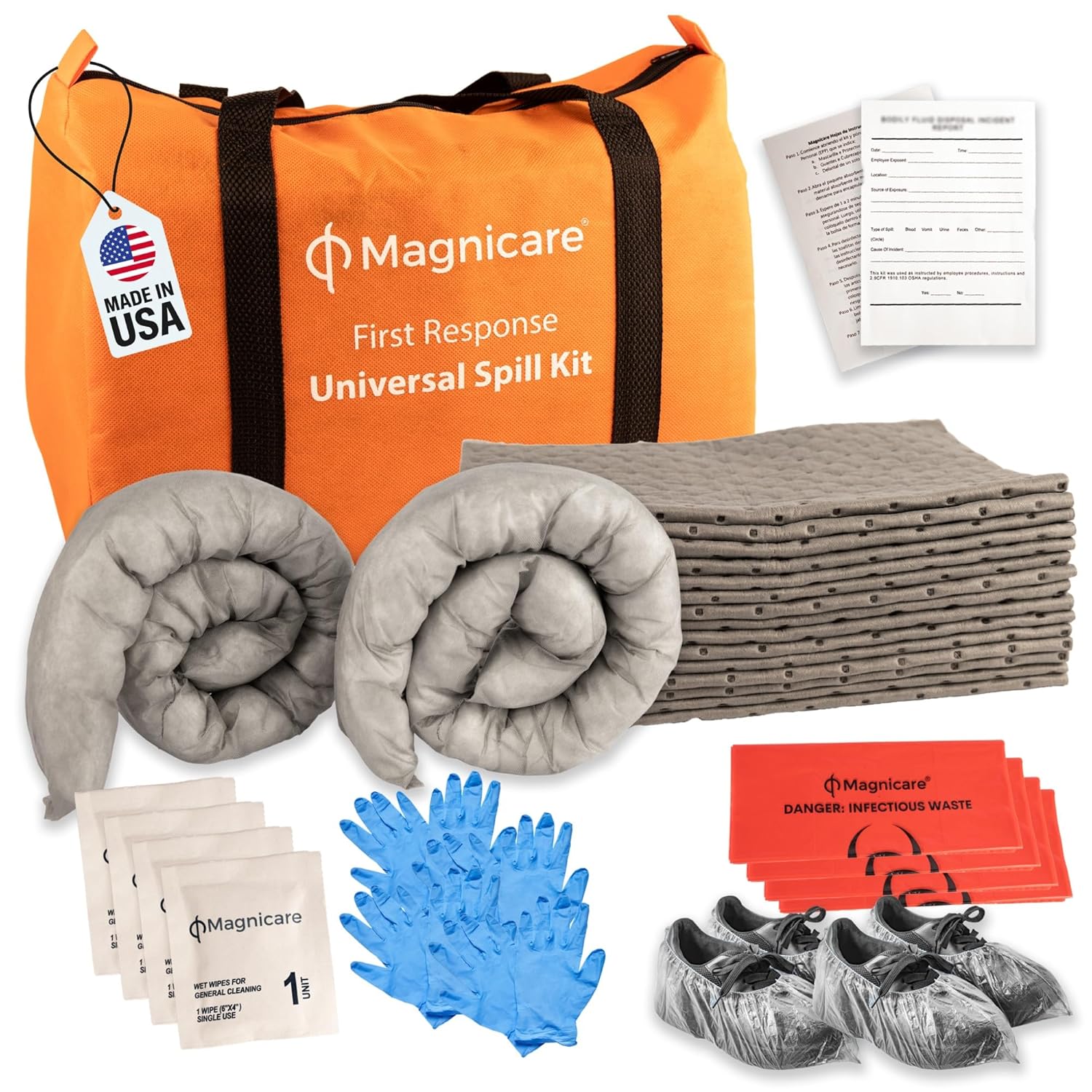
A contents list is only useful if it was copied from the kit you actually bought. Generic lists are what produce the awkward moment when a line reads goggles and the kit has never contained any. The lists below are taken from the current Magnicare product listings and nowhere else.

| Line on the checklist | Universal Spill Kit | Cleanup Kit BAG and BOX |
|---|---|---|
| Universal absorbent mats | 15, listed | Not listed |
| Absorbent socks | 2, listed | Not listed |
| Absorbent powder | Not listed | Listed |
| Gloves | 4 pairs of nitrile gloves, listed | Disposable gloves, listed |
| Shoe covers | 4 pairs, listed | Listed |
| Face masks with shields | Not listed | Listed |
| Aprons | Not listed | Listed |
| Scraper | Not listed | Listed |
| Towels or wipes | 4 wet wipes, listed | Towels or wipes, listed |
| Disposal bags | 4 red disposal bags, listed | Biohazard disposal bags, listed |
| Instructions | Bilingual instructions, listed | Instruction sheet in English and Spanish, listed |
| Report form | A spill report form, listed | An incident report form, listed |
| Eye and face protection as a separate item | Not named | Not named |
| Disinfectant | Not named | Not named |
| An overpack or salvage container | Not named | Not named |
The last three rows are the useful part of the table. Not named means exactly that: the listing does not name the item, which is not the same as the item being absent from your cupboard. Confirm your own stock, and if eye and face protection matters for what you store, read our guide to PPE for bodily fluid cleanup before you write that line.
The Universal Spill Kit listing describes the absorbents as being for “oil, water, coolants, and other compatible non-aggressive liquids” and tells you plainly: “Do not use this kit for unknown or highly hazardous substances.” That sentence belongs on the checklist too, as a line asking whether anything new has been brought on site since the last check.
Matching absorbent format to what you actually store is a separate question with a real answer, covered in oil absorbents explained and, for chemicals, in chemical spill kit selection.
When is a kit present but not usable?
This is where an inventory sheet stops being enough. Every item in the table below can be present, countable and ticked, and still fail on the day. The only way to find out is to handle it.
| Item | What you are looking for | What to do about it |
|---|---|---|
| Absorbent pads and socks | Compressed flat, damp to the touch, discolored at the edges, or stored under something heavy | Damp absorbent has already done part of its job. Replace it and move the kit. |
| Absorbent powder | Caking, a solid crust, a sachet that has been opened and folded over | Powder is sensitive to how it is stored rather than to how old it is — see our guide to absorbent powder |
| Gloves | Tackiness, stiffness, powder residue, a box that has been open in a warm room for a year | Perished gloves are the single most common silent failure. Replace the box, not the pair. |
| Disposal bags | Creased along a fold line, brittle, adhesive strip dried out | Container suitability is covered in red bag and biohazard waste rules |
| The bag or box itself | A broken zip, a split seam, a lid that no longer closes, water staining on the base | A kit that cannot be carried to the spill is not a kit |
| The instruction sheet and report form | Missing, soaked, or already filled in from a previous incident | Replace both. A used form in the kit means the last incident was never filed. |
That last row is worth pausing on. A completed report form still sitting in the kit is simultaneously a stock problem and a records problem, and it is the kind of thing only a physical check ever finds.
Condition judgments like these are ours, offered as practical guidance rather than as regulation. How often an inspection is legally required, and what the CFR does and does not set an interval for, is dealt with in our article on OSHA eyewash station requirements, which works the question through on equipment where the stakes are higher.
Do spill kits expire?
The Magnicare listings state no expiry date for any of the three kits, and in our experience a date stamp would be slightly misleading if they did. Absorbent and powder degrade according to how they have been stored, not according to a calendar.
What is worth dating is the kit, not the contents. Two conventions do almost all the useful work:
- Date the kit when it goes into service, on the outside, in marker. It tells you how long that particular bag has been sitting in that particular place.
- Date anything the moment it is first opened. An opened sachet of powder and an opened box of gloves are on a different clock from sealed ones, and nobody can tell by looking which is which.
Those two dates turn a yes-or-no inventory into something you can reason about. A kit that went into service four years ago in a damp outbuilding deserves a different level of scrutiny than one that was placed in an office corridor last month, and the sheet should let you see the difference without opening anything.
How often should you restock a spill kit?
Restocking runs on use, not on the calendar. The trigger is the end of a cleanup, and the discipline that makes it work is to treat restocking as the last step of the response rather than as a separate errand — which is how our step-by-step blood spill procedure ends.

The monthly check exists because that discipline fails. Partial depletion is invisible from the outside, survives any number of glances, and is only ever caught by counting. So the practical answer to how often you should restock is: immediately after every use, and again on whatever date the inspection finds a shortfall.
That has one consequence for purchasing which is worth stating plainly. A checklist is only worth writing if the restock is quick and cheap. If replacing a used kit means a purchase approval and a two-week wait, the kit comes back to the shelf half full and the sheet gets ticked anyway. Holding one spare, or buying in multi-packs, is what makes an honest inspection possible.
How many kits, and where, is a sizing question rather than an inspection question. Using your own injury records as the evidence base for that decision is covered in our first aid article, reach time and absorbent volume in oil absorbents explained, and kits carried on commercial vehicles — where the kit is away from your site and the inspection is the only thing standing between a driver and an empty duffel — in spill kits for trucks.
What should the inspection record itself say?
No federal rule prescribes the contents of a spill kit inspection record, which means the sheet is yours to design. The test of a good one is not whether it looks official but whether it would still be legible as evidence a year later, to somebody who was not there.

The fields below are our recommendation, not a requirement. They are chosen so that every line is something a reader could later check against a physical object.
| Field | Why it is there |
|---|---|
| Date of the check | Written on the day, not reconstructed |
| Establishment and precise location of the kit | Because the industry exemption at 1904.2 runs per establishment, and because kits move |
| Kit identifier and type | Three kits in one building need three lines, not one |
| Date the kit went into service | The only way to read a condition note in context |
| Contents list version used | So a later reader knows what the kit was being measured against |
| Each line present, with a count | Counted, not glanced at. This is the field that catches partial depletion. |
| Condition notes against the items handled | Free text. The useful part of the sheet. |
| Items replaced, and the date replaced | Turns the sheet into a restock history |
| Name of the person who did the check | Ownership. Not a job title. |
| Date the next check is due | Makes a missed month visible instead of invisible |
Be clear about what this sheet is not. It is not the OSHA injury log, it is not the medical record required by the bloodborne pathogens standard, and it is not the incident report. Those three are separate documents with separate rules and separate retention clocks, all set out in how to document a bodily fluid incident. The inspection record sits alongside them and answers a different question.
If you keep a written exposure control plan, the kit and its location are almost certainly named in it, which means the inspection and the plan can drift apart. Keeping them aligned is part of the annual review described in our exposure control plan template. And if you are still deciding which kit should be in which location, start from universal versus oil-only versus hazmat spill kits.
Frequently Asked Questions (FAQ)
How often should a spill kit be inspected?
Monthly is the working convention and it is what we recommend, because partial depletion is invisible between checks. Set the interval yourself, write it down, and date every check on the day it happens rather than at the end of the quarter.
Does Part 1904 require you to inspect a spill kit?
No. Part 1904 is about recording and reporting injuries and illnesses, not about equipment. It matters to an inspection for a different reason: it decides what paperwork will exist after an incident, and for a partially exempt employer the answer is very little.
Do spill kits have an expiry date?
The Magnicare listings state no expiry date. Absorbent and powder degrade according to storage conditions rather than age, so the two dates worth recording are the date the kit went into service and the date any item was first opened.
Does a small business have to keep an OSHA 300 log?
Section 1904.1 partially exempts a company that had 10 or fewer employees at all times during the last calendar year. The count is for the entire company rather than one site, and it is measured on peak employment during the last calendar year.
How do I know whether my industry is partially exempt?
Section 1904.2 exempts establishments classified in an industry group listed in Non-Mandatory Appendix A to Subpart B of Part 1904. Classification runs on NAICS codes, the exemption applies per establishment rather than per company, and section 1904.2 gives three ways to find your code.
If we treat someone using supplies from the kit, is that a recordable case?
Recordability turns on the criteria at 1904.7, not on where the supplies came from. First aid is defined by a closed list of fourteen treatments at 1904.7(b)(5)(ii), and paragraph (b)(5)(iii) says that list is complete. None of the fourteen describes anything a spill kit contains, which is why a spill kit is not first aid equipment.
Who should sign the spill kit inspection record?
A named person who physically handled the contents. A job title is not enough, because the value of the record a year later depends on somebody being able to say what they saw.
Build the checklist around kits you can actually restock
An inspection sheet is a promise to fix what it finds. That is why the kit you choose matters more than the format of the sheet: a shortfall you can close the same week turns into a corrected record, and a shortfall you cannot close turns into a tick you did not earn.
The Magnicare Universal Spill Kit ships with a counted contents list — 15 universal absorbent mats, 2 absorbent socks, 4 pairs of nitrile gloves, 4 pairs of shoe covers, 4 red disposal bags, 4 wet wipes, bilingual instructions and a spill report form — in a compact orange duffel, which is exactly the kind of list an inspection can be written against. For blood, vomit and other bodily fluids, the Cleanup Kit BAG and the Cleanup Kit BOX both include an instruction sheet and an incident report form in English and Spanish, so the paperwork is in the kit rather than in a drawer somewhere else.
If you are the person who will be doing the checking, buy one more than you need. Multi-packs are available across the cleanup kit range, and a spare on the shelf is the difference between a checklist that gets acted on and a checklist that gets filed.
Paragraph designations in this article were checked against reproductions of the Code of Federal Regulations rather than secondary summaries, and the load-bearing ones against two independent reproductions: 29 CFR 1904.7 on eCFR, Part 1904 in full on eCFR, and 29 CFR 1904.1 at Cornell LII. Where a point was not verified, it is named as judgment rather than filled in.