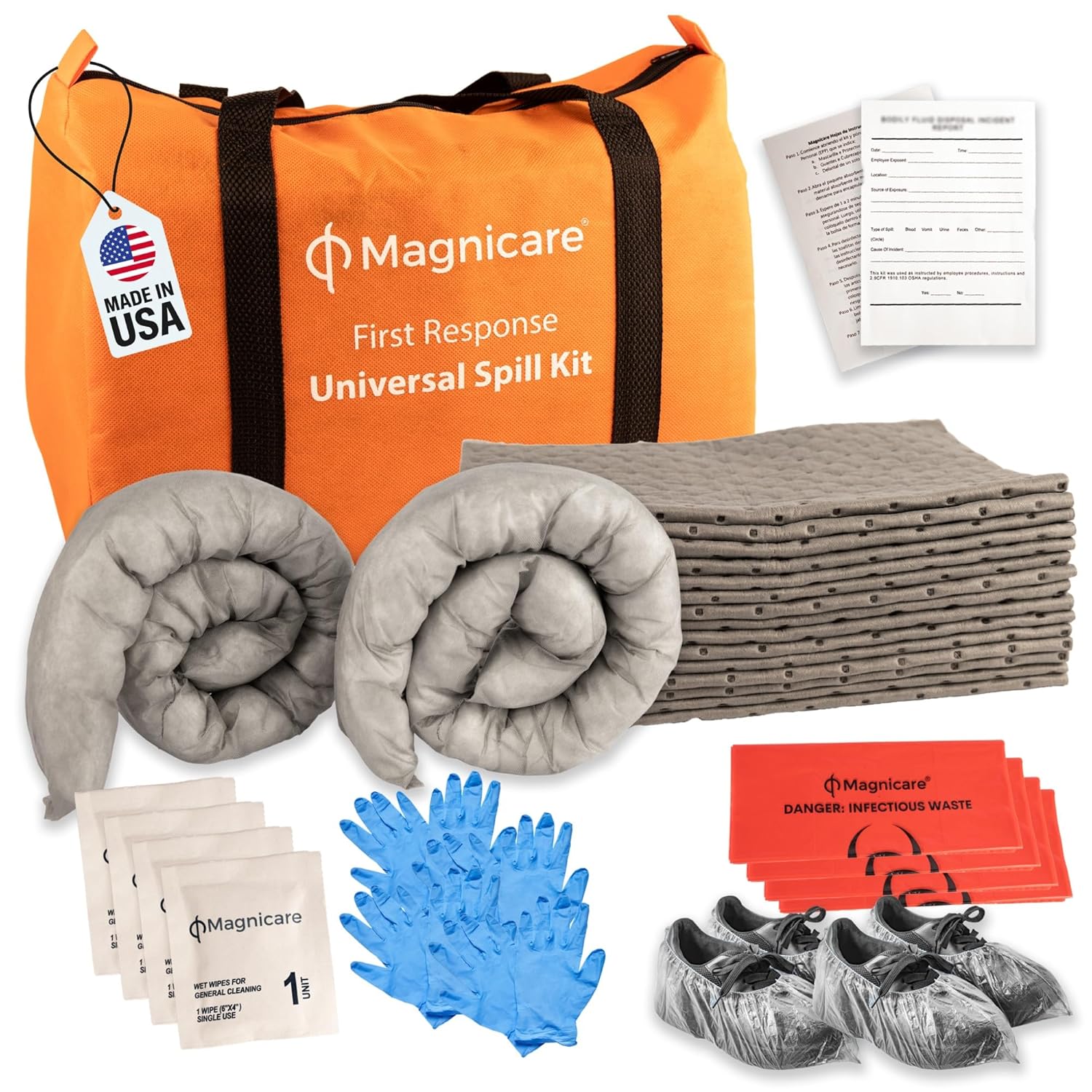
A blood spill kit is a single-use, grab-and-go set of PPE, absorbent, an EPA-registered disinfectant and biohazard waste packaging that lets one trained person contain and decontaminate a blood spill without improvising. OSHA does not certify kits. It regulates the procedure the kit has to make possible — and that is where most kits fail.
The gap between a compliant kit and a box of gloves is not the shopping list. It is whether the kit lets your employee complete every step 29 CFR 1910.1030 requires — contain, decontaminate, bag, label, remove PPE, wash, document — without walking away mid-task to find something.
This article covers the procedure, the waste rules and the compliance program around the kit. If you want a side-by-side comparison of what different kits contain, read our bloodborne pathogen kit buyer's guide instead — the two are designed to sit next to each other, not to repeat each other.

What does OSHA actually require of a blood spill kit?
Nothing, if you read the standard literally. 29 CFR 1910.1030 never uses the phrase "spill kit" and never lists a kit's contents.
What it does instead is impose duties that a kit is the practical way to meet. Read together, these are the requirements that determine what has to be in the box.
| What the standard requires | Citation | What that means the kit must carry |
|---|---|---|
| Universal precautions shall be observed to prevent contact with blood or other potentially infectious materials | 1910.1030(d)(1) | Enough PPE that no one has to make a judgment call about whether this spill "counts" |
| Appropriate PPE provided at no cost to the employee | (d)(3)(i) | The employer buys the kit; employees never supply their own gloves |
| PPE readily accessible and in appropriate sizes | (d)(3)(iii) | Kits stocked where the work happens, in sizes that fit your actual staff |
| Gloves worn for anticipated hand contact; disposable gloves replaced when torn or contaminated | (d)(3)(ix) and (d)(3)(ix)(A) | More than one pair of gloves per kit |
| Masks with eye protection, or chin-length face shields, where splashes or sprays are anticipated | (d)(3)(x) | Face protection, not just a dust mask |
| Gowns, aprons or other protective body clothing appropriate to the exposure | (d)(3)(xi) | A gown or apron, sized to cover |
| Contaminated work surfaces decontaminated with an appropriate disinfectant after any spill | (d)(4)(ii)(A) | An EPA-registered disinfectant with a documented contact time |
| Regulated waste placed in containers that are closable, leak-proof, labeled or color-coded, and closed before removal | (d)(4)(iii)(B)(1)(i)–(iv) | Biohazard bags plus a tie or seal |
| Handwashing facilities readily accessible; antiseptic cleanser or towelettes where washing is not feasible | (d)(2)(iii) and (d)(2)(iv) | Antiseptic wipes in the kit for the field |
A kit that cannot satisfy every row is not a compliance failure by itself. It becomes one the moment an employee has to leave a contaminated area to go find the missing item.
Why is there no such thing as an "OSHA approved" blood spill kit?
Because OSHA does not approve, certify or endorse products of any kind. The agency stated this in standard interpretation letters as far back as 7 July 1976 and again on 15 September 1993.
Sellers still write "OSHA approved blood spill kit" because buyers search for it. The honest version of the claim is that a kit helps you comply with a standard — a statement about your program, not a certificate on the product.
We unpacked this claim in detail in our article on the "OSHA approved" spill kit myth. The short version: judge a kit by whether it completes the procedure, not by the sticker.
When does a blood spill trigger the bloodborne pathogens standard?
The standard defines contaminated as "the presence or the reasonably anticipated presence of blood or other potentially infectious materials on an item or surface" — 1910.1030(b). Visible blood on a floor clears that bar immediately.
What matters more than the volume is who cleans it up. The standard applies to employees with occupational exposure, meaning reasonably anticipated skin, eye, mucous membrane or parenteral contact with blood or OPIM arising from their duties.
Assigning cleanup to a host, a shift lead or a janitor puts that person inside the standard's scope, whether or not anyone wrote it into a job description. Paragraph (c)(2) is explicit that the exposure determination is made without regard to the personal protective equipment the employee might wear.
What about vomit, urine and other fluids?
Vomit, urine, feces and saliva are not automatically other potentially infectious materials under 1910.1030 — only when they are visibly contaminated with blood, when it is impossible to differentiate between fluids, or in the case of saliva during dental procedures.
That distinction matters for paperwork, not for practice. Most operators use the same kit for both and treat every incident as if blood were present, which is what universal precautions means anyway. For the foodservice side of this, see our restaurant vomit kit guide.
What has to happen in the first five minutes?
The sequence below is built from the requirements above plus CDC's environmental services guidance, which says to remove visible organic matter with absorbent material before cleaning and decontaminating. It is the programme-level sequence; if you want it as a timed script — including what changes when the spill is in a public area, when it has already dried, and when you are the only person on shift — follow our step-by-step blood spill cleanup procedure.
- Stop traffic. Cordon the area or post a wet-floor sign. Nobody walks blood into the rest of the building.
- Get the kit, then put on PPE. Gloves, gown or apron, and face protection go on before you approach the spill, not at the edge of it.
- Absorb, don't spread. Apply absorbent powder or lay pads from the outside in. Wiping outward enlarges the contaminated area.
- Scoop the bulk into the biohazard bag. CDC's guidance is to remove visible organic matter with disposable absorbent material discarded into leak-proof, properly labeled containment.
- Clean, then disinfect. These are two separate steps. Cleaning removes soil; disinfection kills what is left, and only works on a cleaned surface.
- Respect the contact time. The surface must stay visibly wet for the full dwell time on the product label.
- Bag everything, seal, remove PPE last. Gloves come off last, and hands get washed after.
- Write it down. Time, location, who cleaned, what PPE was worn, whether anyone had contact.

How do you actually decontaminate the surface?
Paragraph (d)(4)(ii)(A) requires that contaminated work surfaces be decontaminated with an appropriate disinfectant after completion of procedures, immediately or as soon as feasible when surfaces are overtly contaminated or after any spill of blood or OPIM, and at the end of the work shift if the surface may have become contaminated since the last cleaning.
"Appropriate" is the operative word. In practice that means an EPA-registered product with a bloodborne pathogen claim on its label.
What does EPA List S cover?
EPA maintains List S, its register of antimicrobial products effective against HIV, hepatitis B and hepatitis C. EPA's own instruction is to follow the label directions for the specific bloodborne pathogen carefully, including the contact time — and it notes that the same product can carry different contact times for different pathogens.
This is the most commonly skipped step in the whole procedure. A product with a five-minute HBV contact time that gets wiped dry after forty seconds has not disinfected anything.
If you use bleach, what dilution?
CDC's disinfection guidance describes sodium hypochlorite solutions ranging from 5,000–6,150 ppm (a 1:10 dilution of household bleach sold in the United States) down to 500–615 ppm (a 1:100 dilution).
Freshly diluted bleach is cheap and effective, but it degrades, corrodes some surfaces, and has to be mixed correctly every time by whoever is on shift. A pre-measured wipe or ready-to-use spray in the kit removes that variable — which is why most kits ship one.
Why does the surface matter?
Hepatitis B is the reason this step is not theatre. CDC's clinical overview notes that hepatitis B virus is infectious for at least seven days on surfaces. A spill wiped with a damp cloth and no disinfectant is still a hazard a week later.
Red bag or regular trash: where does the waste go?
This is where most small businesses get it wrong in both directions — some red-bag everything, some red-bag nothing.
1910.1030(b) defines regulated waste as: liquid or semi-liquid blood or OPIM; contaminated items that would release blood or OPIM in a liquid or semi-liquid state if compressed; items caked with dried blood or OPIM and capable of releasing these materials during handling; contaminated sharps; and pathological and microbiological wastes containing blood or OPIM.
| Item after a blood spill | Regulated waste? | Why |
|---|---|---|
| Absorbent saturated with blood; drips or squeezes out | Yes | Would release blood in a liquid state if compressed |
| Paper towel with a small dried smear, nothing releasable | Generally no | Fails the "release if compressed" and "caked" tests |
| Gloves and gown visibly soaked | Yes | Contaminated items that would release fluid if compressed |
| Gloves with a spot of dried blood | Generally no | Same reasoning — but check your state rule, which may be stricter |
| Broken glass with blood on it | Yes — contaminated sharp | Named explicitly in the definition |
| Scoop, scraper, empty disinfectant wipe packet | No, unless contaminated | Ordinary waste |
Note the phrasing: OSHA's test is about releasability, not about whether blood touched the item. Many state medical-waste programs are stricter than the federal floor, so the safe operating rule is to follow whichever is tighter.

What has to be true of the container?
Under (d)(4)(iii)(B)(1), regulated waste goes in containers that are (i) closable; (ii) constructed to contain all contents and prevent leakage of fluids during handling, storage, transport or shipping; (iii) labeled or color-coded per (g)(1)(i); and (iv) closed prior to removal to prevent spillage or protrusion of contents.
If the outside of the container gets contaminated, (d)(4)(iii)(B)(2) requires it to be placed in a second container meeting the same four conditions. That is why kits ship more than one bag.
Label or red bag?
Warning labels must be fluorescent orange or orange-red, or predominantly so, with lettering and symbols in a contrasting color, and must be affixed to containers of regulated waste — 1910.1030(g)(1)(i)(A). Paragraph (g)(1)(i)(E) then allows the shortcut most businesses take: red bags or red containers may be substituted for labels.
That single sentence is why pre-printed red biohazard bags are the simplest way to satisfy the labeling rule. Buy them by the box and the question never comes up again.

What happens once it leaves your building?
OSHA's rules end at containment and labeling inside the workplace. Transport is a different regime: the US Department of Transportation defines regulated medical waste at 49 CFR 173.134(a)(5) as a waste or reusable material derived from the medical treatment of an animal or human, including diagnosis and immunization, or from biomedical research.
Final disposal is governed by your state. A restaurant generating one red bag a quarter and a clinic generating one a day face very different obligations — check with your state environmental or health agency before you assume a hauler contract is required.
What if there is broken glass or a sharp in the spill?
This is the one part of blood cleanup that has its own explicit prohibition. Under 1910.1030(d)(4)(ii)(D), broken glassware which may be contaminated shall not be picked up directly with the hands — it must be cleaned up using mechanical means, such as a brush and dust pan, tongs, or forceps.
Gloves do not satisfy this. The rule is about mechanical distance, not barrier protection, because a nitrile glove will not stop a shard.

Contaminated sharps then go into a container that is closable, puncture resistant and leakproof on sides and bottom — (d)(4)(iii)(A)(1). A red bag is not a sharps container; glass will go straight through it.
For businesses where needles are part of the picture rather than the exception — tattoo studios, clinics, care homes — the sharps side of this deserves its own protocol.
How should PPE come off, and where does it go?
Two paragraphs govern the end of the job, and both are routinely broken.
All personal protective equipment shall be removed prior to leaving the work area — (d)(3)(vii). Walking to the break room in a contaminated gown moves the hazard rather than removing it.
When PPE is removed, it shall be placed in an appropriately designated area or container for storage, washing, decontamination or disposal — (d)(3)(viii). In a small business that container is the kit's own biohazard bag, which is why the bag has to be big enough for the gown as well as the absorbent.
Then wash. Employers must ensure employees wash hands immediately or as soon as feasible after removing gloves — (d)(2)(v) — and where handwashing facilities are not feasible, provide an appropriate antiseptic hand cleanser or towelettes — (d)(2)(iv). The included wet wipes are for general cleaning, not antiseptic hand hygiene. Wash your hands with soap and water after removing PPE, and supply any additional hand-hygiene products required by your workplace procedures separately.
What paperwork does a blood spill create?
If nobody was exposed, the answer is: an internal record, plus whatever your cleaning schedule requires. If someone was exposed, the standard takes over.
Following a report of an exposure incident, the employer must make immediately available to the exposed employee a confidential medical evaluation and follow-up — 1910.1030(f)(3). Those evaluations must be at no cost to the employee, at a reasonable time and place, performed by or under the supervision of a licensed physician, and provided according to US Public Health Service recommendations — (f)(1)(ii)(A) through (D).
"Immediately available" is the phrase to plan around. You cannot arrange a provider relationship at 11pm on a Saturday, so the number goes in the kit and in the plan before it is needed.
Records you keep, and for how long
- Medical records — kept for at least the duration of employment plus 30 years, 1910.1030(h)(1)(iv).
- Training records — kept 3 years from the date the training occurred, (h)(2)(ii).
- Sharps injury log — required of employers who must keep an injury and illness log under 29 CFR 1904, recording (A) the type and brand of device involved, (B) the department or work area where the incident occurred, and (C) an explanation of how the incident occurred, (h)(5)(i).
What has to be true before the spill, not after?
A kit on the wall does not make you compliant. It is one artifact of a program that the standard describes in some detail.

| Program element | Requirement | Citation |
|---|---|---|
| Written exposure control plan | Established in writing, designed to eliminate or minimize employee exposure | 1910.1030(c)(1) |
| Accessible to employees | A copy must be accessible to employees | (c)(1)(iii) |
| Reviewed at least annually | Reviewed and updated at least annually and whenever necessary to reflect new or modified tasks and procedures | (c)(1)(iv) |
| Employee input on sharps controls | Solicit input from non-managerial employees, and document the solicitation in the plan | (c)(1)(v) |
| Written cleaning and decontamination schedule | Worksite maintained in a clean and sanitary condition on a written schedule | (d)(4)(i) |
| Training at no cost, during working hours | Provided at no cost to the employee and during working hours | (g)(2)(i) |
| Training timing | At the time of initial assignment, and at least annually thereafter | (g)(2)(ii)(A) and (B) |
| Hepatitis B vaccination | Made available after training and within 10 working days of initial assignment, at no cost | (f)(2)(i) |
The 10-working-day window on hepatitis B vaccination is the one most small employers miss, because it is tied to assignment, not to an incident. If you name someone your cleanup responder in March, the clock started in March.
Our companion articles go deeper on two of these rows: the kit-contents side is covered in the 1910.1030 kit requirements guide, and the "is this really an OSHA rule" question in the OSHA-approved spill kit article.
How many kits do you need, and where should they live?
There is no federal number. What the standard gives you instead is a placement test: PPE must be readily accessible at the worksite and available in appropriate sizes — (d)(3)(iii).
A practical way to apply that: walk from the furthest realistic spill location to the nearest kit. If the round trip means leaving an unattended, uncordoned spill in a public area, you need another kit, not a bigger one.
| Setting | Typical placement that passes the walk test |
|---|---|
| Restaurant or bar | One front-of-house (host stand or server station), one back-of-house |
| Retail store | One at the customer-facing floor, one in the stockroom |
| School | Nurse's office, cafeteria, and one per bus |
| Warehouse or plant | One per first-aid station, plus vehicle-mounted for yard work |
| Care home or clinic | One per floor or wing, plus a housekeeping cart |
| Office | One at reception, one near the first-aid cabinet |
Size the format to where it lives. A grab-and-go bag travels; a wall-mountable box is easier to audit at a glance and harder to walk off with.
The compliant-kit checklist
Take your current kit off the shelf and run it against this list. Every row maps to a requirement above.
- ☐ Two or more pairs of disposable gloves, in sizes that fit your staff — (d)(3)(iii), (d)(3)(ix)(A)
- ☐ Face protection: a mask with eye protection, or a chin-length face shield — (d)(3)(x)
- ☐ Gown or apron — (d)(3)(xi)
- ☐ Absorbent, enough for a realistic spill in your setting
- ☐ Scoop and scraper, so glass is never handled by hand — (d)(4)(ii)(D)
- ☐ EPA-registered disinfectant with a bloodborne pathogen claim and a printed contact time
- ☐ Two red biohazard bags with ties — (d)(4)(iii)(B)(1) and (B)(2)
- ☐ Antiseptic hand wipes — (d)(2)(iv)
- ☐ A written step-by-step instruction card inside the kit
- ☐ An incident report form, and the after-hours medical contact number
- ☐ A visible restock or expiry check date
The last three are what separate a kit from a shopping bag. Instructions turn a frightened employee into a competent one; the report form makes documentation the default; the check date is what an inspector looks for to see whether the program is alive.
Frequently Asked Questions (FAQ)
Is a blood spill kit required by law?
No single rule says "you must own a blood spill kit." OSHA's bloodborne pathogens standard requires appropriate PPE at no cost, decontamination of contaminated surfaces after any spill, and compliant regulated-waste containment. A kit is the practical way to have all of that in one place at the moment you need it.
What is the difference between a blood spill kit and a bodily fluid cleanup kit?
In most catalogues, very little — the same kit is sold under both names. The difference is regulatory scope. Blood and OPIM are covered by 1910.1030; vomit, urine, feces and saliva are not, unless visibly contaminated with blood, impossible to differentiate, or saliva in dental procedures.
Can I just use bleach and paper towels?
You can disinfect with bleach — CDC describes dilutions from 1:10 (5,000–6,150 ppm) to 1:100 (500–615 ppm). What paper towels and a bleach bottle do not give you is PPE in the right sizes, a labeled leak-proof waste container, mechanical means for glass, or a hand-hygiene option away from a sink. Those are the parts OSHA cites.
Do gloves alone count as PPE for a blood spill?
Not where splashes are anticipated. 1910.1030(d)(3)(x) calls for masks in combination with eye protection, or chin-length face shields, whenever splashes, spray, spatter or droplets of blood or OPIM may be generated. Gowns or aprons are required under (d)(3)(xi) when the exposure warrants them.
Does used absorbent always go in a red bag?
No. The federal test is whether the item would release blood or OPIM in a liquid or semi-liquid state if compressed, or is caked with dried blood and capable of releasing it during handling — 1910.1030(b). Saturated absorbent is regulated waste; a lightly stained towel usually is not. Your state rule may be stricter, so follow whichever is tighter.
How long does the disinfectant need to sit?
As long as its own label says. EPA's guidance for List S products is to follow the label directions for the specific bloodborne pathogen carefully, including the contact time — and the same product may have different contact times for different pathogens. Keep the surface visibly wet for the whole period.
Is there an "OSHA approved" blood spill kit?
No. OSHA does not approve, certify or endorse products, a position it stated in standard interpretation letters dated 7 July 1976 and 15 September 1993. A kit can help you comply; it cannot be approved.
Who is allowed to clean up a blood spill at my business?
Any employee you have trained and equipped under the standard. Training must be at no cost and during working hours — (g)(2)(i) — at the time of initial assignment and at least annually thereafter — (g)(2)(ii)(A) and (B). Hepatitis B vaccination must be made available within 10 working days of that assignment under (f)(2)(i).
What do I do if an employee's skin or eyes get contaminated?
Treat it as an exposure incident. Wash or flush immediately, then make a confidential medical evaluation and follow-up immediately available to that employee — 1910.1030(f)(3) — at no cost, at a reasonable time and place, by or under the supervision of a licensed physician, per US Public Health Service recommendations, under (f)(1)(ii)(A)–(D).
How often should a blood spill kit be replaced?
A single-use kit is consumed the first time it is opened — restock it the same shift. Unopened kits should be checked on the schedule your written cleaning and decontamination program sets under (d)(4)(i); disinfectant wipes and solutions carry expiry dates, and a kit with expired disinfectant does not meet the "appropriate disinfectant" requirement of (d)(4)(ii)(A).
Get the kit that finishes the job
The reason to buy a pre-assembled kit rather than a bin of supplies is simple: the procedure above has eight steps, and an employee doing it for the first time will do it under stress, possibly in front of customers. A kit that carries every item — gloves in more than one size, face protection, gown, absorbent, scoop and scraper, an EPA-registered disinfectant, two red biohazard bags and hand wipes — is the difference between a five-minute cleanup and an exposure incident.
Magnicare's kits are built around that sequence. The included wet wipes are for general cleaning. Any disinfectant or additional hand-hygiene products required by your workplace procedures must be supplied separately. The Bloodborne Pathogen & Vomit Cleanup Kit (BAG) is the grab-and-go format for vehicles, buses, carts and front-of-house. The Bodily Fluid Clean Up Kit (BOX) mounts on a wall where you want it audited at a glance. Both ship with written instructions and an incident report form inside, so the documentation step is not left to memory — and both are single-use and individually sealed, so you know the kit on the wall is complete.
Stocking more than one location? Compare formats and multi-packs in the blood cleanup kits collection, and add a box of red biohazard bags so the second-container rule in (d)(4)(iii)(B)(2) never catches you short.
This article is general information about federal OSHA requirements, not legal advice. State plans and state medical-waste rules may impose stricter obligations than the federal standard. Verify the current text of any regulation at eCFR before relying on it.