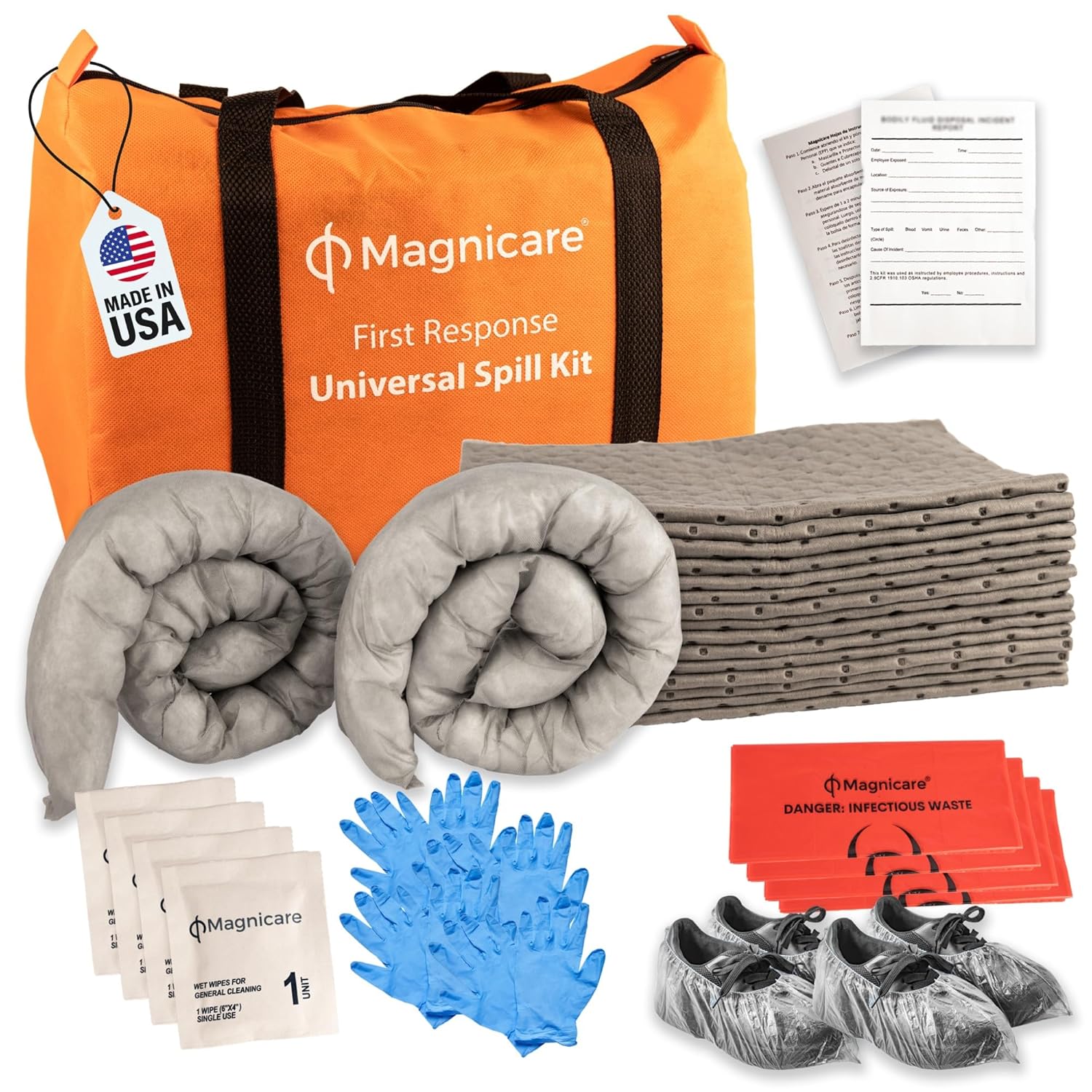
Vomit absorbent powder is a dry gelling or wicking agent you pour over a bodily fluid spill so the liquid stops spreading and can be scooped up as a solid. It is not a disinfectant, and it does not replace one. Most single events need far less powder than people buy — the quantity that matters is the quantity that stops the flow.
That last point is where most buying decisions go wrong. Businesses stock powder by the tub because it feels like insurance, then discover that the binding constraint in a real event is how fast someone can get to the spill, not how many pounds are in the cupboard. This guide covers the chemistry, the sequence, the arithmetic, and the regulatory line between an absorbent and a disinfectant.
How does vomit absorbent powder actually work?
Absorbent powder converts a free-flowing liquid into something with structure. Once the liquid is held in or between solid particles, it stops migrating along grout lines, stops being tracked around on shoe soles, and can be lifted with a scoop instead of chased with paper towels.
That single change is what makes the rest of the cleanup possible. You cannot meaningfully clean a surface that is still wet with spreading fluid, and you cannot apply a disinfectant at its labelled concentration to a puddle that is diluting it.
It also buys you the thing an incident never gives you enough of: time. A gelled spill is stable. It will sit there, contained, while you put on gloves, close off the area and get the right waste bag, instead of expanding across the floor while you improvise.

Gelling or wicking — which type is in your kit?
Commercial bodily fluid absorbents fall into two broad families, and they behave differently enough that it is worth knowing which one you own. The label rarely says outright; the behaviour on contact tells you within seconds.
Superabsorbent polymers (gelling)
These are cross-linked polymer granules — typically sodium polyacrylate, the same chemistry used in disposable nappies. Water is drawn into the polymer network and held there, and the granules swell into a firm gel within seconds.
Gelling absorbents are the usual choice for vomit and other bodily fluids because the result holds together. You sweep up a cohesive mass rather than a wet slurry, and very little liquid is left behind to wick back out under pressure.
Mineral and cellulose absorbents (wicking)
Clay, diatomaceous earth, recycled cellulose and similar materials work by capillary action instead: the liquid is drawn into the pores and spaces between particles rather than into the particles themselves.
These are cheaper per pound and common in industrial spill kits, but they hold liquid loosely. Compressed underfoot or in a bag, a wicking absorbent can release what it picked up — which matters more than it sounds, for reasons covered in the waste section below.
Why the difference shows up in the bin, not on the floor
On a hard floor, both types will get the spill up. The divergence appears afterwards, when the bagged waste is carried, stacked or compressed. A gelled mass stays a gelled mass; a saturated mineral absorbent can weep.
| Gelling (superabsorbent polymer) | Wicking (mineral / cellulose) | |
|---|---|---|
| Mechanism | Liquid drawn into the polymer itself | Liquid held in pores between particles |
| Time to act | Seconds | Seconds to minutes |
| Result | Firm, cohesive gel | Damp, loose granular mass |
| Releases under compression | Largely no | Can do |
| Quantity needed | Small — sachets, not scoops | Considerably more by volume |
| Typical use | Bodily fluids, blood, vomit | Oil, coolant, general industrial liquids |
If your site handles both bodily fluids and chemical or oil spills, these are two different stock items, not one. Our guide to biohazard kits versus bodily fluid kits covers where the categories separate, and the physics of industrial sorbent formats is a subject of its own.
Does absorbent powder disinfect anything?
Unless the container carries an EPA registration number, no. This is not a technicality — it is the single most expensive misunderstanding in this product category, and it is worth understanding exactly where the line sits.
Under federal pesticide law, bacteria and viruses are pests. EPA’s regulation defines a pest to include “any fungus, bacterium, virus, prion, or other microorganism, except for those on or in living man or other living animals and those on or in processed food or processed animal feed, beverages, drugs… and cosmetics” (40 CFR 152.5(d)).
A product sold to kill them is therefore a pesticide requiring registration. 40 CFR 152.15 states that “no person may distribute or sell any pesticide product that is not registered under the Act,” and that a substance is treated as a pesticide if the seller “claims, states, or implies (by labeling or otherwise)… that the substance… can or should be used as a pesticide.”
“The registration number assigned to the pesticide product at the time of registration shall appear on the label, preceded by the phrase ‘EPA Registration No.’ or ‘EPA Reg. No.’”
— 40 CFR 156.10(e)
So the test is mechanical. Turn the container round. If there is no EPA Reg. No. on it, the product is an absorbent, it makes no antimicrobial claim, and the pathogens in the gel are exactly as viable as they were in the puddle.
What about powders that say “encapsulating” or “odour-eliminating”?
Those are physical claims, not antimicrobial ones, and they are legitimate as such. Trapping a smell is not the same as inactivating a virus, and a product that made the second claim without registration would be in breach of 152.15.
Some absorbents genuinely are co-formulated with a registered disinfectant. Those carry a registration number and a full set of labelled directions — the required label contents are listed at 40 CFR 156.10(a)(1)(i)–(ix) — including a contact time you have to honour for the claim to hold.
Where does powder fit in the cleanup sequence?
Powder is step three of roughly eight, and it is the step that makes steps four onward possible. Getting the order wrong — particularly spraying disinfectant onto a wet spill — wastes product and leaves the surface contaminated.
- Stop what you are doing and keep people away from the area.
- Put on gloves, eye and face protection, and a gown or apron.
- Apply absorbent powder, working from the outside of the spill inward.
- Wait for the gel to form, then scoop it up with the scraper and scoop.
- Bag the solids as regulated waste where the waste meets the definition.
- Clean the surface to remove remaining organic soil.
- Apply a registered disinfectant and leave it wet for the full labelled contact time.
- Remove and bag PPE, then wash hands.
Working outside-in matters. Pouring powder into the middle of a puddle pushes a wave of liquid outward and enlarges the contaminated area; ringing the spill first and then filling in contains it.
Step six is not optional and is frequently skipped. CDC’s guidance is to remove visible organic matter first, then clean, then decontaminate — organic soil interferes with disinfectants, so a surface that still looks clean but has not been cleaned will not disinfect reliably.
The full event procedure, including what to do about the dining room and the staff who saw it, is in our restaurant vomit kit guide. For blood specifically, the step-by-step is in the blood spill kit guide.

How much powder do you need for one event?
Less than most people expect, and the reason is that you are not trying to dry the floor. You are trying to convert the liquid into a scoopable solid. Once it holds together under a scraper, more powder adds nothing.
We deliberately do not publish an “absorbs X times its weight” figure, because that number is specific to the polymer, the particle size and the liquid — and bodily fluids are not water. There is no federal or ASTM test method written for bodily fluid absorbents; the published sorbent standards (ASTM F726-17 and F716-18) are written for oil and chemical sorbents. Use the coverage figure on your own product’s label and verify it once, in practice.
The three quantities that actually matter
Rather than a weight ratio, plan around three numbers you can observe in your own building.
| Quantity | How to establish it | Why it matters |
|---|---|---|
| Per-event dose | Your label’s coverage figure, confirmed by one dry run with water on the floor type you have | Sets the size of a single-use sachet |
| Reach time | Walk from the furthest point of the premises to where the kit is stored, timed | The real constraint in an event — not the amount of powder |
| Events per year | Your own incident log for the last 24 months | Sets annual consumption and restock cadence |
Run the dry test once
Pour the volume of water your product’s label claims to handle onto the same flooring you actually have — quarry tile, sealed concrete, vinyl sheet, low-pile carpet — and apply one dose. If a scraper lifts it cleanly in one pass, your dose is right. If it smears, you need more per event and should size your kit accordingly.
Do this with water, in an area you can mop, and write down the result. It takes ten minutes once and settles the question permanently for your site.
Porous surfaces change the answer
Carpet, unsealed grout and porous concrete absorb liquid downward before the powder can act. Powder still helps with what is on the surface, but the material underneath stays contaminated, and no quantity of absorbent fixes that. On porous surfaces, plan for extraction or removal rather than a larger dose.
How much should you keep on hand across a year?
Stocking is a different calculation from dosing, and the failure mode is different too. Over-buying one big tub concentrates all your capacity in one place, which is exactly where it will not be when something happens at the far end of the building.
The better pattern for most sites is more stations, each holding fewer doses.
| Site profile | Stations | Doses per station | Rationale |
|---|---|---|---|
| Single-room café or small retail unit | 1 | 2–3 | Everything is within a few seconds’ walk |
| Restaurant with front and back of house | 2 | 2–3 | Dining floor and kitchen are separate response zones |
| Multi-floor premises or school | 1 per floor | 2–3 | Stairs are the reach-time problem |
| Warehouse or large facility | By zone | 2–3 | Distance, not volume, is the constraint |
Two to three doses per station covers the realistic worst case: one event, one repeat within the same shift, and one spare so a used station is not an empty station. Annual consumption then comes from your incident log, not from a rule of thumb.

Does any regulation tell you how much to stock?
No federal rule sets a quantity of absorbent, a number of kits per square foot, or a distance from a kit to a work area. Anyone quoting such a figure is quoting a convention, not a citation.
What the regulations do impose is adequacy and accessibility. Under OSHA’s bloodborne pathogens standard, personal protective equipment must be readily accessible and provided in appropriate sizes (29 CFR 1910.1030(d)(3)(iii)), and the employer must have a written schedule for cleaning and decontamination under (d)(4)(i). A kit that is locked in an office at the other end of the site does not meet that standard regardless of how much powder is in it.
Food businesses have a parallel obligation. FDA Food Code § 2-501.11 requires written procedures for employees to follow when responding to vomiting or diarrheal events, and specifies that the procedures “shall address the specific actions employees must take to minimize the spread of contamination and the exposure of employees, consumers, food, and surfaces to vomitus or fecal matter.” Adoption and edition vary by state.
The practical reading: your own written procedure is what defines “enough,” and an inspector will assess the kit against that document. What a health inspector checks item by item is covered in our restaurant bodily fluid cleanup kit checklist.
What happens to the gelled waste?
This is where gelling versus wicking stops being an academic distinction. OSHA’s definition of regulated waste at 1910.1030(b) turns on releasability — liquid or semi-liquid blood or other potentially infectious materials, items that would release these substances in a liquid or semi-liquid state if compressed, and items caked with dried blood capable of releasing it during handling.
Absorbing a liquid so that it can no longer be released under compression is therefore directly relevant to how the resulting waste is classified. A properly gelled mass behaves differently under that test than a saturated wicking absorbent that weeps when the bag is stacked.
Two cautions, though. First, the test is about the blood or OPIM content, not about the absorbent: gelling a fluid that is visibly contaminated with blood does not make it ordinary trash. Second, vomit, urine and faeces are not automatically covered by 1910.1030 — the standard reaches them only when they are visibly contaminated with blood, or when it is impossible to tell one fluid from another.
Where the waste is regulated, containers must be closable, constructed to contain all contents and prevent leakage, labelled or colour-coded, and closed before removal, under (d)(4)(iii)(B)(1)(i)–(iv). Our blood spill kit guide has the item-by-item red bag or trash breakdown, and red biohazard bags are sold separately for restocking.
What about dust, slips and food-contact surfaces?
Three practical hazards come with powder, and all three are manageable once you know they exist.
Airborne dust
Pouring fine granules from height creates an airborne cloud. Keep the container low and pour slowly. Your product’s safety data sheet is the authority on any exposure controls that apply to the specific formulation — and under OSHA’s hazard communication standard, safety data sheets must be readily accessible during each work shift in the work area (29 CFR 1910.1200(g)(8)).
Slip risk from residue
Unabsorbed granules on a hard floor behave like ball bearings. Sweep thoroughly, and note that this is one of the arguments for gelling absorbents over loose granular products in customer-facing areas — there is simply less loose material left behind.
Food-contact surfaces
A prep counter, a cutting board or a slicer that has been contaminated is a different problem from a floor. Under the Supplement to the 2022 Food Code, equipment and food-contact surfaces must be disinfected when contaminated with “vomitus, fecal matter, blood, or any other bodily fluid that can lead to disease transmission” (§ 4-1002.11), disinfection must follow the EPA-registered label use directions, and disinfectants applied to a food-contact surface must be rinsed with potable water unless the label directs otherwise (§ 4-1003.11).
The Supplement also requires that the concentration of the sanitising or disinfecting solution be accurately determined using a test kit or other device (§ 4-501.116), and amends the equipment requirements to include a test kit that measures disinfectant concentration (§ 4-302.14). If you have added disinfection to your procedure, you need the strips to prove the concentration. Full detail is in the Supplement to the 2022 Food Code.
How do you store powder so it still works in two years?
Superabsorbent polymers do exactly what they are designed to do with whatever moisture reaches them, including humidity. A tub left open in a warm kitchen will slowly clump and lose capacity, and a clumped absorbent will not disperse over a spill.
- Keep doses sealed individually. Single-use sachets are far more robust than an opened bulk container.
- Store away from heat and steam. Dishwash areas and near-oven cupboards are the worst locations in a kitchen.
- Check by feel, monthly. A sachet should stay soft and loose. Hard or lumpy means replace it.
- Restock immediately after use. The most common failure in a real event is an empty station, not an inadequate one.
- Log the check. The written cleaning and decontamination schedule under 1910.1030(d)(4)(i) is easier to evidence when the inspection is recorded.

Which Magnicare kit gives you the right amount?
Both Magnicare formats are built around the same principle: one sealed dose of absorbent per event, packaged with everything else the event needs, so nothing is measured out under pressure.
The Bloodborne Pathogen & Vomit Cleanup Kit (bag format) is the compact option — it hangs on a hook, travels in a vehicle, and suits front-of-house and tight spaces where a box will not fit. The Bodily Fluid Clean Up Kit (box format) is the stationary version for a fixed response station in a kitchen, corridor or staff area.
Because the doses are sealed individually, stocking several stations is a matter of buying several kits rather than dividing a tub. That is the pattern we would recommend for anything larger than a single room — and the reason the bag format is often bought in multiples alongside one box.
Browse the full range in the blood and bodily fluid cleanup kits collection, and if you are still deciding which category of kit you need, start with the OSHA 1910.1030 kit requirements guide.

Frequently Asked Questions (FAQ)
Does vomit absorbent powder kill germs?
No, unless the container carries an EPA registration number. An absorbent with no EPA Reg. No. makes no antimicrobial claim, and the pathogens in the gel remain viable. Under 40 CFR 152.15 a product sold with a claim that it kills bacteria or viruses is a pesticide requiring registration, and 40 CFR 156.10(e) requires the registration number to appear on the label.
How much absorbent powder do I need for one vomit event?
Enough to turn the spill into a solid you can lift in one pass with a scraper, which is usually one sealed single-use dose. Adding more once the gel holds together achieves nothing. Confirm your own product's coverage figure with a one-off dry test using water on the floor type you actually have.
Can I use absorbent powder on carpet?
It helps with surface liquid but does not solve the problem. Carpet, unsealed grout and porous concrete absorb fluid downward before the powder can act, so the material underneath stays contaminated. On porous surfaces, plan for extraction or removal rather than a larger dose of powder.
Is vomit absorbent powder the same as cat litter or oil-dry granules?
No. Cat litter and oil-dry are mineral wicking absorbents that hold liquid loosely in the spaces between particles, and they can release it again under compression. Bodily fluid powders are generally superabsorbent polymers that draw liquid into the polymer itself and form a firm gel that stays put.
Do I still need to disinfect after using absorbent powder?
Yes. Scoop up the gel, clean the surface to remove remaining organic soil, then apply a registered disinfectant and leave it wet for the full labelled contact time. CDC guidance is to remove visible organic matter first, because organic soil interferes with disinfectants.
Does absorbed vomit go in a red biohazard bag?
It depends on what is in it. Vomit, urine and faeces are not automatically covered by OSHA's bloodborne pathogens standard — 1910.1030 reaches them only when they are visibly contaminated with blood, or when it is impossible to differentiate between body fluids. Where the waste is regulated, the container must be closable, leak-resistant, labelled or colour-coded, and closed before removal.
How long does absorbent powder last in storage?
Sealed single-use doses keep for years; an opened bulk tub in a warm, humid kitchen does not. Superabsorbent polymers take up ambient moisture and clump, and clumped powder will not disperse over a spill. Check sachets by feel monthly and replace anything hard or lumpy.
Is there an OSHA rule for how much absorbent to keep on site?
There is no federal quantity, no kits-per-square-foot figure and no proximity rule. What OSHA requires is that protective equipment be readily accessible and in appropriate sizes under 1910.1030(d)(3)(iii), and that there be a written cleaning and decontamination schedule under (d)(4)(i). Your own written procedure is what defines what is adequate.
Stock the dose, not the tub
The thing that decides how a bodily fluid event goes is whether someone can reach a complete, sealed, ready dose within seconds — not how many pounds of powder the site owns. Buy for stations, keep two to three doses at each, and restock the moment one is used.
The Bloodborne Pathogen & Vomit Cleanup Kit and the Bodily Fluid Clean Up Kit both ship with the absorbent, the scoop and scraper, PPE and the waste bag in one sealed pack, so the dose is already measured and nothing has to be assembled while a dining room waits. Shop the full cleanup kit range →