Federal law tells you what to do about a leak, not what to carry in order to do it. The emergency equipment list for power units at 49 CFR 393.95 names a rated fire extinguisher, warning devices, fusees and red flags, and no spill kit or absorbent of any kind. The duties sit elsewhere: make a safe disposition of a leaking package, hold a written response plan above a packaging threshold, telephone within 12 hours, file within 30 days. The kit is yours to specify, and that is a freedom with a test attached.
This article is about kits carried on commercial vehicles. It is not about hauling regulated medical waste, which has its own packaging regime and lives in our guide to biohazard waste disposal rules.
Does DOT require a spill kit on a commercial vehicle?
No federal rule names a spill kit as required equipment on a commercial motor vehicle. We looked for one in the obvious place and it is not there, and we also looked for the word in the places people assume it must be.
That absence is not a loophole. It is a design choice, and once you see it the whole topic gets simpler: the rules describe outcomes you are responsible for, and leave the equipment to you. Three separate federal duties attach to a leaking load, and none of them can be performed with the contents of 393.95 alone.
| Duty | Where it lives | What it needs that 393.95 does not give you |
|---|---|---|
| Make a safe disposition of a broken or leaking package | 49 CFR 177.854(b) and (c) | Something to contain, overpack or absorb with |
| Hold a written plan identifying response equipment | 49 CFR 130.31(a)(3) | Equipment that actually exists where you said it does |
| Report the incident by telephone and in writing | 49 CFR 171.15 and 171.16 | A record of what happened, written at the time |
Read the table in the other direction and it becomes a specification. A kit that lets you contain a leak, that matches the plan you filed, and that includes somewhere to write down what you did, satisfies all three. That is a more useful starting point than a list of parts.
One more thing worth saying plainly before anyone sells you something: there is no such status as a DOT approved spill kit. DOT does not approve, certify or endorse products, and the same argument we set out at length about the phrase OSHA approved spill kit applies here without modification.
What emergency equipment does 49 CFR 393.95 actually require?
Section 393.95 is titled Emergency equipment on all power units, and it opens by saying that each truck, truck tractor, and bus, except those towed in driveaway-towaway operations, must be equipped as follows. Here is the whole of it.
| Paragraph | Requirement |
|---|---|
| (a) Fire extinguishers | A rated extinguisher, with the detail in (a)(1) through (a)(6) |
| (a)(1)(i) | A power unit transporting hazardous materials in a quantity requiring placarding needs an Underwriters Laboratories rating of 10 B:C or more |
| (a)(1)(ii)(A) and (B) | A power unit not used to transport hazardous materials needs either one extinguisher rated 5 B:C or more, or two extinguishers each rated 4 B:C or more |
| (a)(4) Condition, location, and mounting | The extinguisher must be filled and located so that it is readily accessible for use |
| (a)(6) Exception | Paragraph (a) does not apply to the driven unit in a driveaway-towaway operation |
| (b) to (e) | [Reserved] |
| (f) Warning devices for stopped vehicles | One of the listed options must be used: bidirectional emergency reflective triangles, or fusees |
| (g) Restrictions on the use of flame-producing devices | Limits on where fusees and similar devices may be used |
| (h) to (i) | [Reserved] |
| (j) Requirements for fusees | Each fusee must be capable of burning for 30 minutes |
| (k) Requirements for red flags | Red flags must be not less than 12 inches square |
That is the complete list. The words spill, absorbent, sorbent and spill kit appear nowhere in the section, and we confirmed that against two independent reproductions of the Code of Federal Regulations rather than taking one source for a negative.
Notice what the section is interested in. Every item on the list protects the vehicle and the traffic around it: put out a fire, warn oncoming drivers, be visible. Nothing on the list is about what comes out of the load. That job is handled by a different part of the regulations, and it is handled by describing conduct instead of cargo.
What do the rules require you to do when a package leaks in transit?
The relevant section is 49 CFR 177.854, titled Disabled vehicles and broken or leaking packages; repairs. It runs from (a) to (h), and the run-in headings tell you how it thinks.
| Paragraph | Run-in heading | Verified phrase |
|---|---|---|
| (a) | Care of lading, hazardous materials | special care shall be taken to guard the vehicle and its load |
| (b) | Disposition of containers found broken or leaking in transit | disposition of such package or container shall be made by the safest practical means afforded under |
| (c) | Repairing or overpacking packages | Packages may be repaired when safe and practicable |
| (d) | Transportation of repaired packages | The package must be safe for transportation. |
| (e) | Disposition of unsafe broken packages | it shall be stored pending proper disposition in the safest and most expeditious manner possible. |
| (f) | Stopped vehicles; other dangerous articles | Whenever any motor vehicle transporting Class 3 (flammable liquid), Class 4 (flammable solid) |
| (g) | Repair and maintenance of vehicles containing certain hazardous materials | No person may use heat, flame or spark producing devices to repair or maintain the cargo or fuel containment system |
| (h) | No repair with flame unless gas-free | No repair of a cargo tank used for the transportation of any Class 3 (flammable liquid) |
These are short excerpts rather than whole sentences, because the tooling we verify with caps the length of a quotation. Stitching them into longer sentences and calling them verbatim would be a small dishonesty, so each cell holds only what we actually read.
Here is the finding that matters, and it comes from reading the section for the word that is missing. Nowhere does 177.854 tell a driver to clean up a spill. It tells them to make a disposition of the package, by the safest practical means. Cleaning the road surface is not the duty; dealing with the container is.
And that is exactly why the kit is unavoidable. Paragraph (c) permits a leaking package to be repaired or overpacked when it is safe and practicable to do so, and paragraph (e) requires an unsafe one to be stored pending proper disposition. Both are physical acts. Both need something in the vehicle to do them with. The duty at (c) can only be discharged with equipment the equipment list at 393.95 never mentions.

The sequence on that card is the same one we set out in detail for workplace spills: ring the liquid first, recover second. The reasoning behind it, and the differences between pads, socks and booms, is in our guide to oil absorbents and their formats.
Who has to have a written oil spill response plan?
49 CFR Part 130 is titled Oil Spill Prevention and Response Plans, and section 130.1 says the part prescribes prevention, containment and response planning requirements. The threshold that decides whether it reaches you is a number, and it is a number about the packaging rather than the load.
Section 130.31, Basic spill response plans, opens by providing that no person may transport liquid petroleum oil in a packaging having a capacity of 3,500 gallons or more unless a plan is in place. Five things that plan must do are then listed.
| Provision | What the plan must do |
|---|---|
| 130.31(a)(1) | Sets forth the manner of response to discharges that may occur during transportation |
| 130.31(a)(2) | Takes into account the maximum potential discharge of the contents from the packaging |
| 130.31(a)(3) | Identifies private personnel and equipment available to respond to a discharge |
| 130.31(a)(4) | Identifies the appropriate persons and agencies, including their telephone numbers, to be contacted |
| 130.31(a)(5) | For each motor carrier, is retained on file at that person’s principal place of business |
Paragraph (a)(3) is the only place in this entire chain that mentions response equipment, and it does not ask you to carry any. It asks you to identify equipment available to respond. That is a documentation duty, and documentation duties have a way of becoming equipment duties the moment somebody checks.
Put (a)(3) next to (a)(5) and the practical problem appears. The plan is retained at the principal place of business. The spill is not at the principal place of business. A plan that identifies equipment nobody can reach from the shoulder of a highway is a plan that was true when it was written and false when it was needed.
The cheapest way to make a response plan honest is to put the equipment it names in the vehicle, and then describe it in the plan as being in the vehicle. The sentence writes itself and it stays true.
Two boundaries, because the threshold is narrower than people assume. It is the capacity of the packaging, so a tank trailer rated above 3,500 gallons is inside Part 130 even on a day it runs part-loaded, and a pickup carrying drums is not inside it at all. And the part covers oil. A load that is not oil is governed by the hazardous materials regulations generally rather than by Part 130, and selection then happens at the chemistry level, which is the subject of our chemical spill kit guide.
Who do you call, how fast, and what do you file afterwards?
There are two federal hazardous materials reports and they have different triggers, different deadlines and different thresholds. Most of the confusion about reporting a truck spill comes from treating them as one thing.
The 12-hour telephone report
49 CFR 171.15 is titled Immediate notice of certain hazardous materials incidents. Paragraph (a) requires notice as soon as practical but no later than 12 hours after the occurrence of any incident, to the National Response Center, at 800-424-8802 toll free or 202-267-2675 toll call. Paragraph (b) says a telephone report is required whenever any of the following occurs during the course of transportation in commerce.
| Provision | Trigger |
|---|---|
| 171.15(b)(1)(i) | A person is killed |
| 171.15(b)(1)(ii) | A person receives an injury requiring admittance to a hospital |
| 171.15(b)(1)(iii) | The general public is evacuated for one hour or more |
| 171.15(b)(1)(iv) | A major transportation artery or facility is closed or shut down for one hour or more |
| 171.15(b)(1)(v) | The operational flight pattern or routine of an aircraft is altered |
| 171.15(b)(2) | Fire, breakage, spillage or suspected radioactive contamination involving a radioactive material |
| 171.15(b)(3) | Fire, breakage, spillage or suspected contamination involving an infectious substance other than a regulated medical waste |
| 171.15(b)(4) | A release of a marine pollutant exceeding 450 L (119 gallons) for a liquid or 400 kg (882 pounds) for a solid |
| 171.15(b)(5) | A situation of such a nature that a continuing danger to life exists at the scene |
| 171.15(b)(6) | During transportation by aircraft, a fire, violent rupture, explosion or dangerous evolution of heat |
Read that list as a group and the principle is clear: the telephone report is about consequences to people and to the road, not about volume. A drum can empty itself into a ditch without a single item on that list being true.
The 30-day written report
49 CFR 171.16, Detailed hazardous materials incident reports, requires a Hazardous Materials Incident Report on DOT Form F 5800.1 (01/2004) within 30 days of discovery of the incident. Paragraph (a)(1) picks up any of the circumstances set forth in 171.15(b). Then comes the sub-item that catches people out.
Paragraph 171.16(a)(2) reaches an unintentional release of a hazardous material or the discharge of any quantity of hazardous waste, and it states no quantity floor at all. Paragraph (a)(3) adds a specification cargo tank with a capacity of 1,000 gallons or greater containing any hazardous material, (a)(4) covers an undeclared hazardous material being discovered, and (a)(5) a fire, violent rupture, explosion or dangerous evolution of heat.
So the two reports do not nest the way intuition says. The widely held belief that a small spill with nobody hurt goes unreported is wrong for hazardous materials: there was no telephone call to make, and there is still a form to file. Paragraph (b)(3) then requires a written or electronic copy of the report to be retained for two years, and paragraph (c) requires the report to be updated within one year of the date of occurrence where the listed conditions apply.
One honest limit. The Clean Water Act has its own oil discharge notice, and 40 CFR 110.6 requires immediate notification of the National Response Center by any person in charge of a vessel or of an onshore or offshore facility, with no quantity threshold stated. Whether a motor vehicle in transit is an onshore facility for that purpose turns on a definition we did not verify in this research, so we are naming the question rather than answering it. The sheen test that decides when an oil discharge is reportable is covered in our spill kit selection guide. The duty that plainly attaches to transportation is the one in 49 CFR 171.15 and 171.16.
Where should the kit live on the vehicle?
Nothing federal tells you where to keep the kit, so everything in this section is our recommendation rather than a requirement. It is built on one regulation that is not about kits at all.
49 CFR 177.848 is titled Segregation of hazardous materials. It applies to materials in labeled or placarded packages, to the compartments of a multi-compartment cargo tank and to portable tanks, and paragraph (d) carries the Segregation Table for Hazardous Materials. Paragraph (c) gives examples in plain words, including that cyanides, cyanide mixtures or solutions may not be stored, loaded and transported with acids. Paragraph (e) explains how to read the table, and (e)(3) describes separating packages so that, in the event of leakage from packages, commingling would not occur.

The whole segregation regime exists because packages leak. Hold that thought next to the question of stowage and the answer stops being a matter of taste. A kit stowed behind segregated freight has to be retrieved by opening the one space the regulations are trying to keep undisturbed, and it arrives after the liquid does.
Three practical consequences, offered as judgment and not as law:
- Reachable without opening the load. A cab-accessible bag or an external toolbox beats a kit under the last pallet.
- The used absorbent is the new problem. Once a mat has taken up product it carries that product’s character, and the commingling logic in (e)(3) is the reason to bag it rather than leave it loose in the load space.
- Two kits beat one in two places. A kit in the yard and a kit in the vehicle are not duplication, because the second one is the only one present when it matters.
What should actually be in a truck spill kit?
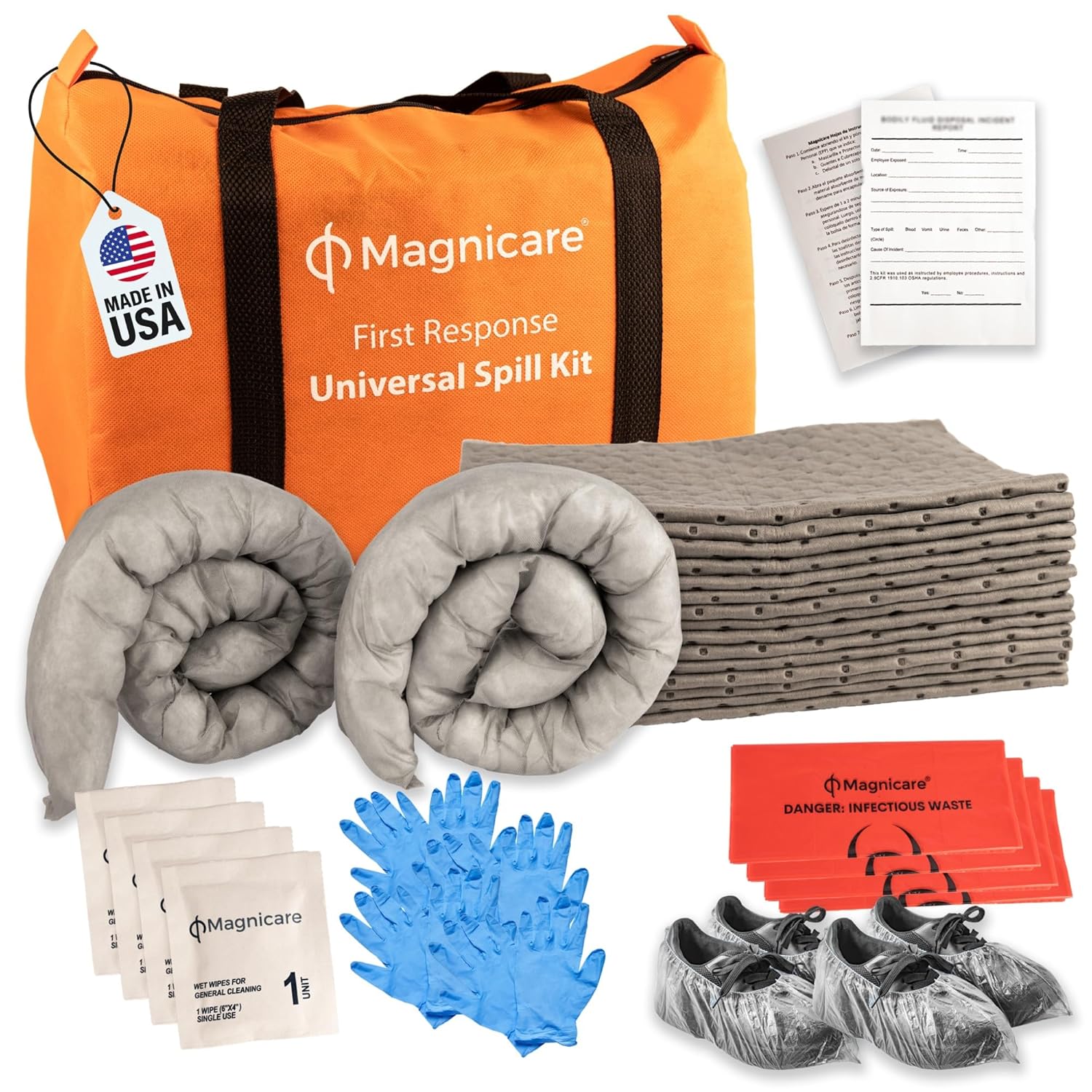
We re-read the live Universal Spill Kit listing before writing this section, because a listing is a moving target and this one had changed since we last checked. As published today it names the following.
- 15 universal absorbent mats
- 2 absorbent socks
- 4 pairs of nitrile gloves
- 4 pairs of shoe covers
- 4 red disposal bags
- 4 wet wipes
- Bilingual instructions
- A spill report form
- A compact bright orange duffel bag
The listing also describes where it expects the kit to be kept, and it is worth quoting because it names the use case this article is about. It says the kit is suitable for keeping on hand in warehouses, workshops, vehicles, loading areas, and other locations where compatible liquid spills may occur. The product names vehicles itself, and it claims nothing about any regulation. We are not going to improve on that.

Now map the kit onto the three duties from the first section, and be honest about the gaps. The right column is the part most articles leave out.
| What the duty needs | What the listing names | What has to come from outside the kit |
|---|---|---|
| Contain the liquid before it travels | 2 absorbent socks | More socks for a wide shoulder or a sloping surface |
| Recover what you contained | 15 universal absorbent mats | Nothing, for a modest leak |
| Protect the person doing it | Nitrile gloves and shoe covers | Eye and face protection, which this listing does not name |
| Contain the used absorbent | 4 red disposal bags | A disposal route, and a rigid container if the waste is going anywhere by road |
| Overpack or store a leaking package under 177.854(c) and (e) | Not named | An overpack or salvage drum sized to the packages you actually carry |
| Write down what happened | A spill report form | Your own filing decision, and the federal form if 171.16 applies |
Two notes on that table. The listing names no eye or face protection, so confirm your own stock rather than assuming; the selection reasoning for protective equipment is in our article on PPE requirements for fluid cleanup. And the overpack row is the one nobody sells you with the kit, even though it is the row that maps directly onto a regulation.
When is a universal kit the wrong kit?
This is the section a product page would normally skip, and it is the most useful one here. The Magnicare listing draws the line itself, in its own words, and we are going to repeat it rather than soften it.
The listing says to check that the spilled liquid is compatible with the absorbents before use, to follow the included instructions and your facility procedures for spill response and disposal, and not to use the kit for unknown or highly hazardous substances. It describes the absorbents as being for spills involving oil, water, coolants, and other compatible non-aggressive liquids.
That is a clean statement of scope, and it maps onto the regulatory picture better than most compliance copy does.
| What you are hauling | Is a universal kit the right tool? | Where the real answer lives |
|---|---|---|
| Fuel, hydraulic oil, coolant, lubricants, non-placarded loads | Yes, within the volume it can absorb | Format and quantity, in our absorbents guide |
| Liquid petroleum oil in a packaging of 3,500 gallons or more | Only as part of a written plan | 49 CFR 130.31 |
| Placarded corrosives, reactives or oxidizers | No. Selection is a chemistry question | Our chemical spill kit guide |
| An unknown or unlabeled substance | No, by the listing’s own instruction | Your emergency response information and the shipper |
| Blood or other bodily fluids in a passenger vehicle | No. That is a different kit entirely | The bloodborne pathogen cleanup kit |
A universal kit that is honest about its limits is more useful than a kit that claims to cover everything, because the second kind gets opened in front of a substance it cannot handle. Keep the kit for the loads it fits, and know which loads need a conversation with the shipper instead.
What paperwork does a vehicle spill produce?
A vehicle spill can generate up to three different kinds of paper, and only the federal ones have deadlines attached.
| Record | Trigger | Clock |
|---|---|---|
| Telephone report to the National Response Center | A circumstance in 49 CFR 171.15(b) | As soon as practical, no later than 12 hours |
| DOT Form F 5800.1 (01/2004) | A circumstance in 49 CFR 171.16(a) | Within 30 days of discovery; retain a copy two years; update within one year where (c) applies |
| Your own operational record | Any spill at all | No federal clock. Your plan decides |
The spill report form in the kit is where that third record starts. It is not the federal filing and it is not a substitute for one. What it is good for is the thing the federal form cannot do: it sits in the vehicle, so it gets filled in while the detail is still accurate, and the 5800.1 is then written from something better than memory thirty days later.
If the incident involved an employee and blood or other potentially infectious material, a completely separate set of records applies and none of it is in Part 171. We treat that properly in our article on documenting a bodily fluid incident, which explains why one event can produce three distinct records with three different retention periods. The same discipline is worth borrowing here: decide in advance where each record lives, because deciding at the roadside does not work.
Keeping the vehicle and the yard clean after a leak is an employer duty in its own right under the walking and working surfaces rules, and we cover that ground, including why a wrung-out absorbent is not the same as a clean floor, in our absorbents article.
Frequently Asked Questions (FAQ)
Is there such a thing as a DOT approved spill kit?
No. DOT does not approve, certify or endorse spill kits, in the same way OSHA does not. We set out the approval question in full in our guide to the phrase OSHA approved spill kit. A supplier who tells you a kit is DOT approved is describing a status that does not exist, so judge the kit by what it contains and by whether it lets you perform the duties in 49 CFR 177.854 and your own response plan.
Does FMCSA require a spill kit on a truck?
The emergency equipment section for power units, 49 CFR 393.95, requires a rated fire extinguisher, warning devices for stopped vehicles, fusees and red flags. The words spill, absorbent, sorbent and spill kit do not appear anywhere in that section. We checked that against two independent reproductions of the CFR.
How many gallons triggers an oil spill response plan?
Under 49 CFR 130.31(a) a basic spill response plan is required before anyone transports liquid petroleum oil in a packaging having a capacity of 3,500 gallons or more. Note that the test is the capacity of the packaging, not the amount you happen to be hauling that day.
How quickly do I have to report a spill from a truck?
For the circumstances listed in 49 CFR 171.15(b), a telephone report to the National Response Center is due as soon as practical but no later than 12 hours after the incident. That list is about serious outcomes: a death, an injury requiring hospital admittance, an evacuation of an hour or more, a major artery closed for an hour or more.
Do I have to file anything for a small spill nobody was hurt by?
Often yes. The detailed report at 49 CFR 171.16(a) is due within 30 days of discovery, and 171.16(a)(2) reaches an unintentional release of a hazardous material or the discharge of any quantity of hazardous waste. There is no quantity floor in that sub-item, so a leak that triggered no telephone call can still require the 30-day form.
Where should a spill kit be stored on a commercial vehicle?
There is no federal answer, so this is our recommendation rather than a requirement: somewhere the driver can reach without opening the load. The segregation rules in 49 CFR 177.848 exist because packages leak, and a kit buried behind segregated freight is a kit that arrives after the liquid does.
Can one universal kit cover every load I haul?
No, and the Magnicare listing says so itself. It tells you to check that the spilled liquid is compatible with the absorbents before use, and not to use the kit for unknown or highly hazardous substances. For a placarded corrosive or a reactive load, selection happens at the chemistry level, which our chemical spill kit guide covers.
Is the spill report form in the kit the record DOT wants?
No. It is where your own operational record starts. The federal filing is DOT Form F 5800.1, and if an employee was exposed to blood or other potentially infectious material the OSHA records are a separate set again, which we cover in our article on incident records.
Specifying a kit that matches the duty
Start from the three duties rather than from a parts list. You need to be able to contain and recover a compatible liquid, you need the equipment your response plan says you have, and you need to write down what happened while you still remember it accurately.
The Magnicare Universal Spill Kit covers the first and the third in one bag: 15 universal absorbent mats and 2 absorbent socks for containment and recovery, nitrile gloves and shoe covers for the person doing it, 4 red disposal bags for what comes off the ground, wet wipes, bilingual instructions and a spill report form, all in a compact high-visibility orange duffel that can be found in a dark trailer. The listing names vehicles as one of the places it expects the kit to be kept.
Check two things against your own operation before you buy. Confirm that the liquids you actually carry are compatible with universal absorbents, because the listing tells you to and because the answer decides whether this is the right kit. And confirm your own stock of eye and face protection and of an overpack sized to your packages, neither of which this kit names.
If you run a mixed fleet, the useful rule is one kit per vehicle plus one in the yard, because the kit that matters is the one that is already where the spill is. Browse the full range of cleanup and spill kits to match the kits to the loads.
Every paragraph designation in this article was checked against reproductions of the Code of Federal Regulations, and the load-bearing ones against two independent reproductions. Where we could not verify something, we have said so rather than filled the gap.