An oil spill kit carries its absorbent in four formats, and each one exists to solve a different geometry problem. Pads cover flat surfaces and drips. Socks and booms build a barrier. Booms float on water. Loose granular gets into rough concrete, corners and cracks where nothing flat will sit.
Format is a separate decision from chemistry. Whether an absorbent is oil-only or universal decides what it picks up; whether it is a pad, a sock, a boom or a granular decides where you can physically put it and how much of the liquid you get back out of the building.
This guide stays on the formats and the physics. What the materials actually are under federal law, how weight and bonding change what a pad holds, whether you can wring one out and use it again, and what happens to the saturated pile afterwards.
What is actually in an oil spill kit?
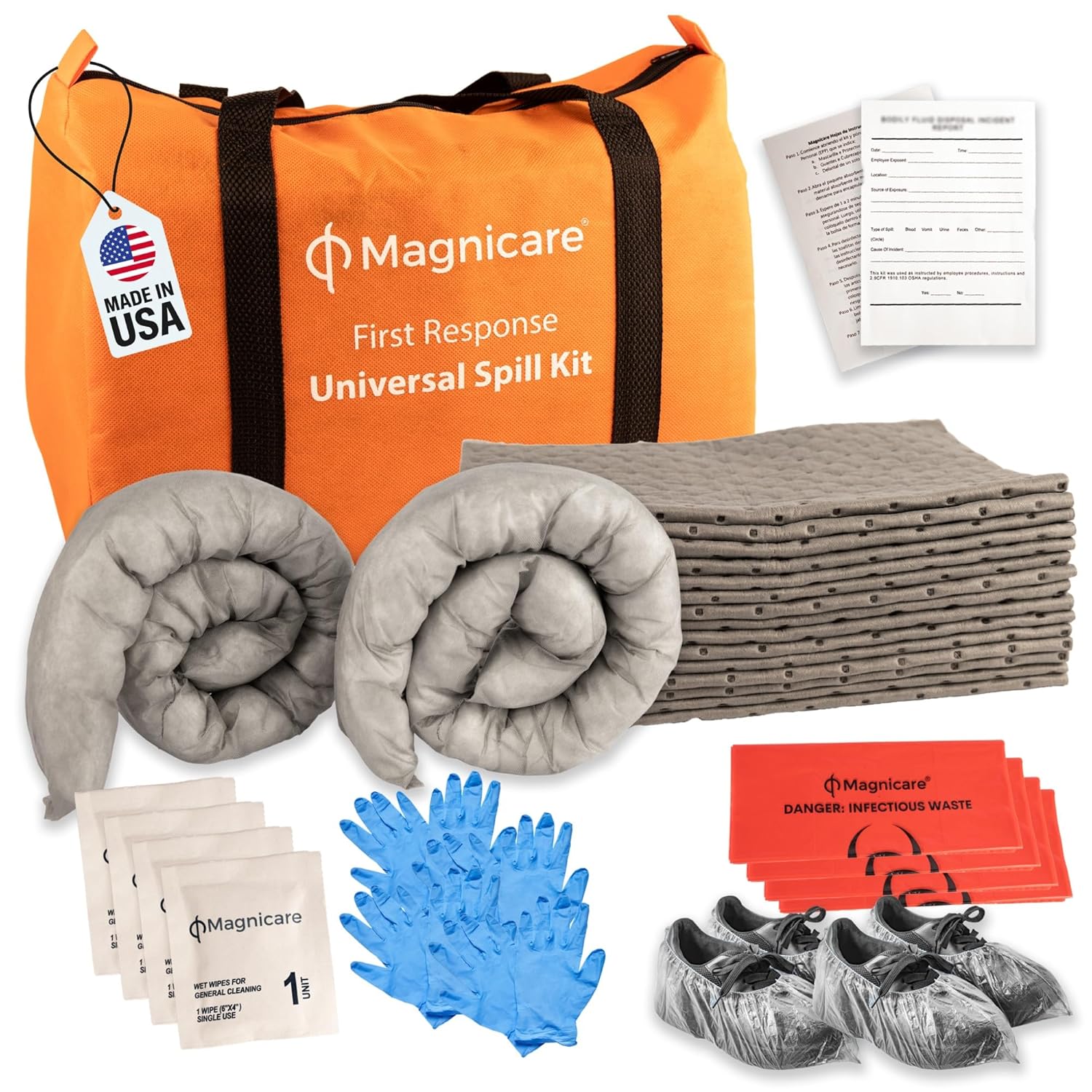
Strip the marketing off and an oil spill kit is four things: absorbent in one or more formats, something to contain the spill before you absorb it, PPE so the person cleaning up is not the next incident, and bags to take the waste away as a controlled stream rather than a wet pile.
The absorbent is the part buyers compare and the part sellers describe worst. A listing that says "50 pads" tells you almost nothing, because a pad's weight, ply, bonding and perforation change what it holds and whether it survives being dragged across concrete.

| Format | What it is for | Where it fails |
|---|---|---|
| Pad / mat / roll | Flat surfaces, drips under equipment, wiping down after the bulk is gone | Rough or broken concrete, corners, anywhere it cannot lie flat |
| Sock | Ringing the spill, damming a doorway, catching a steady drip at its source | Picking up the body of the spill — a sock is a barrier, not a sponge |
| Boom | Floating containment on open water, retention ponds, drainage channels | Indoor hard floors — far more material than the job needs |
| Loose granular | Rough concrete, gravel, floor cracks, uneven yard surfaces | Recovering the oil — it makes a floor walkable rather than clean, and all of it has to be swept back up |
What are oil absorbents actually made of?
Federal law gives a usefully precise answer. EPA's National Contingency Plan defines sorbents at 40 CFR 300.5 as "inert and insoluble substances that readily absorb and/or adsorb oil or hazardous substances, and that are not combined with or act as a chemical agent, biological agent, or sinking agent."
Two things are doing work in that sentence. Inert and insoluble means a sorbent is not supposed to react with what it picks up. Not combined with a chemical agent means an absorbent that also claims to treat, neutralise or disinfect has stopped being a plain sorbent and is being regulated as something else.
The materials themselves are named in 40 CFR 300.915(g), which sets out how sorbent products get onto EPA's publicly available Sorbent Product List. Under 300.915(g)(1), a product made solely of the following materials, or any combination of them, needs no technical data submitted at all:
| Family | Named materials | Citation |
|---|---|---|
| Natural organic | Feathers, cork, peat moss, and cellulose fibers such as bagasse, corncobs, and straw | 300.915(g)(1)(i) |
| Inorganic / mineral | Volcanic ash, perlite, vermiculite, zeolite, and clay | 300.915(g)(1)(ii) |
| Synthetic | Polypropylene, polyethylene, polyurethane, and polyester | 300.915(g)(1)(iii) |
That table is the whole absorbent market in miniature. The mats and socks in a modern kit are the synthetic family, almost always polypropylene. "Oil dry," "floor dry" and the grey grit in a bucket are the mineral family, usually clay. The corn cob, peat and cellulose products are the natural organic family.
Where a product uses a material not on that list, 300.915(g)(2) requires the manufacturer to submit specified information before it is listed. Anything outside the three families above is, by EPA's own framing, the unusual case.
How does oil-only differ from universal, in one paragraph?
Oil-only absorbents are hydrophobic and oleophilic — they repel water, float, and take up hydrocarbons. Universal absorbents are hydrophilic and take up water and oil alike, which is why a universal mat handles the mixed reality of a workshop floor: coolant one week, hydraulic fluid the next.
Which family belongs in your kit is a separate question from format, and we work it through side by side in our comparison of universal, oil-only and HazMat spill kits. If your inventory runs to solvents, acids or caustics rather than fuel and lube oil, the selection goes a level deeper again in matching absorbent type to what you actually store. The rest of this article assumes you have settled that and are choosing shapes.
When are absorbent pads the right format?
A pad is the default for anything flat and anything final. Drips under a press, a puddle on a shop floor, the film left behind after the socks have done their work — all pad work.

Pads come as individual sheets, as rolls you tear to length, and as heavier mats sized to sit under a machine permanently. Rolls are the cheaper way to cover an unpredictable footprint; cut sheets and mats are faster under pressure because nobody is looking for scissors.
- Drip control. A pad or mat parked under a known leak buys you time until maintenance arrives, and keeps the floor out of scope for a slip citation.
- Surface recovery. Lay, do not wipe. Dragging a saturated pad spreads a thin film over a wider area and makes the floor more slippery, not less.
- Final wipe. The last pad comes up nearly dry. If it does not, the spill is not finished.
- Machinery wrapping. Pads cut into strips wrap around a leaking fitting far better than a sock will.
What do socks and booms do that pads cannot?
A sock is a barrier first and an absorbent second. Its job is to stop the spill reaching a drain, a doorway or a traffic lane while you deal with the middle of it.
That is why the sequence matters: socks go down on the downhill side before anything is thrown at the puddle. Absorbing from the middle outwards while the edge is still spreading is how a five-minute job becomes a thirty-minute one.
- Identify where the liquid is heading — drain, door, pit, aisle.
- Ring or dam that side with socks, overlapping the ends rather than butting them.
- Work the body of the spill inwards from the perimeter with mats.
- Lift the socks last, into the same waste stream as everything else.

Booms are the same idea scaled up and floated. They are built with a skin, a fill and a rope or cable running through them so a length can be towed and anchored, which is what makes them the format for retention ponds, drainage channels and open water. Indoors, a boom is almost always more material than the job needs.
If oil reaches water, the calculation stops being about cleanup and becomes about reporting. The sheen test and the National Response Center notification duty are set out in our spill kit comparison — worth reading before you need it rather than after.
Is loose granular "oil dry" worth using on an oil spill?
Usually not, if the goal is recovering the oil. Loose granular — the clay-based "oil dry" or "floor dry" that comes in a bucket or a bag — is the mineral family from the table above, and what it mostly does is make a wet floor walkable again. It does not lift the oil out of the building.
That distinction matters, because the job is not finished when the floor stops being slippery. Granular has to be swept back up, it adds its own weight and volume to whatever waste stream the oil puts you in, and clay leaves a fine residue that can be as slick as the oil was. Whatever is not swept becomes dust and gets tracked through the building on tyres and boots.
Where it still earns its place is the surface a pad cannot touch: broomed or broken concrete, expansion joints, gravel, an uneven outdoor yard. On those, flat material bridges the surface instead of making contact, and granular is the only format that reaches the oil at all.
- Apply from the outside in, so you are not pushing the edge outwards.
- Give it contact time before sweeping. Sweeping early leaves oil behind and just moves grit around.
- Sweep with a scoop or dustpan, not hands, and bag it immediately.
- Plan the follow-up wash. Granular residue is its own slip hazard.
On smooth indoor concrete — the forklift bay, the production floor, the loading dock — mats and socks recover far more of the oil for far less mess afterwards. That is why the Magnicare Universal Spill Kit is built around universal absorbent mats and socks rather than a bucket of granular.
Granular is also where oil absorbents and bodily-fluid absorbents get confused. They are not the same product and not the same chemistry — a super-absorbent gelling powder solidifies aqueous fluid, which is a different mechanism entirely, and we take that apart in our guide to absorbent powder for bodily fluids. Do not substitute one for the other.
How do you read pad weight, ply and bonding?
Four words on a spec sheet carry most of the information, and none of them are regulated terms — they are trade descriptions, so ask the supplier what they mean by them rather than assuming.
| Term | What it describes | What it changes in use |
|---|---|---|
| Weight (light / medium / heavy, or single / double / triple) | How much polypropylene is in a given area of pad | Heavier pads hold more per sheet and tear less; lighter pads cost less per square foot for wiping work |
| Ply | Number of layers laminated together | More plies usually means more strength and a slower, more even take-up |
| Bonding (bonded vs unbonded) | Whether the fibres are heat- or needle-bonded together, and whether the surface is sealed | Bonded pads shed far less lint, survive being dragged, and can often be wrung; unbonded pads take up faster but fall apart wet |
| Dimpled and perforated | Surface texture and tear lines | Dimpling holds the layers together and speeds wicking across the sheet; perforation lets one person take the size they need without cutting |
The practical reading: for a maintenance bay where pads get walked on and dragged, pay for bonded and heavier. For a wipe-down bench where the pad is used once and binned, light and unbonded is the cheaper honest choice.
Socks are read the same way but with two extra questions — what the skin is made of, and what the fill is. A polypropylene skin with a polypropylene fill behaves as one material; a mesh skin with a mineral or cellulose fill behaves like the fill and will slump differently once wet.
Why we do not publish an "absorbs X times its weight" figure
Because the number is only true for the liquid, the temperature and the drain time the test used. Absorbency depends on the fibre, the loft, the viscosity of the oil and how long the material is allowed to drip before it is weighed. Quote a figure from a crude-oil bench test and it will not survive contact with cold hydraulic fluid on a January morning.
There are real standardised methods behind supplier figures — ASTM F726, Standard Test Method for Sorbent Performance of Adsorbents for Use on Crude Oil and Related Spills, and ASTM F716 for absorbents used on chemical and light hydrocarbon spills. They are laboratory test methods run under controlled conditions. They are not product certifications, and they do not promise a result on your floor.
The useful substitute takes three minutes. Weigh a dry pad, saturate it in the actual liquid you store, hold it up for thirty seconds to drain, and weigh it again. Repeat with the pad you are thinking of switching to. That comparison is worth more than any figure on a box because it uses your fluid.
Can you wring out an oil absorbent and use it again?
Sometimes, and it is worth knowing when, because wringing does two useful things at once: it recovers product, and it changes what the leftover material legally is.
Whether a pad survives wringing comes down to bonding. A bonded polypropylene pad or sock can usually be run through a wringer several times before it loses loft. An unbonded pad will shred. Loose granular cannot be wrung at all — once it is loaded, it is waste.
The regulatory half is the part most buyers have never read. Under 40 CFR 279.10(c)(1), materials containing or otherwise contaminated with used oil from which the used oil has been properly drained or removed to the extent possible such that no visible signs of free-flowing oil remain in or on the material are not used oil, and so are not subject to EPA's used-oil rules in Part 279 — though they may still be subject to the hazardous waste regulations if those apply.
The operative test is no visible signs of free-flowing oil. Draining and wringing is not housekeeping — it is what moves the material out of one federal waste category.
Two cautions. 40 CFR 279.10(c)(2) puts the exception aside for material burned for energy recovery: those are regulated as used oil regardless. And the recovered oil itself is still used oil, so it belongs in the used-oil container, not down a drain.
Part 279 is the federal floor. States run their own used-oil and waste programs on top of it, and some are stricter, so confirm locally before you build a wringing routine into a written procedure.
Is any oil absorbent "EPA approved"?
No — and the regulation that people cite to claim otherwise says so fairly plainly.
EPA does maintain a Sorbent Product List under 40 CFR 300.915(g), which identifies known sorbent materials and products for use when responding to an oil discharge. But for a product made solely of the materials in 300.915(g)(1) — the feathers-to-polyester list above — the rule states that no technical data are required to be submitted for listing, and no further action is necessary for use as a sorbent. There is no approval step for an ordinary polypropylene mat, because the rule does not ask for one.
The wider Subpart J framework points the same way. For products on the NCP Product Schedule proper, 40 CFR 300.965 requires a mandatory disclaimer stating that listing "does NOT mean that EPA approves, recommends, licenses, or certifies the use of" the product on an oil discharge, and that only a Federal On-Scene Coordinator may authorise its use in a response. Listing is a catalogue entry, not a seal.
Two things follow for a buyer. First, this whole framework is about federal response to oil discharges into navigable waters — it is not a standard governing the mats you keep for a forklift leak. Second, "EPA approved absorbent" on a product listing is doing the same work as "OSHA approved spill kit," which we pulled apart in what the standard actually says about OSHA-approved spill kits. Judge the material, the format and the spec, not the badge.
How is used oil absorbent disposed of?
Saturated absorbent is a waste, and what kind of waste it is depends on what it absorbed and how much of it is still free to flow. The determination is yours to make as the generator, at the point the waste is generated — the general rule is set out in our spill kit guide and it is not optional.
| What the absorbent picked up | Where the analysis starts |
|---|---|
| Used oil, drained so no visible free-flowing oil remains | Not used oil under 40 CFR 279.10(c)(1); check the hazardous waste rules and your state program |
| Used oil, still dripping | Treat as used oil; manage under Part 279 |
| Any oil-soaked material going to energy recovery | Regulated as used oil under 40 CFR 279.10(c)(2), drained or not |
| Solvent, acid, caustic or an unknown | Hazardous waste determination first; see chemical spill kit selection |
| Blood or other bodily fluids | A different regime entirely — red biohazard bags, never the spill kit's clear bag |
Practically, that means the disposal bag is a real part of the kit rather than packaging. Bag at the point of use, tie it, label it, and keep oil-soaked material out of the same container as anything else until you know what it is.
How much absorbent should an oil spill kit hold?
Size to the largest single container you could realistically drop in that zone, not to the total volume you store on site. A 55-gallon drum going over is a different event from a 5-gallon pail, and one kit rated for the pail does not become two kits when you buy a second pail.

Then split the capacity across formats rather than buying one shape in bulk. A kit that is all mats cannot dam a doorway; a kit that is all socks cannot pick up the middle. A workable default for an indoor bay is socks enough to ring the largest credible spill, plus mats enough to take the body of it and the final film — and granular kept separately, only if you have rough ground that mats cannot reach.
There is no federal figure for kits per square foot, and anyone quoting one is quoting a rule of thumb. The defensible method is reach time: can someone reach the kit, carry it back and have socks down before the liquid reaches the drain? If not, you need another station, not a bigger bag. The Magnicare Universal Spill Kit ships in a carry duffel for exactly that reason — the kit goes to the spill.
Why oil on the floor is an OSHA problem before it is an EPA one
Most oil spills never reach water and never trigger a reporting duty. They stay on the floor, and that is where the citation risk actually sits.
OSHA's walking-working surfaces rule at 29 CFR 1910.22 is short and blunt. Under 1910.22(a)(1) the employer must ensure all places of employment, passageways, storerooms, service rooms and walking-working surfaces are kept in a clean, orderly and sanitary condition. Under 1910.22(a)(2), the floor of each workroom is maintained in a clean and, to the extent feasible, dry condition.
1910.22(a)(3) is the one worth pinning to the wall: walking-working surfaces must be maintained free of hazards such as sharp or protruding objects, loose boards, corrosion, leaks, spills, snow and ice. Spills are named in the standard.
The rule also has a maintenance limb. 1910.22(d)(1) requires walking-working surfaces to be inspected regularly and as necessary and maintained in a safe condition, and 1910.22(d)(2) requires hazardous conditions to be corrected or repaired before an employee uses the surface again. A drip pan and a stack of mats under a known leak is not tidiness — it is the cheapest evidence you have that the condition was being managed.
How do you store absorbents so they still work?
Polypropylene does not expire, but a kit does degrade in ways that only show up on the day you open it.
- Keep it sealed and dry. A universal mat left open in a damp store will have taken up ambient moisture before you get to it.
- Keep it out of sunlight. Prolonged UV makes thin polypropylene brittle, and a pad that tears when lifted drops the oil back where it came from.
- Do not stack heavy items on socks. Compressed fill stays compressed and the sock will not seat flat against the floor.
- Close the granular bucket if you keep one. Clay and cellulose granulars both cake with humidity, and caked granular does not spread.
- Restock the same shift it is used. The common failure is not a bad pad, it is an empty station.
A monthly look at contents against the packing list, with a dated sheet on the kit, is the cheapest inspection record you will ever produce. Seal the kit afterwards so the next person can see at a glance that it is complete.
Frequently Asked Questions (FAQ)
What is the difference between an absorbent pad and a sock?
A pad is for picking liquid up off a flat surface; a sock is for stopping the liquid moving in the first place. Socks go down as a ring or a dam on the side the spill is heading, before anything is thrown at the middle of it. Using socks to absorb the body of a spill wastes them.
What are oil absorbent pads made of?
Almost always polypropylene. EPA's sorbent rule at 40 CFR 300.915(g)(1)(iii) names polypropylene, polyethylene, polyurethane and polyester as the synthetic sorbent materials; 300.915(g)(1)(i) covers natural organics such as cork, peat moss, bagasse, corncobs and straw, and 300.915(g)(1)(ii) covers minerals such as volcanic ash, perlite, vermiculite, zeolite and clay.
Is there such a thing as an EPA approved oil absorbent?
No. EPA maintains a Sorbent Product List, but under 40 CFR 300.915(g)(1) a product made solely of the listed materials needs no technical data submitted and no further action is necessary for use as a sorbent. For products on the NCP Product Schedule, 40 CFR 300.965 requires a disclaimer stating that listing does not mean EPA approves, recommends, licenses or certifies the product.
Can oil absorbent pads be wrung out and reused?
Bonded polypropylene pads and socks usually can be, several times, before they lose loft. Unbonded pads shred, and loose granular cannot be wrung at all. Wringing also matters legally: under 40 CFR 279.10(c)(1), material contaminated with used oil that has been drained or removed to the extent possible so that no visible signs of free-flowing oil remain is not used oil under Part 279.
How do you dispose of used oil absorbent pads?
Make a waste determination at the point of generation based on what was absorbed. Drained oil-soaked material may fall outside the used-oil rules under 40 CFR 279.10(c)(1), but material burned for energy recovery is regulated as used oil either way under 279.10(c)(2), and state programs can be stricter. Solvents, acids and unknowns start with a hazardous waste determination.
Is oil dry or loose granular absorbent good for oil spills?
It makes a floor walkable rather than clean. Clay-based granular does not lift the oil out of the building, it all has to be swept back up, it adds weight and volume to the waste, and the residue can be as slippery as the oil was. It earns its place only on surfaces a flat pad cannot touch, such as broken concrete, expansion joints, gravel and uneven outdoor yards. On smooth indoor concrete, absorbent mats and socks recover far more.
Why do suppliers quote "absorbs 25 times its weight" figures?
Because standardised bench tests such as ASTM F726 and ASTM F716 produce a number under controlled conditions with specified test liquids. Those methods are test procedures, not certifications, and the result does not transfer to your fluid at your temperature. Weigh a dry pad, saturate it in your own liquid, drain it for thirty seconds and weigh it again instead.
Do I need a boom if my spill risk is indoors?
Almost never. Booms are built to float and be anchored, which suits retention ponds, drainage channels and open water. Indoors, socks do the containment job with far less material. Buy a boom when there is a credible route from your storage to water.
Does OSHA have a rule about oil on the floor?
Yes. 29 CFR 1910.22(a)(2) requires the floor of each workroom to be maintained in a clean and, to the extent feasible, dry condition, and 1910.22(a)(3) requires walking-working surfaces to be kept free of hazards including leaks and spills. 1910.22(d)(1) and (d)(2) add regular inspection and correction before the surface is used again.
Build the kit around the format you will actually use
The mistake is buying one shape in quantity. A hundred mats will not stop a spill reaching a drain, and a box of socks will not lift the film off the floor afterwards. What a working kit needs is the pairing — socks to ring the spill and dam the route to the drain, mats to take up the body of it and the final film — plus the PPE and disposal bags that turn a wet mess into a documented waste.

The Magnicare Universal Spill Kit ships in a bright orange duffel with 15 universal absorbent mats, 2 absorbent socks, nitrile gloves, shoe covers, red biohazard bags, wet wipes, bilingual instructions and a spill report form — so whoever finds the spill can carry the entire response to it in one hand. Multi-packs cover a loading dock, a production floor, a chemical store and a vehicle bay in a single order, and a sealed spare means no station ever runs half-empty.
If your site also has to handle blood or bodily fluids, keep that stream separate: the Magnicare cleanup kit range covers it with its own PPE and red biohazard bag disposal, stocked alongside the spill kit rather than inside it.