There is no OSHA-approved chemical spill kit, and no federal contents list for one. What decides the kit is the chemistry you store: the flash point, the pH and the incompatible materials already printed on each product's safety data sheet. Match the absorbent to those three things and the kit is defensible. Buy by the label on the bucket and it is not.

Is there such a thing as an "OSHA approved" chemical spill kit?
No. OSHA does not approve, certify or endorse commercial products, a position the agency has stated in standard interpretation letters going back to 1976-07-07 and restated on 1993-09-15. Any kit advertised as OSHA-approved is using a phrase the agency does not issue.
What OSHA does require is that the protective equipment you select actually suits the hazard. Under 29 CFR 1910.132(d)(1) the employer must assess the workplace to determine whether hazards are present that necessitate PPE, and under 1910.132(d)(2) must verify that assessment through a written certification.
That is the real compliance test, and it is a document rather than a sticker. We unpacked the wider version of this question in what the standard actually says about "OSHA approved" spill kits; this article takes the next step down, from the category to the chemistry.
What do you need to know about a chemical before you can choose a kit?
Three numbers and one list. You already own all four, because every hazardous chemical in the workplace has a safety data sheet, and under 29 CFR 1910.1200(g)(2) that sheet must carry sixteen numbered sections in a fixed order.
Our universal versus oil-only versus HazMat comparison covers Sections 6, 8 and 13 — the clean-up method, the PPE and the disposal route. For matching an absorbent to a chemical, two more sections do the work.
| SDS section | Designation | What to pull from it |
|---|---|---|
| Section 9 — Physical and chemical properties | 1910.1200(g)(2)(ix) | Flash point, pH, density and viscosity — the numbers that decide whether the spill floats, spreads, burns or eats the absorbent |
| Section 10 — Stability and reactivity | 1910.1200(g)(2)(x) | Incompatible materials and conditions to avoid — the single most useful line on the sheet for absorbent selection |
| Section 6 — Accidental release measures | 1910.1200(g)(2)(vi) | The containment and clean-up method the manufacturer specifies |
| Section 8 — Exposure controls/personal protection | 1910.1200(g)(2)(viii) | Glove material, eye protection and respiratory protection expected |
| Section 13 — Disposal considerations | 1910.1200(g)(2)(xiii) | How the saturated absorbent should be handled downstream |
Section 10 is the one most buyers skip. If it names organic or combustible materials as incompatible, a cellulose-based absorbent is the wrong medium for that spill regardless of how much liquid it holds.
The three characteristics that sort the whole shelf
EPA's hazardous waste characteristics give you a clean, citable way to group chemicals for spill planning, because the same properties that make a waste hazardous are the ones that make a spill dangerous.
- Ignitable. A liquid with a flash point below 60 °C (140 °F), other than a solution containing less than 24 percent alcohol by volume and at least 50 percent water by weight — 40 CFR 261.21(a)(1).
- Corrosive. Aqueous and a pH less than or equal to 2 or greater than or equal to 12.5, or a liquid that corrodes SAE 1020 steel at a rate greater than 6.35 mm (0.250 inch) per year at 55 °C — 40 CFR 261.22(a)(1) and (a)(2).
- Reactive. Normally unstable; reacts violently with water; forms potentially explosive mixtures with water; generates toxic gases when mixed with water; or is a cyanide- or sulfide-bearing waste that generates toxic gases between pH 2 and 12.5 — 40 CFR 261.23(a)(1) through (a)(5).
Write those three labels beside every chemical on your inventory and the kit specification almost writes itself. A site that is entirely ignitable liquids needs a different response from one holding drums at pH 1.

Which chemical families need which absorbent?
Absorbent selection is a compatibility question before it is a capacity question. The table below maps the common storage families to the property that governs the choice and the SDS line that proves it.
| What you store | Governing property | What that means for the absorbent |
|---|---|---|
| Solvents, thinners, fuels, alcohols | Flash point below 140 °F (261.21(a)(1)) | Ignition control dominates. Vapour is the hazard, not the puddle. Section 6 will usually call for eliminating ignition sources before any absorbent is placed. |
| Acids — sulfuric, hydrochloric, phosphoric, nitric | pH ≤ 2 (261.22(a)(1)) | Needs an absorbent the SDS does not list as incompatible in Section 10. Many acids name metals and organic materials as incompatible, which rules out common media. |
| Caustics — sodium hydroxide, potassium hydroxide, ammonia solutions | pH ≥ 12.5 (261.22(a)(1)) | Same logic in reverse. Caustics are also slippery underfoot long after they are "absorbed," so containment and rinse planning matter as much as the medium. |
| Oxidizers — peroxides, nitrates, chlorates, strong bleach concentrates | Reactivity (261.23) | The highest-risk family for the wrong absorbent. If Section 10 lists combustible or organic materials as incompatible, cellulose and other organic media are excluded. |
| Water-reactive materials | 261.23(a)(2)–(a)(4) | Anything that reacts violently with water, forms explosive mixtures with it, or generates toxic gas with it. These do not belong in a general-purpose spill response at all. |
| Coolants, hydraulic fluid, lubricants, mild detergents | Usually none of the three | The ordinary case, and where a universal spill kit does its best work — broad compatibility, fast deployment, no special handling. |
Note what the table does not do: it does not name a brand of absorbent per chemical. Absorbency figures and compatibility claims vary by manufacturer and are tested under standard methods such as ASTM F726-17 for adsorbents and ASTM F716-18 for absorbents, so the manufacturer's own data — not a general rule of thumb — is the thing to check against your Section 10 list.
When does a neutralizer help, and when does it make things worse?
A neutralizer converts an acid or a caustic to something closer to pH 7. It is genuinely useful on a small, identified, single-chemical spill where the responder knows exactly what is on the floor.
It is a bad default for everything else, because neutralization is a chemical reaction and reactions release energy. EPA's own rule on handling ignitable, reactive or incompatible wastes is written around exactly the outcomes to avoid.
Precautions must prevent reactions that "generate extreme heat or pressure, fire or explosions, or violent reactions," "produce uncontrolled toxic mists, fumes, dusts, or gases in sufficient quantities to threaten human health or the environment," or "produce uncontrolled flammable fumes or gases in sufficient quantities to pose a risk of fire or explosions." — 40 CFR 264.17(b)(1)–(3)
Three practical consequences follow. Neutralize only when the chemical is identified and the SDS supports it; never neutralize an unknown liquid; and never neutralize a mixed spill where two containers have run together.
For an unidentified spill, absorb and contain. Absorption is reversible in a way a runaway reaction is not.
Which chemicals must never share a container — or a shelf?
This is where most small-site chemical programmes quietly fail an inspection. The federal rules on incompatible materials are short and unambiguous.
On containers, 40 CFR 264.177(a) states that "incompatible wastes, or incompatible wastes and materials … must not be placed in the same container." Paragraph (b) adds that hazardous waste "must not be placed in an unwashed container that previously held an incompatible waste or material."
On layout, 264.177(c) requires that a container holding waste incompatible with nearby materials in other containers, piles, tanks or impoundments be separated from them or protected by "a dike, berm, wall, or other device."
OSHA adds one blunt storage rule for flammables. Under 29 CFR 1910.106(d)(7)(iv), in the fire-control provisions: "Materials which will react with water shall not be stored in the same room with flammable liquids."

What this means for the kit, not just the shelf
Everything above applies to used absorbent too. Saturated pads from an acid spill and saturated pads from a caustic spill are incompatible materials, and 264.177(a) does not carve out an exception because they are now inside a disposal bag.
The practical version: one waste container per spill event, sealed and labelled before the next one is opened. A kit that ships with a single disposal bag is a kit that quietly encourages the wrong behaviour on a two-chemical site.
How big should a chemical spill kit be?
There is no federal rule that sizes a spill kit. There is, however, a federal rule that sizes the containment under a container storage area, and it is the most sensible benchmark available.
Under 40 CFR 264.175(b)(3), a containment system must have "sufficient capacity to contain 10% of the volume of containers or the volume of the largest container, whichever is greater."
Borrow that logic. Size the response to the largest single container in the area, not to the average spill you imagine. A shelf of twelve one-gallon jugs and a single 55-gallon drum are not the same planning problem even though the total is similar.
The cabinet limit that caps the worst case
For flammables there is a hard ceiling that makes the maths easier. 29 CFR 1910.106(d)(3)(i) states that "not more than 60 gallons of Category 1, 2, or 3 flammable liquids, nor more than 120 gallons of Category 4 flammable liquids may be stored in a storage cabinet."
If your flammables live in a compliant cabinet, you know the maximum credible release from that cabinet. That number, not a guess, is what your kit and your secondary containment should be built around.
| Storage situation | What sizes the response |
|---|---|
| Single largest container is a 5-gallon pail | A portable kit that a single responder can carry to the spill |
| Single largest container is a 55-gallon drum | Drum-scale absorbent volume plus socks or booms long enough to ring the drum footprint |
| Flammables cabinet at the 1910.106(d)(3)(i) limit | 60 or 120 gallons is the worst credible case — plan containment first, absorption second |
| Mixed families in one room | One kit per family, or one broadly compatible kit plus separate waste containers per event |

Where should kits sit in a facility that stores more than one chemical family?
Place kits by storage zone, not by floor area. A single kit at the centre of a building serves nobody well if the acids are at one end and the solvents at the other.
There is no federal spill-kit proximity rule and no kits-per-square-foot figure, so anyone quoting one is quoting a convention. What is defensible is the reasoning: a kit belongs where the release would occur, reachable without passing through the spill.
Two habits make this work in practice. Keep the relevant safety data sheets with the kit rather than in an office binder — 1910.1200(g)(8) requires them to be readily accessible in the work area anyway. And where corrosives are stored, a portable eye wash station belongs in the same zone as the kit, because 29 CFR 1910.151(c) asks for drenching facilities available for immediate emergency use — and we set out what OSHA's eyewash station requirements actually say, and where the familiar numbers really come from, since none of them appear in the CFR.

What happens to the saturated absorbent afterwards?
The absorbent inherits the chemical. Under 40 CFR 262.11 a person who generates a solid waste must determine whether that waste is hazardous, and the determination is made at the point of generation — which is the moment the pad comes off the floor, not the day the hauler arrives.
Section 13 of the SDS is where the manufacturer states how the material should be handled downstream, and it should be read before the first spill rather than after it.
Two things are worth stating plainly. Used chemical absorbent is not automatically ordinary trash, and it is not biohazard waste either — the red-bag rules that govern blood and bodily fluids are a completely separate regime, which we mapped out in the difference between a biohazard kit and a bodily fluid kit.
What does a chemical spill kit not cover?
A kit is for an incidental release — one that can be safely absorbed, neutralized or otherwise controlled at the time of release by employees in the immediate release area. Beyond that line you are in emergency response under 29 CFR 1910.120, with trained responders and a written plan, and our spill kit comparison guide walks through exactly where that line falls.
Four situations should stop an in-house response every time:
- The chemical is unidentified, or two chemicals have already mixed.
- The material is water-reactive, or the SDS warns of toxic gas generation.
- The release has reached a drain, soil or a watercourse.
- Anyone needs a respirator to approach it — that triggers a written respiratory protection programme, not a bigger kit.
Blood and bodily fluids are a separate regime again, governed by OSHA 29 CFR 1910.1030 rather than by anything in this article. A site that has both needs both kits.

Frequently Asked Questions (FAQ)
Is there an OSHA approved chemical spill kit?
No. OSHA does not approve, certify or endorse commercial products, a position stated in interpretation letters dating to 1976-07-07 and restated on 1993-09-15. What OSHA requires is a hazard assessment under 29 CFR 1910.132(d)(1), verified by written certification under 1910.132(d)(2), and PPE and equipment that match the hazard you identified.
What is the difference between a chemical spill kit and a universal spill kit?
"Universal" describes an absorbent with broad compatibility across common non-aggressive liquids such as coolants, oils and water-based fluids. "Chemical" or "HazMat" describes a kit built for aggressive chemistries such as strong acids, caustics and oxidizers. The deciding factor is not the label but whether the absorbent appears on the incompatible materials list in Section 10 of your safety data sheet.
Which SDS section tells me what absorbent to use?
Section 6, Accidental release measures, gives the manufacturer's clean-up method, and Section 10, Stability and reactivity, lists incompatible materials. Under 29 CFR 1910.1200(g)(2) these are designations (g)(2)(vi) and (g)(2)(x) respectively. Section 9 supplies the flash point and pH that classify the chemical in the first place.
Can I use the same spill kit for acids and caustics?
The absorbent may be compatible with both, but the waste is not. 40 CFR 264.177(a) states that incompatible wastes, or incompatible wastes and materials, must not be placed in the same container, and 264.177(b) prohibits placing hazardous waste in an unwashed container that previously held an incompatible material. Use a separate, sealed disposal container for each spill event.
What pH counts as a corrosive chemical?
Under 40 CFR 261.22(a)(1) an aqueous waste is corrosive if it has a pH less than or equal to 2 or greater than or equal to 12.5. Paragraph (a)(2) adds a second route: a liquid that corrodes SAE 1020 steel at a rate greater than 6.35 mm (0.250 inch) per year at a test temperature of 55 °C.
Should I put a neutralizer in my spill kit?
Only for identified single-chemical acid or caustic spills where the safety data sheet supports neutralization. Neutralization is an exothermic reaction, and 40 CFR 264.17(b) is written around preventing exactly the outcomes it can cause — extreme heat or pressure, fire or explosions, violent reactions and uncontrolled toxic or flammable gases. For an unknown or mixed spill, contain and absorb instead.
How large should a chemical spill kit be?
No federal rule sizes a spill kit, but 40 CFR 264.175(b)(3) sizes secondary containment at 10% of the volume of containers or the volume of the largest container, whichever is greater. Applying the same logic, size the response to your largest single container. Where flammables are in a storage cabinet, 29 CFR 1910.106(d)(3)(i) caps that cabinet at 60 gallons of Category 1, 2 or 3 flammable liquids or 120 gallons of Category 4, which gives you a defined worst case.
Can water-reactive chemicals be stored with flammable liquids?
No. 29 CFR 1910.106(d)(7)(iv), in the fire-control provisions of the flammable liquids standard, states that materials which will react with water shall not be stored in the same room with flammable liquids. Water-reactive materials also fall outside the scope of a general-purpose spill kit and should be planned for separately.
Stock the kit that matches what is on your shelves
Pull the safety data sheets for everything in your storage area, write ignitable, corrosive or reactive beside each one, and check Section 10 before you check a price. That half-hour is the difference between a kit that works and a kit that sits there.
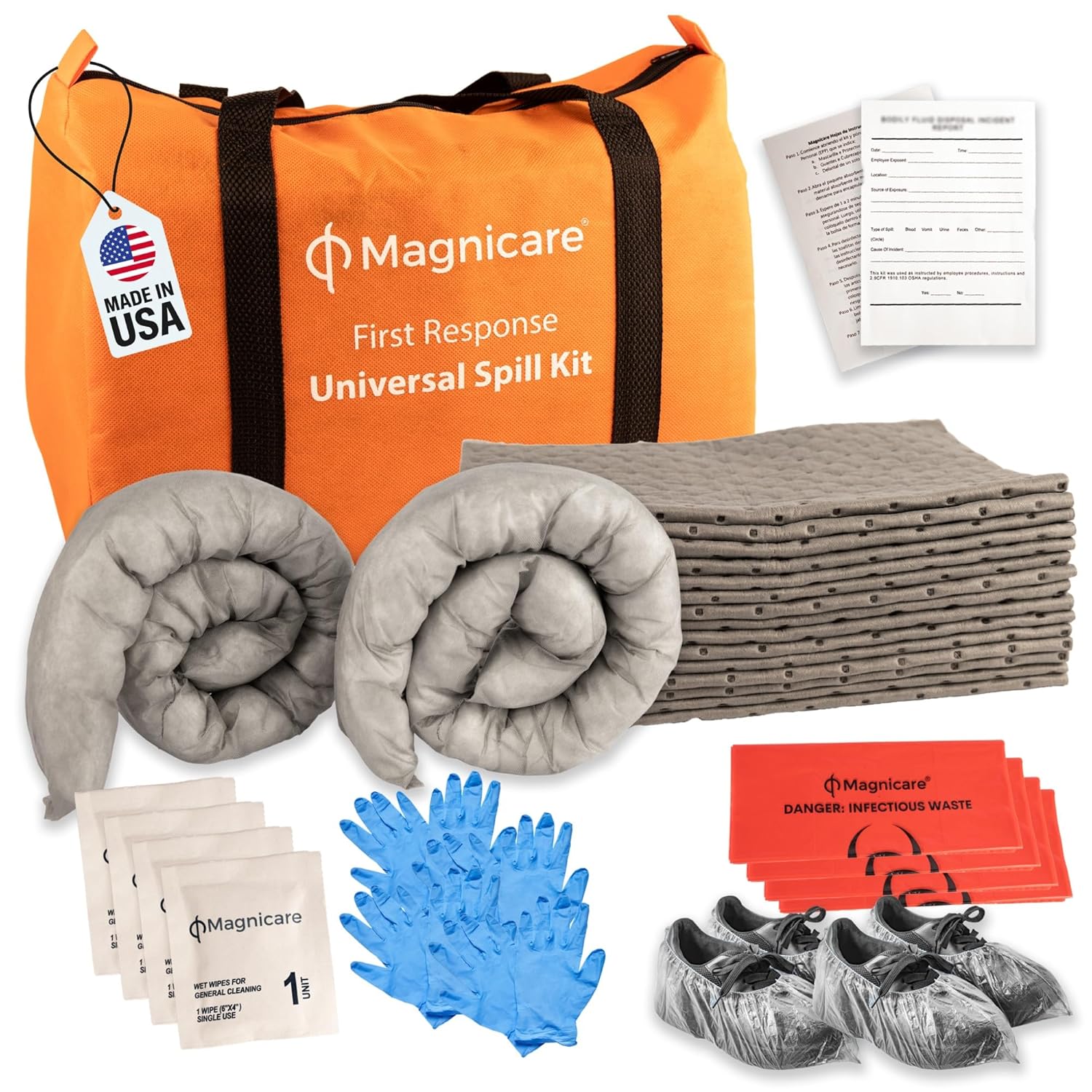
The Magnicare Universal Spill Kit is built for the ordinary case that covers most facilities — coolants, oils, hydraulic fluid, detergents and water-based chemistry — with absorbents, PPE, disposal bag and printed instructions staged in one grab-and-go package. Where corrosives are stored, pair it with a portable eye wash station in the same zone — and check what ships in the box, because flushing solution is frequently sold separately from the station that holds it. And if your site also handles blood or bodily fluids, that is a separate kit with separate rules — see the blood and bodily fluid cleanup range.
One kit, staged where the spill would happen, is worth more than three in a cupboard nobody can find.