

Short answer: is there such a thing as an "OSHA approved" spill kit?
No. OSHA has never approved, certified, or endorsed any commercial spill kit, cleanup kit, or piece of PPE — and it says so directly in its own standard interpretation letters.
What OSHA does instead is set performance requirements: your kit and your procedure have to meet a standard's language, whether or not any label says "approved." A kit can be perfectly compliant with no badge on it, and a kit stamped "OSHA approved" can still fail an inspection if it's missing what the standard actually requires.
Why OSHA can't "approve" a kit
This isn't a technicality. OSHA has put it in writing multiple times, in response to companies asking for exactly this kind of approval.
"OSHA may not approve, endorse, or recommend any product or process."
— OSHA Standard Interpretation, July 7, 1976
"OSHA does not approve or endorse products... OSHA specifically informed [the manufacturer] that 'although OSHA cannot, of course, approve or endorse particular products, the [device] appears to be an acceptable mechanical device.'"
— OSHA Standard Interpretation, September 15, 1993, discussing 29 CFR 1910.1030
Both letters make the same point: even when OSHA reviews a specific product and calls it "acceptable" for a specific use, the agency is explicit that this is not approval and can't be advertised as one.
There's a narrow exception worth knowing about so you don't confuse it with kit shopping. The word "approved" has an actual regulatory meaning in a handful of older standards — for example 29 CFR 1910.107(a)(8), which defines "approved" as listed by a nationally recognized testing lab like Underwriters Laboratories. That definition applies to specific equipment categories named in that standard (spray-finishing equipment). It does not create a general "OSHA approved" certification program, and it has nothing to do with spill or cleanup kits.
What OSHA actually checks instead
An inspector doesn't ask "is this kit approved." They ask three things:
| Question | What it means for your kit |
|---|---|
| Does your exposure control plan or spill response procedure exist and match what's on the shelf? | Paper and reality have to agree — a kit sitting unused because staff don't know the procedure fails the same way as no kit at all. |
| Does the equipment meet the specific standard that applies to your hazard? | Blood/bodily fluids → 29 CFR 1910.1030. Chemicals/oil → General Duty Clause + Hazard Communication (1910.1200). These have different required contents. |
| Is PPE selected per 29 CFR 1910.132 (general PPE) for the actual hazard present? | Gloves and eye protection have to be appropriate to what's being cleaned up — nitrile for bodily fluids and many chemicals, but not all chemicals; check your SDS. |
None of that shows up as a sticker. It shows up in your written plan, your training records, and what's physically in the kit when someone opens it.
If you handle blood or bodily fluids: 29 CFR 1910.1030
This is the standard we broke down line by line in our first article. The short version: 1910.1030(d)(3)(i) requires your employer to provide appropriate PPE at no cost, and 1910.1030(d)(3)(iii) requires it to be "readily accessible" and "in appropriate sizes" — gloves, and additional PPE such as gowns, masks, and eye protection when splash or spray is reasonably anticipated.
A kit built for this standard needs, at minimum:
- Nitrile or vinyl gloves (not latex-only, for allergy reasons)
- An absorbent agent for the fluid volume you actually see
- A leak-proof, labeled biohazard bag for waste
- A scraper or scoop so hands never contact contaminated material directly
- Eye/face protection when splash risk exists (restaurants, schools, care facilities)
Our Bloodborne Pathogen & Vomit Cleanup Kit is built to this list, not to a label.
If you are comparing kits from several sellers rather than auditing one you already own, our bloodborne pathogen kit buyer's guide goes through the contents component by component and maps each item back to the paragraph of the standard it answers to.
If you run a restaurant, a second set of rules applies on top of this one — the FDA Food Code requires written procedures for vomiting and diarrheal events, and the disinfectant most kitchens already own does not kill norovirus. Here is what a restaurant kit actually needs.

If you handle chemical, oil, or fuel spills: the General Duty Clause + HazCom
Chemical and oil spills don't have one dedicated OSHA standard the way bloodborne pathogens do. Instead, two things apply together:
- Section 5(a)(1), the General Duty Clause — the employer must keep the workplace free of recognized hazards. An unmanaged chemical spill is a recognized hazard.
- 29 CFR 1910.1200, Hazard Communication — you have to know what's in the spill (via the Safety Data Sheet) before you can select the right PPE and absorbent for it. A universal absorbent that isn't rated for a specific solvent is a compliance gap, not just a performance one.
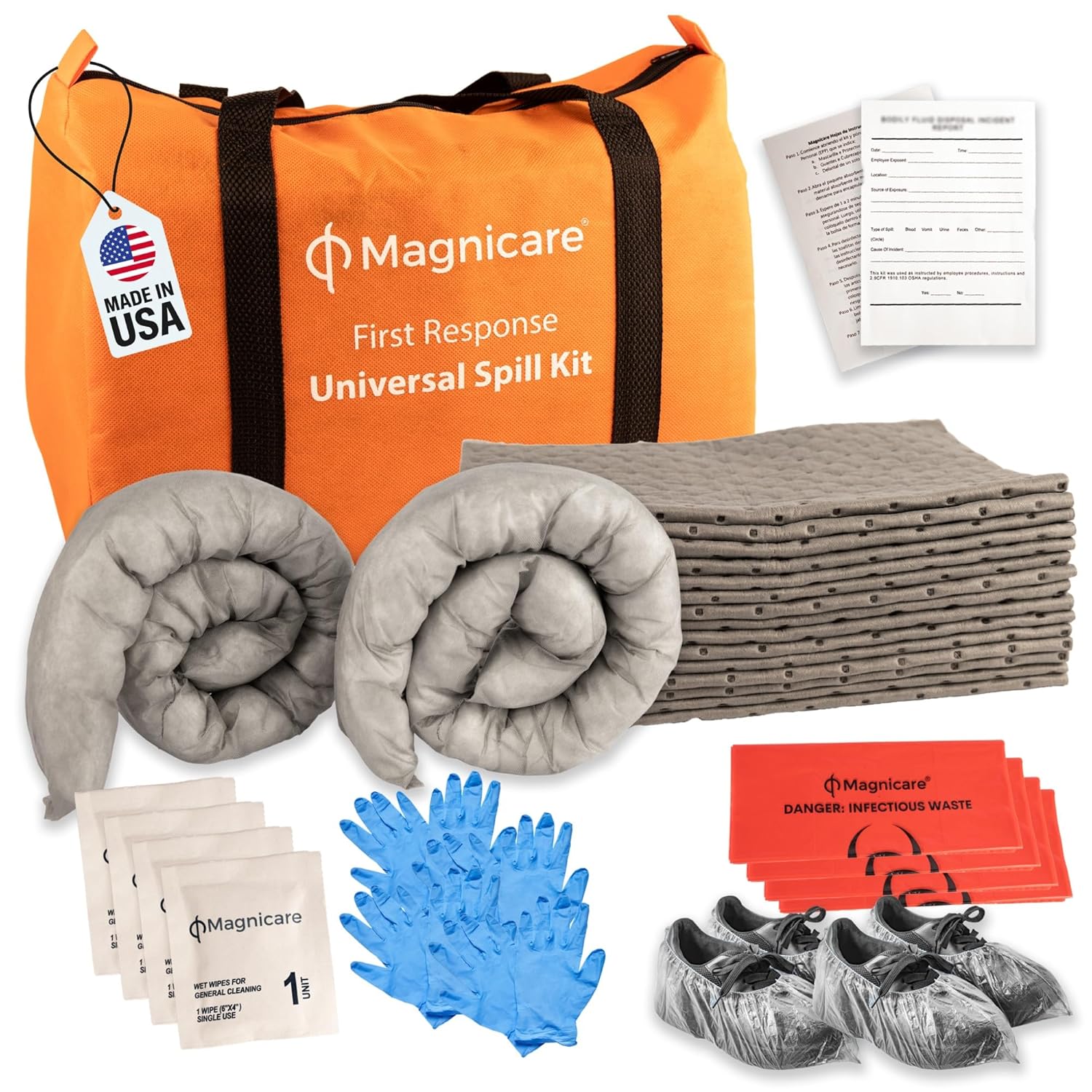
That's why a chemical/oil kit needs a broader absorbent capability than a bodily-fluid kit — oil-only pads won't take up polar chemicals, and vice versa. Format matters as much as chemistry here: pads, socks, booms and loose granular each solve a different part of the same spill, and a kit stocked with only one of them can contain or recover but not both. Which of the three absorbent families you actually need comes down to what you store and where it could go, and we walk that decision step by step in our guide to choosing between universal, oil-only and HazMat spill kits. One level below that category choice, matching absorbent type to the specific chemical families you store is where the Safety Data Sheet earns its keep — Section 10 tells you what the substance reacts with, which is the line that rules an absorbent or a neutraliser in or out. Our Universal Spill Kit is built for that range: it covers oil, coolant, and general chemical spills rather than one narrow substance.

7-point audit: is your kit actually compliant?
Run this in under five minutes on the kit you already have.
- Do you have a written exposure control plan or spill procedure that names this kit specifically?
- Are the gloves nitrile/vinyl, not latex-only?
- Is there enough absorbent for the largest spill you'd realistically see, not just a token amount?
- Is the waste bag rated leak-proof and labeled (biohazard symbol for bodily fluids)?
- Is eye/face protection included if splash is plausible at your site?
- Do the people who'd use it know where it is and how, without reading the box first?
- Has anything in the kit expired, dried out, or been partially used since the last check?
Two "no" answers is a real compliance gap — regardless of what's printed on the kit's packaging.

Why so many kits are labeled "OSHA approved" anyway
Because it sells, and enforcement of the claim itself is rare — OSHA polices workplace conditions, not marketing copy on unrelated retail listings.
The practical risk isn't a fine for the label. It's trusting the label instead of checking the contents. A kit can say "OSHA approved" and still be missing the one item your specific hazard requires, and a kit with honest, accurate marketing can be fully compliant. The label tells you nothing either way — the audit above does.

Frequently Asked Questions (FAQ)
Does OSHA certify or approve spill kits?
No. OSHA states directly that it "may not approve, endorse, or recommend any product or process" (1976 interpretation letter, reaffirmed in 1993).
What does "OSHA approved" mean on a product listing, then?
Usually shorthand for "built to help you comply with the applicable OSHA standard." It's marketing language, not a regulatory status. Check the actual contents against the standard that applies to your hazard.
Which OSHA standard applies to a bodily-fluid spill kit?
29 CFR 1910.1030, the Bloodborne Pathogens standard, when blood or fluids visibly contaminated with blood are involved, or when differentiating fluids is not possible. See our full breakdown.
Which standard applies to a chemical or oil spill kit?
No single dedicated standard — the General Duty Clause (Section 5(a)(1)) plus Hazard Communication (29 CFR 1910.1200) govern it, driven by what the Safety Data Sheet says about the specific substance.
Can I lose an OSHA inspection over the wrong kit even if I have "a" spill kit?
Yes. Having any kit present doesn't satisfy the standard if its contents don't match your actual hazard — for example, an oil-only absorbent kit at a site whose real exposure is bodily fluids.
Run the 7-point audit above against what's actually in your kit today. If it doesn't hold up, our Universal Spill Kit and Bloodborne Pathogen & Vomit Cleanup Kit are built against the standards cited above, not against a label.


