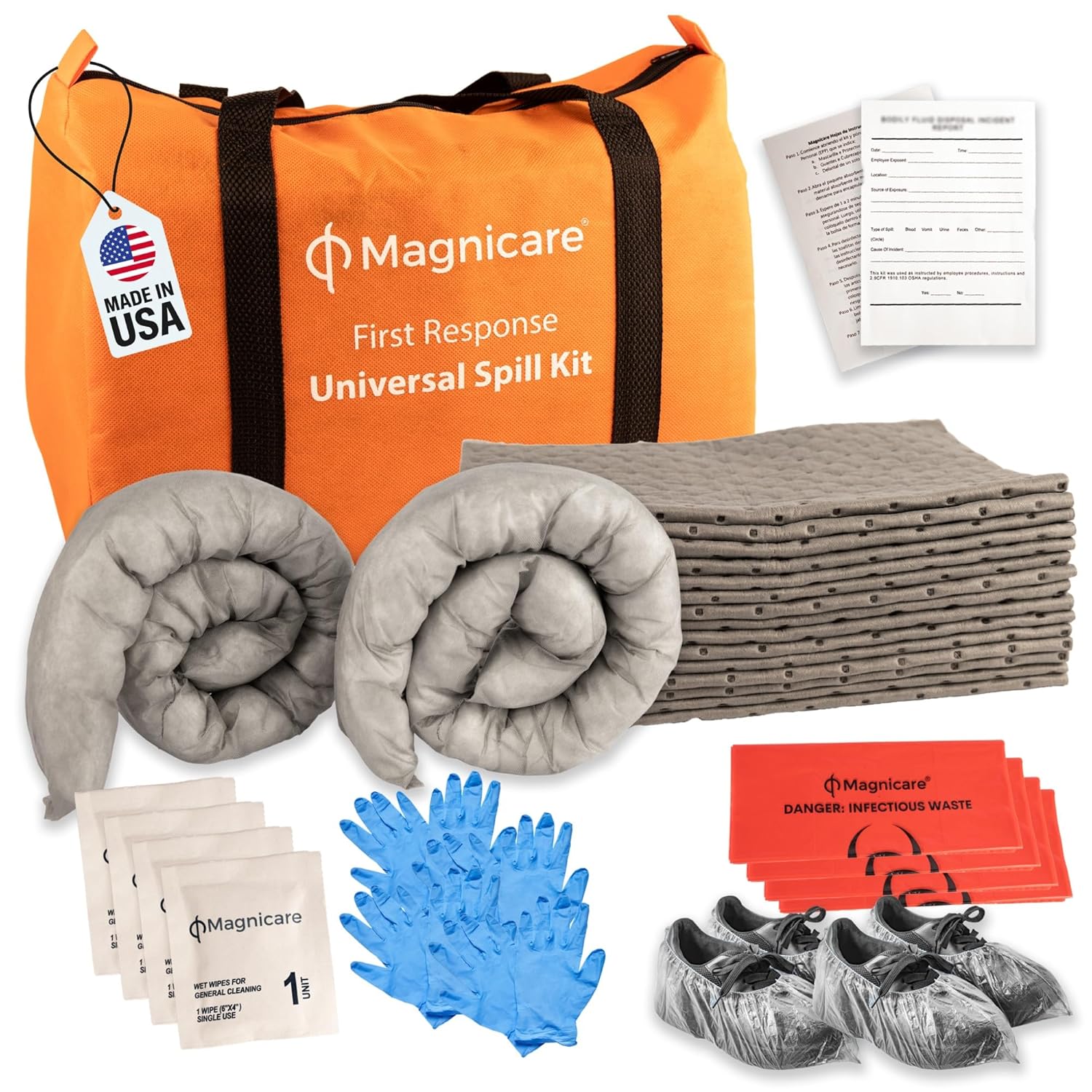
A universal spill kit is the right default for most facilities. It absorbs water-based liquids, coolants, oils and most general-purpose chemicals, so one kit covers the mixed spills a warehouse or shop actually sees. Choose an oil-only kit when hydrocarbons hit water, and a HazMat kit when you store acids, caustics or aggressive solvents.
The three kit types are not interchangeable, and the difference is not marketing. It comes down to what the absorbent is made of, what it will and will not pick up, and what your safety data sheets and your waste stream demand.
This guide walks the decision the way a compliance officer would: what each absorbent does, how to read your own chemical inventory, where the federal rules actually apply, and how to size and place kits so they are usable when something goes over.
What is a universal spill kit, and what does it absorb?
A universal spill kit is a packaged set of absorbents, containment items, PPE and disposal bags built to handle the widest practical range of non-aggressive liquids. In the trade these are also called general-purpose, maintenance or "gray" kits.
The absorbents inside are hydrophilic — they take up water as readily as oil. That is exactly what you want for the spills most facilities actually have: coolant, hydraulic fluid, detergent, antifreeze, wash water, condensate, mystery puddles under a pallet.
The trade-off is that a universal absorbent will happily soak up rainwater or wash-down water along with the product you were trying to recover. On a wet floor or an outdoor pad, that means you use more material to pick up less contaminant.

What is normally inside
- Absorbent pads or mats — the workhorse for flat surfaces and drips.
- Absorbent socks or booms — laid as a ring to stop the spill spreading before you start soaking it up.
- Loose granular absorbent — in some kits, for rough concrete, corners and floor cracks where a pad will not sit flat.
- PPE — gloves at minimum, often shoe covers and eye protection.
- Disposal bags and ties — so the used absorbent leaves the area as a controlled waste, not a wet pile in a corner.
- A scoop or dustpan — where granular is included, for recovering it without hand contact.
The Magnicare Universal Spill Kit covers the core of that list — 15 universal absorbent mats, 2 absorbent socks, nitrile gloves, shoe covers, red biohazard bags, wet wipes, bilingual instructions and a spill report form — in an orange duffel so it can be carried to the spill rather than the spill being walked to the supply closet.
How do universal, oil-only and HazMat kits actually differ?
The difference is chemistry, not color. Color coding — gray for universal, white for oil-only, yellow for HazMat — is an industry convention that most suppliers follow, but it is not a federal requirement and nothing stops a manufacturer from using different colors.
| Kit type | Absorbent behavior | Picks up | Does not suit | Typical user |
|---|---|---|---|---|
| Universal (gray) | Hydrophilic — absorbs water and oil alike | Coolants, hydraulic fluid, antifreeze, detergents, most non-aggressive chemicals, water | Recovering oil off standing water; strong acids and caustics | Warehouses, workshops, fleet yards, food plants, general facilities |
| Oil-only (white) | Hydrophobic and oleophilic — repels water, floats | Fuel, motor oil, hydraulic oil, diesel — including on water | Water-based spills, coolants, most chemicals | Marinas, fuel depots, generator rooms, outdoor tank farms |
| HazMat / chemical (yellow) | Chemically resistant carrier and casing | Aggressive acids, caustics, solvents, unknown liquids | Everyday oil and water spills — cost per pickup is far higher | Labs, plating shops, battery rooms, chemical storage |
Why "absorbent" and "adsorbent" are not the same word
An absorbent draws liquid into the body of the material like a sponge. An adsorbent holds liquid on its surface. Most polypropylene spill products work by adsorption, which is why ASTM's performance test for them is titled for adsorbents — ASTM F726, Standard Test Method for Sorbent Performance of Adsorbents for Use on Crude Oil and Related Spills.
It matters commercially. Adsorbed liquid can weep back out under pressure, which is why a saturated pad left on a forklift route re-wets the floor. Weight, ply and bonding change how much a pad holds and how much it gives back, and we compare those format by format in our guide to oil spill kit absorbents — pads, socks, booms and loose granular. Bag the used material rather than stacking it.

Which kit does your facility actually need?
Start from your chemical inventory, not from the catalog. Walk the site, list every liquid stored in volumes above a few gallons, and sort it into three buckets: water-based, hydrocarbon, aggressive.
| If you store… | Buy first | Add if the risk is real |
|---|---|---|
| Mixed maintenance liquids, coolant, detergent, food-plant fluids | Universal | Nothing else usually needed |
| Diesel or fuel oil near a drain, waterway or retention pond | Universal for indoors | Oil-only for the outdoor or on-water risk |
| Forklift battery charging (sulfuric acid) | HazMat / acid-neutralizing | Universal for the rest of the building |
| Lab reagents, solvents, unknown or mixed waste | HazMat | Universal at the receiving dock |
| Blood or other bodily fluids | A dedicated bloodborne pathogen kit — not a spill kit | See the bloodborne pathogen kit buyer's guide |
Most single-site operations land in the same place: one universal kit per zone, plus one specialist kit sited at the one place where the specialist hazard actually lives. Buying three kit types for every corner of the building wastes money and slows the response, because nobody is sure which bag to grab.
Bodily fluids are the exception that catches people out. A universal absorbent will physically pick up blood or vomit, but it does not give you the PPE, disinfectant or red-bag disposal that those events require. That is a separate product line — the bodily fluid cleanup kit — and the two should sit side by side rather than substitute for each other.
Is any spill kit "OSHA approved"?
No. OSHA does not approve, certify or endorse products of any kind, and it has said so directly in standard interpretation letters going back to 1976-07-07 and again on 1993-09-15. Any listing that claims an "OSHA approved" or "OSHA certified" spill kit is using language OSHA itself does not use.
What exists instead is a kit that helps you comply with obligations that fall on you as an employer: hazard assessment, PPE selection, emergency planning, waste handling. We unpacked this in detail in what the standard actually says about "OSHA approved" spill kits.
The practical version: judge a kit on contents, absorbency and whether your people can use it, and treat "OSHA approved" on a product page as a signal to look harder at the spec sheet.
When does a spill stop being a cleanup and become an emergency response?
This is the single most important line in spill planning, and it is drawn in OSHA's HAZWOPER standard, 29 CFR 1910.120.
The definition of "emergency response" in 1910.120(a)(3) excludes incidental releases. Its words: "Responses to incidental releases of hazardous substances where the substance can be absorbed, neutralized, or otherwise controlled at the time of release by employees in the immediate release area, or by maintenance personnel are not considered to be emergency responses within the scope of this standard."
The same definition also excludes "responses to releases of hazardous substances where there is no potential safety or health hazard (i.e., fire, explosion, or chemical exposure)."
What that means in practice
- Incidental release — a spill your own trained staff can absorb and control at the point it happened, with the kit on the wall. A spill kit is the correct answer.
- Emergency response — an uncontrolled release requiring people from outside the immediate area. This pulls in the HAZWOPER emergency-response requirements, including the plan elements at 1910.120(q)(2)(i) through (q)(2)(xii) and the trained-responder tiers at 1910.120(q)(6): first responder awareness, first responder operations, hazardous materials technician, hazardous materials specialist and on-scene incident commander.
There is a third position worth knowing about. Under 1910.120(q)(1), employers "who will evacuate their employees from the danger area when an emergency occurs, and who do not permit any of their employees to assist in handling the emergency, are exempt from the requirements of this paragraph if they provide an emergency action plan complying with 29 CFR 1910.38."
So there are three defensible postures: handle incidental spills in-house with a kit, build a full HAZWOPER response capability, or evacuate and call the fire department under a written emergency action plan. What is not defensible is having no written position at all and improvising on the day.
What does your safety data sheet tell you about which kit to buy?
Your SDS already contains the answer, and it is free. Under OSHA's Hazard Communication standard, 29 CFR 1910.1200(g)(2), every safety data sheet must carry sixteen numbered sections in a fixed order. Two of them decide your kit.

| SDS section | Title | What to pull from it |
|---|---|---|
| Section 6 | Accidental release measures | Containment and clean-up method the manufacturer specifies — whether absorb, neutralize or dike, and what materials to avoid |
| Section 8 | Exposure controls/personal protection | Glove material, eye protection and respiratory protection the manufacturer expects |
| Section 13 | Disposal considerations | How the saturated absorbent should be handled downstream |
Section 8 is where the glove decision gets made, and Section 10 — stability and reactivity — is where the absorbent decision gets made, which we take apart chemical family by chemical family in matching absorbent type to what you actually store. A nitrile glove that is fine for coolant is not automatically fine for a solvent, and a kit that ships with one glove type does not override what your SDS calls for.
Those sheets also have to be where the work is. Under 1910.1200(g)(8), employers must ensure safety data sheets are readily accessible during each work shift to employees when they are in their work areas — which is a good reason to keep the relevant SDS with the kit rather than in a binder in the office.
Do oil spills carry separate reporting rules?
Yes, and this is where oil-only kits earn their place. EPA's oil discharge rule at 40 CFR Part 110 defines discharges that "may be harmful" — the widely known sheen rule.
40 CFR 110.3 covers discharges that "cause a film or sheen upon or discoloration of the surface of the water or adjoining shorelines or cause a sludge or emulsion to be deposited beneath the surface," or that violate applicable water quality standards.
40 CFR 110.6 then requires the person in charge of a vessel or facility, as soon as they have knowledge of such a discharge, to immediately notify the National Response Center. There is no minimum gallon count in the sheen test — visible sheen on water is the trigger.
SPCC: does the oil rule apply to your site?
EPA's Spill Prevention, Control and Countermeasure rule at 40 CFR Part 112 turns on storage capacity. Under 40 CFR 112.1(d)(2), a facility is outside the rule if it has 1,320 US gallons or less of aggregate aboveground oil storage capacity (counting containers of 55 gallons and larger), or 42,000 gallons or less completely buried — and the rule only reaches facilities that could reasonably be expected to discharge oil into or upon navigable waters.
If you are over those thresholds, an oil-only kit at the tank pad is not optional housekeeping; it is part of showing you can control a discharge before it reaches water.
What PPE belongs in a spill kit?
The kit's PPE is not a free gift, it is your compliance with a PPE selection duty you already have. Under 29 CFR 1910.132(d)(1), the employer must assess the workplace to determine if hazards are present, or are likely to be present, which necessitate the use of personal protective equipment — and then select PPE that fits the affected employee.
1910.132(d)(2) adds that the employer must verify the assessment through a written certification identifying the workplace evaluated, the person certifying it, and the date of the assessment.
| Item | Universal kit | Oil-only kit | HazMat kit |
|---|---|---|---|
| Chemical-resistant gloves | Yes | Yes | Yes — material matched to SDS Section 8 |
| Eye protection | Goggles | Goggles | Goggles plus face shield where splash is credible |
| Protective coverall or apron | Recommended | Recommended | Yes |
| Respiratory protection | Usually not required for incidental spills | Usually not | Assess — may push the event out of "incidental" |
| Emergency eye flushing | Site-dependent | Site-dependent | Strongly indicated near corrosives |
If your assessment lands on corrosives, eye flushing capability belongs in the same walk-to distance as the kit. A portable eye wash station covers areas where plumbed equipment is impractical; the detailed requirements are in our breakdown of the OSHA kit standards.
What size kit do you need, and where should it live?
Size the kit to the largest single container you can realistically drop, not to the total volume you store. One 55-gallon drum going over is a different event from a 5-gallon pail.

A workable rule of thumb
- Identify the largest single container in the zone.
- Choose a kit whose stated absorbency meets or exceeds that volume.
- Site it within roughly 30 seconds' walk of the risk, unobstructed, at the same level — not up a ladder or behind stacked pallets.
- Repeat per zone. Loading dock, production floor, chemical store and vehicle bay are four zones, not one.
- Keep one sealed spare kit in stores so a used kit can be swapped immediately rather than run half-empty.
Portability decides more than people expect. A duffel-format kit gets carried to the spill; a wall cabinet gets raided for a handful of pads and then left open and incomplete. Multi-packs of the universal spill kit exist for exactly this reason — one per zone plus a spare, bought once.
What do you do with the used absorbent?
Saturated absorbent is a waste, and what kind of waste it is depends entirely on what it absorbed. Under EPA's generator rule at 40 CFR 262.11, a person who generates a solid waste "must make an accurate determination as to whether that waste is a hazardous waste in order to ensure wastes are properly managed."
40 CFR 262.11(a) requires that determination at the point of waste generation, before any dilution, mixing or other alteration of the waste occurs. In plain terms: you decide what the bag is before you throw it in with anything else, and mixing does not make the problem smaller.
- Non-hazardous absorbed material — typically general waste, subject to your state and local rules.
- Hazardous by listing or characteristic — manage under the RCRA generator requirements; do not put it in the dumpster.
- Oil-contaminated material — check used-oil and state requirements before assuming general waste; the federal test is in our guide to oil spill kit absorbents.
- Anything involving blood or bodily fluids — a separate stream entirely, handled in red biohazard bags, never in the spill kit's clear disposal bag.
This is why a kit that ships with labeled disposal bags and ties is worth more than a bigger pile of loose pads. The bag is what turns a wet mess into a documented waste.
How do you keep a kit ready between spills?
The failure mode is boring and universal: the kit gets opened for a small spill, half the pads are used, nobody restocks it, and it is short on the day it matters.

- Seal it. A tamper-evident tie tells you at a glance whether the kit is complete.
- Inspect monthly. Contents against the packing list, PPE intact, bags present, nothing damp.
- Restock the same day it is used — before the end of the shift that used it.
- Log it. A dated inspection sheet on the kit is the cheapest evidence you will ever produce for an inspector.
- Train on it. Under the incidental-release logic above, your defense rests on staff being able to control the spill at the time of release. That is a training claim, not a purchasing one.
Frequently Asked Questions (FAQ)
Can a universal spill kit be used on oil?
Yes. Universal absorbents pick up oil as well as water-based liquids, which is why they suit mixed indoor spills. They are the wrong choice only when you need to recover oil from standing water, because they will absorb the water too — that is the job of an oil-only kit.
What is the difference between an oil-only and a universal spill kit?
Oil-only absorbents are hydrophobic and oleophilic: they repel water, float, and take up hydrocarbons. Universal absorbents are hydrophilic and take up both. Oil-only is for fuel and oil, especially on or near water; universal is the general-purpose default for indoor mixed liquids.
Is there such a thing as an OSHA approved spill kit?
No. OSHA does not approve, certify or endorse any product, a position it stated in standard interpretation letters dated 1976-07-07 and 1993-09-15. Kits can help you comply with OSHA obligations, but no kit carries OSHA approval.
When is a spill an emergency response rather than a cleanup?
Under 29 CFR 1910.120(a)(3), a release that can be absorbed, neutralized or otherwise controlled at the time of release by employees in the immediate release area, or by maintenance personnel, is an incidental release and falls outside the HAZWOPER emergency-response requirements. An uncontrolled release needing responders from outside that area is an emergency response.
How do I know which absorbent my chemical needs?
Read Section 6, "Accidental release measures," of the safety data sheet, and Section 8 for glove and eye protection. OSHA's Hazard Communication standard at 29 CFR 1910.1200(g)(2) requires every SDS to carry those numbered sections, and 1910.1200(g)(8) requires the sheets to be readily accessible during each work shift.
Do I have to report an oil spill?
If oil discharges to navigable waters or adjoining shorelines and causes a film, sheen or discoloration of the surface, or a sludge or emulsion beneath it, 40 CFR 110.3 treats it as a discharge that may be harmful, and 40 CFR 110.6 requires the person in charge to immediately notify the National Response Center. There is no minimum gallon figure in the sheen test.
What size spill kit should I buy?
Match the kit's stated absorbency to the largest single container you could drop in that zone, not to your total storage volume. Then place one kit per risk zone within about 30 seconds' walk, and keep a sealed spare so a used kit can be swapped out immediately.
Can I use a spill kit for blood or vomit?
No. A universal absorbent will physically absorb the liquid, but it does not provide the PPE, disinfectant or red-bag disposal that bodily fluid cleanup requires. Use a dedicated bodily fluid or bloodborne pathogen kit and keep the two stocked separately.
How often should a spill kit be inspected?
Monthly is the practical standard, plus a same-shift restock every time the kit is opened. Keep a dated inspection log attached to the kit — it is the simplest evidence that the kit was ready.
Get the kit that covers the spills you actually have
Most facilities do not need three kit types. They need one universal kit per zone that is complete, portable and stocked with the PPE and disposal bags that make the cleanup defensible — plus one specialist kit where a specialist hazard genuinely lives.
The Magnicare Universal Spill Kit ships in a bright orange duffel with 15 universal absorbent mats, 2 absorbent socks, nitrile gloves, shoe covers, red biohazard bags, wet wipes, bilingual instructions and a spill report form, so the person who finds the spill can carry the whole response to it in one hand. Multi-packs cover a four-zone site in a single order, and a sealed spare means you are never running a half-empty kit.
If your risks run wider than liquids, the Magnicare cleanup kit range covers bodily fluid and bloodborne pathogen response alongside it.