Does a restaurant legally need a vomit kit?
Not the kit itself — but you are required to have something you almost certainly cannot deliver without one. The FDA Food Code requires every food establishment to have written procedures for responding to vomiting and diarrheal events. A kit is simply how those written procedures become executable at 9pm on a Saturday.
That distinction matters, because a health inspector will ask for the procedure first and look at your supplies second. A shelf full of gear with no written plan fails. A written plan with nothing on the shelf fails harder.
What the FDA Food Code actually requires
The governing language is §2-501.11, Clean-up of Vomiting and Diarrheal Events, in the 2022 FDA Food Code (the 10th edition, and the current one). It is two sentences long:
“A food establishment shall have written procedures for employees to follow when responding to vomiting or diarrheal events that involve the discharge of vomitus or fecal matter onto surfaces in the food establishment.”
“The procedures shall address the specific actions employees must take to minimize the spread of contamination and the exposure of employees, consumers, food, and surfaces to vomitus or fecal matter.” — FDA Food Code §2-501.11
Read the second sentence closely, because it is where most procedures fail an inspection. It requires specific actions covering four separate things: employees, consumers, food, and surfaces.
A one-line policy that says “staff will clean up spills promptly using the kit” addresses none of those four. It is not a procedure. It is an intention.
One important caveat on jurisdiction. The Food Code is a model code — the FDA publishes it, and each state adopts it independently, sometimes on an older edition and sometimes with amendments. Almost every state has adopted a version containing §2-501.11, but the edition, the section numbering, and any added requirements are set by your state or county. Check your own regulator’s adopted version before you finalize a procedure. The Conference for Food Protection, the industry body whose recommendations drive Food Code revisions, is a useful place to track where the model code is heading next.
Where OSHA comes in — and where it doesn’t
This is the most commonly mangled point in restaurant safety training, so it is worth being precise.
Vomit is not automatically covered by the Bloodborne Pathogens standard. 29 CFR 1910.1030 lists the specific fluids it treats as other potentially infectious materials, and vomit, urine, feces and saliva are not among them.
There are two exceptions, and in a restaurant one of them applies most of the time:
- Any body fluid visibly contaminated with blood.
- “All body fluids in situations where it is difficult or impossible to differentiate between body fluids.”
A server looking at a puddle on a dining room floor cannot differentiate what is in it. Neither can a manager looking at a restroom floor. That second exception is not a technicality — it is the normal case, which is why the defensible position is to treat any unidentifiable bodily fluid spill as if 1910.1030 applies. And if you are trying to work out which product category you are even shopping for, a biohazard cleanup kit and a bodily fluid kit are not the same thing — that comparison maps each kind of mess to the rule that governs it, and shows where an in-house response has to stop.
When it does apply, you inherit real obligations: appropriate PPE readily accessible at no cost to the employee, a closable and leak-proof waste container that is labeled or color-coded, an exposure control plan, annual training, and the hepatitis B vaccination offer. We break all of that down line by line in what OSHA actually requires in a bloodborne pathogen cleanup kit.
What OSHA does not do is certify any of it. There is no such thing as an OSHA-approved kit, and any product sold to you on that basis is being marketed loosely — we covered why that label is meaningless and what to check instead.
What has to be in a restaurant vomit kit
Work backwards from the two rulebooks. Each row below exists because a specific requirement demands it, not because it fills out a box — and if you want the same list walked through the way an inspector works down it, our item-by-item restaurant bodily fluid cleanup kit checklist maps every piece to the Food Code or OSHA paragraph that puts it in the box.
| Item | Why it is in the kit | Source |
|---|---|---|
| Absorbent solidifier powder | Turns liquid into a scoopable solid so waste can be contained without leaking, and so the bulk of the contamination leaves before any chemical is applied | Food Code §2-501.11 (minimize spread); 1910.1030(d)(4)(iii)(B)(1) |
| Nitrile or vinyl gloves, in more than one size | Barrier protection sized to the person actually wearing it | 1910.1030(d)(3)(i) |
| Mask and eye or face protection | Splash risk is highest during removal, with the responder’s face above the work | OSHA norovirus guidance; 1910.1030(d)(3)(i) |
| Gown or disposable apron | Keeps contamination off street clothes and uniforms that then move through the kitchen | 1910.1030(d)(3)(i) |
| Shoe covers | Shoes are how a contained spill becomes a trail across the dining room | Food Code §2-501.11 (minimize spread) |
| Scraper and scoop | Hands never contact contaminated material directly | 1910.1030(d)(3)(ix) |
| Disinfectant rated against norovirus | Routine food-contact sanitizers are frequently ineffective against norovirus | Supplement to the 2022 Food Code |
| Leak-proof biohazard bag and tie | Closable, leak-proof, labeled or color-coded waste containment | 1910.1030(d)(4)(iii)(B)(1) |
| Hand hygiene provision | For a cleanup that happens away from a sink | 1910.1030(d)(2)(iii)–(iv) |
| Incident report form | Your evidence that the written procedure was actually followed | Food Code §2-501.11 (written procedures) |

The 8-step response, in order
Order is not a stylistic preference here. Two steps are routinely performed in the wrong sequence, and both mistakes actively make the contamination worse.

Contain (steps 1–3)
1. Close the area. Move guests and staff back and block the section. The instinct is to clean fast so the dining room looks normal again. The correct instinct is to stop foot traffic, because shoes are what turn one square foot of floor into a contaminated dining room.
2. Pull exposed food and single-use items. Uncovered food, drinks, condiment caddies, cutlery rolls and napkins in the affected area are discarded. The Food Code specifically requires your procedure to address the evaluation and disposal of exposed food.
3. Put PPE on before approaching. Gloves, mask, eye protection, gown — donned away from the spill, not standing over it.
Remove (steps 4–5)
4. Solidify with absorbent powder. This is the step that makes everything after it possible. A bag of loose liquid does not meet the leak-proof containment requirement, and disinfectant sprayed into a puddle simply dilutes itself while spreading the puddle. Work from the outside of the spill inward, and keep in mind that the powder is an absorbent rather than a disinfectant — a distinction our guide to how vomit absorbent powder works and how much you actually need covers alongside the quantity arithmetic. The disinfection step comes later, once the solids are gone.
5. Scoop and bag as regulated waste. Scraper and scoop into a leak-proof, labeled biohazard bag. Seal it before it leaves the area.
Verify (steps 6–8)
6. Clean, then disinfect. Two distinct actions. Cleaning removes residue; disinfection kills what is left. Skipping the clean step means the disinfectant is working through a layer of organic matter, which is exactly the condition under which it fails.
7. Remove PPE, then wash hands. Gloves come off without touching their outer surface. Soap and water — alcohol hand sanitizer is poorly effective against norovirus and is not a substitute here.
8. Document it and restock the kit. A used kit put back on the shelf is a kit that will fail the next time. This is also the step that produces the record proving your written procedure is real.
What you close, what you clean, what you throw away
The Food Code does not print a radius. It requires your written procedure to define one — which means this is a decision you make in advance, on paper, not something a server improvises during service.

Some local health departments specify a distance in their own guidance; many do not. Either way, fix your boundary in writing, mark it on a floor plan, and train to it. The point of a procedure is that the decision was made in daylight by a manager, not at 9pm by whoever happened to be closest.
Why your sanitizer probably doesn’t kill norovirus
This is the gap that turns a cleanup into an outbreak, and it is almost always invisible to the operator.
Norovirus is a non-enveloped virus, which makes it far more resistant than the bacteria your food-contact sanitizer was chosen to kill. Quaternary ammonium compounds at food-contact concentrations — the sanitizer in most restaurant three-compartment sinks and spray bottles — are frequently ineffective against it.
The Supplement to the 2022 Food Code makes the point directly:
“Some compounds that are routinely used for sanitizing food-contact and nonfood-contact surfaces may not be effective against some viruses such as norovirus. It is therefore important that food establishments have procedures for the cleaning and disinfection of vomitus and/or diarrheal contamination events that include the use of EPA-registered disinfectants against norovirus.” — Supplement to the 2022 FDA Food Code
You have two defensible options.
Use a product on EPA List G. The EPA maintains a published register of antimicrobial products effective against norovirus. If the product you are using is not on that list, you cannot claim it works, and you should assume it does not.
Or use chlorine bleach at the right concentration. CDC guidance for food workers specifies a chlorine bleach solution of 1,000 to 5,000 ppm — 5 to 25 tablespoons of household bleach (5.25%) per gallon of water. For heavily contaminated surfaces, OSHA’s norovirus fact sheet recommends a 1:10 dilution, roughly 1⅔ cups of bleach per gallon.
Two things people get wrong even with the right product. Contact time is not optional — the surface has to stay visibly wet for the duration the label specifies, which is usually far longer than a single wipe leaves it. And bleach solutions degrade; a bottle mixed last month is not the concentration written on the label.
The stakes here are unusually high because the infectious dose is so small. OSHA’s fact sheet puts it at as few as 10 to 100 virus particles. That is a margin of error close to zero.

How many kits, and where they live
“We have one” is the answer that fails in practice, because the constraint is never whether a kit exists. It is the walk to the spill.
Size the count by response time, not by floor area. If reaching the kit and returning takes more than about a minute, the area is uncovered, and in that minute staff will improvise with a mop and the nearest spray bottle — which is precisely the failure mode the procedure exists to prevent.
For most single-unit restaurants that means at least two: one for front of house and one covering the kitchen and restrooms. Multi-floor sites, patios and banquet spaces each need their own.
Format follows placement. A grab-and-go bag kit wins wherever the responder has to travel — dining room, patio, restroom corridor — because one person carries it in one hand. A box kit is better for a fixed station that gets audited and restocked on a schedule, since it stores and inventories more cleanly. Most operations end up running both, and sites with a high incident rate keep a supply of spare biohazard bags so a partially used kit is never the reason a response gets improvised.

The 48-hour rule most operators miss
The kit handles the spill. It does not handle the far more common route by which norovirus reaches your customers.
CDC analyzed 1,008 foodborne norovirus outbreaks reported between 2009 and 2012. Restaurants were the single most common setting, at 64%, with catering and banquet facilities accounting for another 17%. Among the outbreaks where a contamination factor was documented, infected food workers were implicated in 70% — and bare-hand contact with ready-to-eat food was explicitly identified in more than half of those.
Which means the highest-value control in this entire article is not a product. It is CDC’s exclusion guidance: food workers should stay home while sick and for at least 48 hours after symptoms stop.
That last clause is the one that gets skipped. A cook who feels fine on Sunday morning after being ill Saturday night is still shedding virus. A written vomiting-and-diarrheal-event procedure that does not include the exclusion and return-to-work rule is only doing half its job.
Six failures that turn an incident into an outbreak
- Disinfectant sprayed before removal. Dilutes the chemical, spreads the spill, and leaves organic matter shielding the surface.
- A mop and bucket. A mop redistributes contamination across the floor and then carries it back into the mop sink. It has no place in this procedure.
- Ordinary bin liners. Not leak-proof under load and not labeled. They fail the waste containment requirement on two counts.
- Food that was merely wiped down. Anything uncovered in the affected zone is discarded, not salvaged.
- The kit is in the manager’s locked office. A kit nobody can reach in under a minute functionally does not exist.
- No written procedure, or one nobody has read. This is the finding that produces the citation, and the one that takes ten minutes to fix.
Frequently Asked Questions (FAQ)
Does a restaurant legally have to have a vomit cleanup kit?
The Food Code requires written procedures for responding to vomiting and diarrheal events, not a kit specifically. In practice a kit is how those procedures get executed, since the standard requires you to minimize spread and protect employees, consumers, food and surfaces — which is not achievable with a mop and a spray bottle.
What should be in a restaurant vomit and diarrhea cleanup kit?
Absorbent solidifier powder, gloves in more than one size, a mask and eye or face protection, a gown or apron, shoe covers, a scraper and scoop, a disinfectant rated against norovirus, a leak-proof labeled biohazard bag with a tie, hand hygiene provision, and an incident report form. Each item maps to a specific Food Code or OSHA requirement rather than being generic first aid supplies.
Can I just use bleach to clean up vomit in a restaurant?
Bleach at the correct concentration is acceptable — CDC specifies 1,000 to 5,000 ppm, which is 5 to 25 tablespoons of 5.25% household bleach per gallon of water. But it must be applied after the material has been solidified and removed, never sprayed onto a puddle, and the surface has to stay wet for the full contact time. Bleach solutions also lose strength over time, so mixing fresh matters.
Does my restaurant sanitizer kill norovirus?
Probably not. Quaternary ammonium sanitizers used at food-contact concentrations are frequently ineffective against norovirus, which is non-enveloped and unusually resistant. Check whether your product appears on EPA List G, the register of antimicrobial products effective against norovirus. If it is not on the list, assume it does not work for this purpose.
Does OSHA’s bloodborne pathogen standard apply to vomit?
Not automatically. Vomit, urine, feces and saliva are not on the standard’s list of other potentially infectious materials. They are covered when visibly contaminated with blood, or when it is difficult or impossible to differentiate between body fluids — which describes most restaurant incidents, so treating them as covered is the defensible position.
How long should a sick employee stay off work after vomiting?
CDC guidance for food workers is to stay home while symptomatic and for at least 48 hours after symptoms stop. Returning as soon as someone feels better is a common and consequential mistake, since virus shedding continues after symptoms end.
How many cleanup kits does a restaurant need?
Enough that any point of the premises is within about a minute’s round trip of one. For most single-unit restaurants that is at least two — one front of house, one covering the kitchen and restrooms — with additional kits for separate floors, patios and banquet spaces.
Putting it in place this week
Three things, in order, and none of them takes long.
Write the procedure. Two pages covering the eight steps above, your zone boundary marked on a floor plan, the exclusion and return-to-work rule, and who is responsible at each shift. That document is what an inspector asks for first.
Check your disinfectant against EPA List G. If it is not on the list, replace it. This is the cheapest fix in the article and the one most likely to be wrong right now.
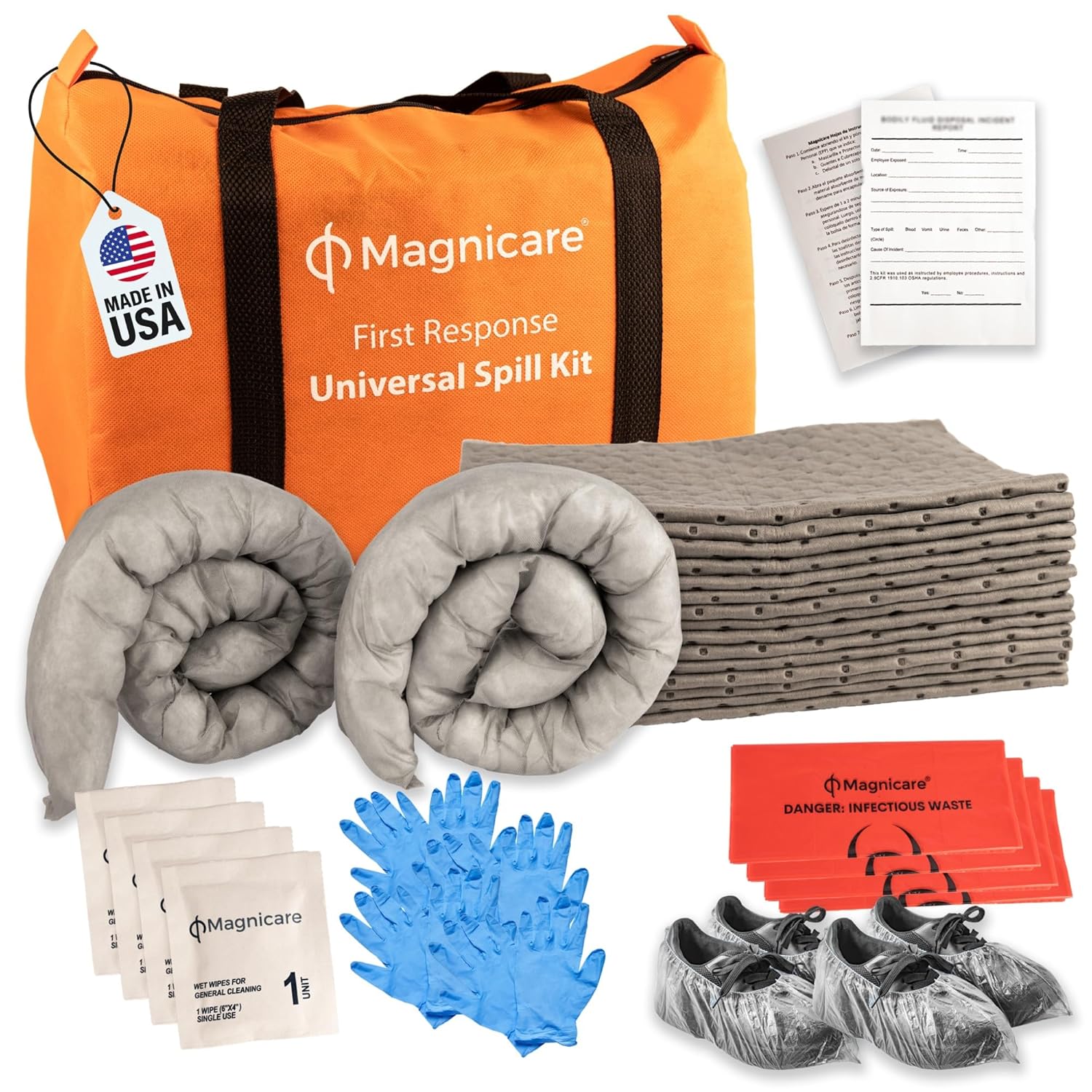
Put a kit within a minute of every part of the floor. Our Bloodborne Pathogen & Vomit Cleanup Kit (BAG) carries absorbent powder, full PPE, a scraper and scoop, a biohazard bag and an incident report in a format one person grabs on the way to the spill. For a fixed, auditable station, the Bodily Fluid Clean Up Kit (BOX) holds the same contents in a form that inventories cleanly at open and close.
A procedure without supplies is paperwork. Supplies without a procedure is a shelf. You need both, and the whole thing costs less than one closed evening. Compare Magnicare cleanup kits →
This article summarizes the FDA Food Code, CDC guidance and OSHA standards in plain language and quotes them directly. It is not legal advice. The Food Code is a model code adopted separately by each state, sometimes on an earlier edition or with amendments, and your local health department may impose additional requirements. Always work from the version your own regulator has adopted.