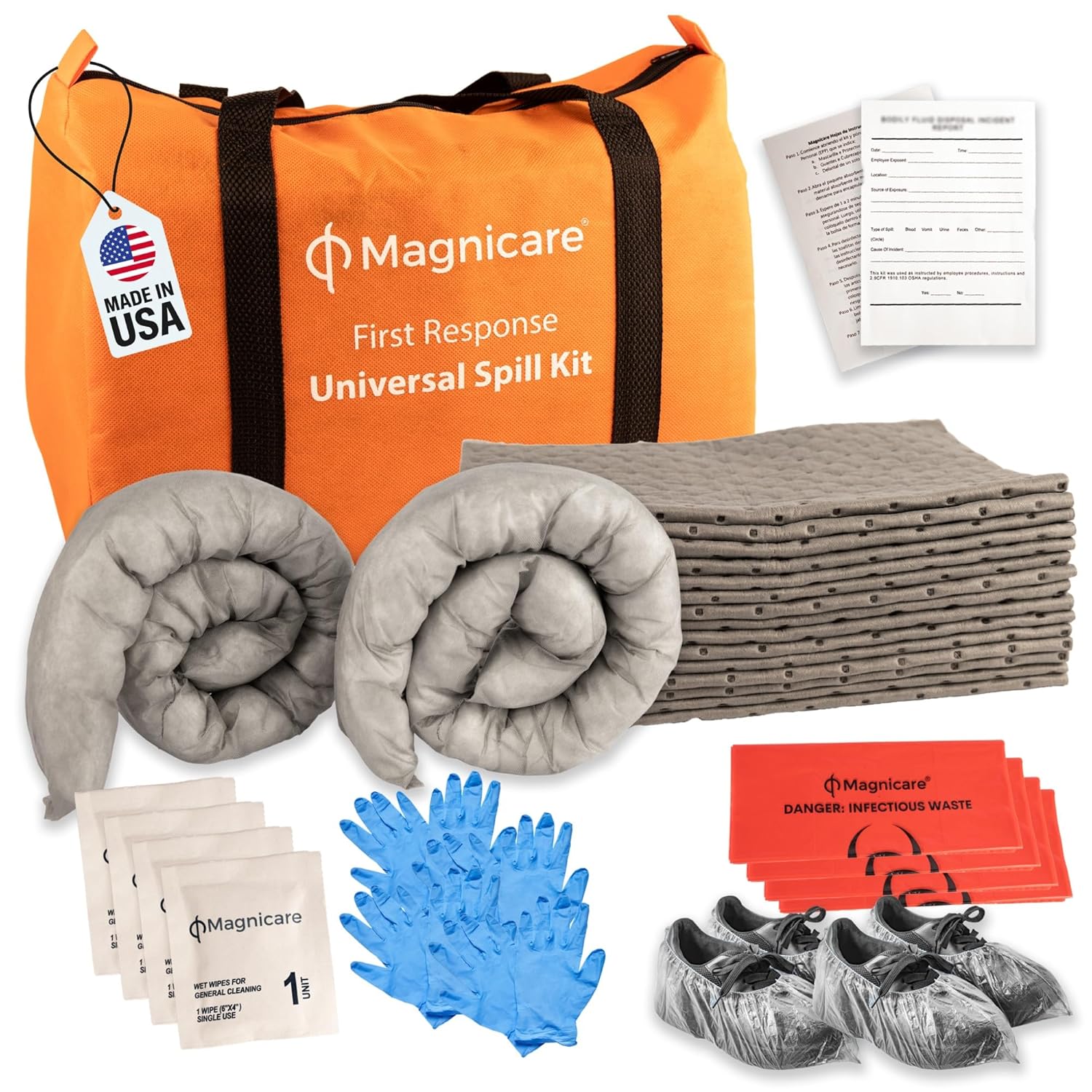
A bloodborne pathogen kit is a self-contained set of barrier PPE, absorbent, and waste-containment supplies for cleaning a blood spill without touching it. No federal rule publishes a contents list. OSHA regulates the protection and the waste handling, not the packaging — so a kit is judged on whether it satisfies those duties, item by item.
That distinction matters, because "bloodborne pathogen kit" is a shopping term, not a regulatory one. Two kits at the same price can differ enormously in what they actually let you do.
This guide walks the contents list the way a safety manager would: what each item is for, which paragraph of the standard it answers to, and where the cheap kits quietly cut corners.
What is a bloodborne pathogen kit, and when do you actually need one?
It is a grab-and-go kit that lets one person contain, absorb, collect and dispose of a blood spill while staying fully separated from it. Everything is single-use. Nothing gets carried back to a supply closet afterward.
The trigger for needing one is a specific legal term. OSHA defines occupational exposure as "reasonably anticipated skin, eye, mucous membrane, or parenteral contact with blood or other potentially infectious materials that may result from the performance of an employee's duties" (29 CFR 1910.1030(b)).
"Reasonably anticipated" is the operative phrase. It does not require that anyone has been exposed. It asks whether, given the work, exposure is foreseeable.
A restaurant manager who will eventually deal with a customer's nosebleed, a school custodian, a hotel housekeeper, a gym cleaner, a cosmetology instructor — all of these are foreseeable. If you are weighing this kit against something marketed as a biohazard kit, the two are not the same category, and we put their scope side by side in biohazard cleanup kit vs bodily fluid kit. That is why the buyer for a cleanup kit is so rarely a hospital.

Why the urgency is real, not marketing
Hepatitis B is the reason blood spills are treated differently from other messes. The CDC states that the virus "is infectious for at least 7 days on surfaces" (CDC, Clinical Overview of Hepatitis B).
A spill that was wiped with paper towels on Monday is not automatically safe on Thursday. That single fact is what turns "clean it up" into a documented procedure with PPE attached.
Is there an official OSHA list of what belongs in the kit?
No. There is no federal contents list for a bloodborne pathogen kit, and no such thing as an OSHA-approved or OSHA-certified one. OSHA does not approve, certify or endorse commercial products — a position the agency has stated in standard interpretation letters going back to 1976-07-07 and restated on 1993-09-15.
Any seller advertising an "OSHA certified bloodborne pathogen kit" is either careless or hoping you will not check. We covered the full history of that claim in our guide to what the standard really says about "OSHA approved" spill kits.
What exists instead is a set of duties. The standard tells you what protection must be available, what condition it must be in, and how the waste must be contained. A kit is simply the most practical way to satisfy several of those duties at once, in one grab.
Buy against the duties, not against the label. A kit that satisfies eight paragraphs of the standard is worth more than one with a compliance badge printed on the lid.
Which OSHA paragraphs does each kit item answer to?
This is the table to shop with. Each row is a real requirement from 29 CFR 1910.1030, matched to the item that satisfies it.
| Requirement | Citation | Kit item that answers it |
|---|---|---|
| PPE provided at no cost, and "appropriate" — meaning it does not permit blood to pass through to work clothes, skin, eyes or mucous membranes under normal conditions of use | 1910.1030(d)(3)(i) | The kit as a whole |
| PPE in appropriate sizes "readily accessible at the worksite or issued to employees" | 1910.1030(d)(3)(iii) | Kit stored on the floor where incidents happen — not in a locked office |
| Gloves worn whenever hand contact with blood is reasonably anticipated | 1910.1030(d)(3)(ix) | Disposable gloves |
| Disposable gloves replaced as soon as practical when contaminated, torn or punctured | 1910.1030(d)(3)(ix)(A) | More than one pair per kit |
| Masks with eye protection, or chin-length face shields, whenever splashes, spray, spatter or droplets may be generated | 1910.1030(d)(3)(x) | Mask with face shield |
| Appropriate protective clothing — gowns, aprons or similar outer garments | 1910.1030(d)(3)(xi) | Disposable apron; shoe covers for floor-level work |
| Regulated waste in containers that are closable, leak-proof, and labeled or color-coded | 1910.1030(d)(4)(iii)(B)(1) | Red biohazard bags with ties |
| Hands washed immediately or as soon as feasible after removing gloves or other PPE | 1910.1030(d)(2)(v) | Not in most kits — see below |
| Written schedule for cleaning and decontamination, based on location, surface and task | 1910.1030(d)(4)(i) | Instruction sheet supports it; the written schedule is yours to produce |
Note the last two rows. They are the ones most buyers miss, and they are the reason a kit alone is not a compliance program. Our guide to the blood spill procedure, waste rules and the compliance program around the kit covers what has to happen once the kit is opened, and our breakdown of the full 1910.1030 kit requirements covers the paperwork side in detail.
The seven components worth checking before you buy
Contents lists are written to look generous. These are the seven places where the real differences hide.
1. Absorbent — volume, not presence
Almost every kit lists "absorbent powder." Very few list how much. A solidifier turns liquid into a gel you can scrape up as a solid, which is the entire point — it means no mopping, no wringing, no splash.
Ask what volume of liquid a single kit's absorbent is rated to solidify. A sachet sized for a teaspoon of blood is not sized for a laceration on a tile floor.
2. Face protection, not just a mask
Paragraph (d)(3)(x) pairs masks with eye protection — goggles, glasses with solid side shields, or a chin-length face shield. A plain procedure mask on its own does not satisfy it where splashes may be generated.
Kneeling over a floor spill with a scraper is exactly the scenario the paragraph describes. Look for a mask that integrates a shield, or a mask plus separate eye protection.
3. Gloves — count and material
One pair is a design flaw. Paragraph (d)(3)(ix)(A) requires replacement as soon as a glove is torn or punctured, and a scraper plus broken glass is how gloves get punctured.
Two pairs is the working minimum. Double-gloving for the collection step, then a fresh outer pair for the disinfection step, is standard practice.

4. A scraper you can actually throw away
The scoop-and-scraper pair is what keeps the response contactless. Once the absorbent has gelled the spill, you lift it as a solid and drop it straight into the bag.
Reusable dustpans defeat this. Anything that gets used should leave with the waste.
5. Red bags that meet the container rule
Paragraph (d)(4)(iii)(B)(1) is specific: regulated waste containers must be closable, constructed to contain all contents and prevent leakage, labeled or color-coded, and closed before removal.
That means a bag with a working closure and a biohazard marking — not a kitchen liner. Sites that respond more than occasionally usually keep a separate box of red biohazard bags so the kit is never the limiting factor.
6. Written instructions your staff can read
The person who opens the kit is rarely the person who bought it. They are often nineteen, on shift, and have never done this before.
An instruction sheet inside the kit — in every language your floor speaks — is worth more than any single item in it. Both Magnicare kits ship with instructions in English and Spanish.
7. An incident report form
This is the item buyers skip and inspectors ask for. If an employee is exposed, the standard's post-exposure obligations start immediately, and they start from a record.
A form in the kit means the record gets written while the details are fresh, not reconstructed three weeks later.
What does a corner-cutting kit look like?
After the seven checks, the pattern is easy to see. These are the signals that a kit is priced low because it does less.
- "OSHA approved" or "OSHA certified" on the label. No such designation exists. It tells you the seller has not read the standard.
- A contents list with no quantities. "Gloves, mask, apron" without counts usually means one of each.
- A mask with no eye protection. Fails (d)(3)(x) in the exact scenario the kit is sold for.
- No absorbent volume stated. The single most common omission.
- Clear or untinted waste bags. Fails the labeled-or-color-coded requirement in (d)(4)(iii)(B)(1).
- No instruction sheet. The kit assumes training it cannot verify you have.
- A sharps container included in a general-purpose kit. Not a red flag exactly, but check it is genuinely puncture-resistant per (d)(4)(iii)(A)(1) rather than a rigid plastic tub.
Bag or box: which format fits your site?
Magnicare ships the same contents in two formats, and the choice is genuinely about where the kit lives rather than what it holds.
| Bag format | Box format | |
|---|---|---|
| Best for | Vehicles, mobile response, tight back-of-house, carrying to the incident | Fixed wall or shelf station, storerooms, front-of-house cabinets |
| Handling | Soft-sided, carried by hand to the spill | Stacks and sits square on a shelf |
| Visibility | Grab handle; easy to spot in a locker | Presents as a station; easier for staff to find unprompted |
| Typical buyer | Food trucks, rideshare and shuttle fleets, cosmetology and tattoo studios, schools with bus routes | Restaurants, retirement homes, offices, retail floors, gyms |
| Contents | Identical: absorbent powder, wipes, disposable gloves, mask with face shield, shoe covers, apron, scraper, biohazard bags, instructions in English and Spanish, incident report form | |

Most multi-room sites end up with both — a box-format cleanup kit as the main station and a bag-format kit for whoever has to walk to the incident.
What is deliberately not in a cleanup kit?
Three things sit outside almost every bloodborne pathogen kit on the market. Each is separately required, and none of them is an oversight. A fourth sits outside it for a different reason altogether — the workplace first aid kit answers a completely separate standard, and we set out what OSHA's first aid kit rule actually requires and where a cleanup kit takes over.
An EPA-registered disinfectant
Absorbent removes the spill. Disinfectant treats the surface underneath it, and that is a second, separate step.
Disinfectants are pesticides under federal law and are registered by the EPA rather than OSHA. The EPA publishes List S — registered antimicrobial products effective against bloodborne pathogens, covering HIV, hepatitis B and hepatitis C. Check the EPA registration number on the label against that list.
The EPA is explicit that "a product's effectiveness can change depending on how you use it," and that you must follow the label directions for the specific pathogen, "including the contact time." Contact time is the number people skip. A disinfectant that needs four minutes of visible wetness does nothing if it is wiped dry in twenty seconds.
Hand-washing
Paragraph (d)(2)(v) requires that employees wash their hands immediately or as soon as feasible after removing gloves. Paragraph (d)(2)(iii) requires readily accessible handwashing facilities.
Where that is not feasible — a food truck, a shuttle bus, an outdoor site — (d)(2)(iv) allows "an appropriate antiseptic hand cleanser in conjunction with clean cloth/paper towels or antiseptic towelettes." The standard is clear that this is a stopgap: hands must still be washed with soap and running water as soon as feasible.
If your kit will be used away from a sink, add sanitizer and towelettes to it yourself.
A sharps container
Contaminated sharps have their own container rule under (d)(4)(iii)(A)(1): closable, puncture-resistant, leak-proof on sides and bottom, and labeled or color-coded. A biohazard bag does not meet it.
If broken glass or needles are foreseeable at your site, a proper sharps container is a separate purchase — not something to improvise from what is in the kit.
How many kits do you need, and where should they live?
The governing phrase is in (d)(3)(iii): PPE must be "readily accessible at the worksite." Readily accessible is a distance test, not an inventory test.
One kit in a locked manager's office fails it. So does one kit on the third floor of a building where the incident happens in the basement.
- Map where blood incidents actually happen. Entrances, restrooms, kitchens, stairwells, loading docks, dining floors.
- Place a kit within roughly one minute's walk of each. If someone has to leave the floor to fetch it, place another.
- Do not lock it. A kit behind a key that only a manager holds is not readily accessible on a Saturday night.
- Tell every shift where it is. Put it in the onboarding walk-through, not just the safety binder.
- Add a second on any floor with a single kit and a high incident rate. One response consumes the whole kit.

Sites that respond regularly usually stop buying one at a time. Multi-packs exist for exactly this — a kit per floor, plus a spare, so a single incident never leaves the building without coverage.

When should a kit be restocked or replaced?
A bloodborne pathogen kit is single-use in the truest sense. One incident consumes it.
The failure mode is predictable: someone uses the kit, the bag goes in the waste stream, and nobody reorders. Six weeks later the next incident finds an empty shelf.
- Immediately after any use. Replace the kit the same week. There is no partial restock — the PPE inside was designed to leave with the waste.
- Quarterly inspection. Confirm the kit is present, sealed, and in its assigned location. Check that nobody has raided it for gloves.
- When PPE is borrowed. The most common cause of an incomplete kit is staff taking gloves from it for unrelated tasks. Keep a separate glove box nearby so the kit is never the convenient option.
- On any relocation or remodel. If the floor plan changes, re-run the accessibility map.
- When the standard's scope changes for you. New equipment, new services, or a new shift pattern can change what is reasonably anticipated.
If your site also handles vomit and other bodily fluids — which is most foodservice and care settings — our guide to choosing and using a vomit cleanup kit in a restaurant covers the non-blood side of the same problem.
Frequently Asked Questions (FAQ)
Is there an OSHA-approved bloodborne pathogen kit?
No. OSHA does not approve, certify or endorse any commercial product, a position stated in agency interpretation letters dated 1976-07-07 and 1993-09-15. A kit can help you meet the requirements of 29 CFR 1910.1030, but no kit can be "OSHA certified."
What must a bloodborne pathogen kit contain?
There is no federal contents list. In practice a kit needs disposable gloves (more than one pair), a mask with eye or face protection, a disposable apron, shoe covers, an absorbent that solidifies liquid, a disposable scraper and scoop, red biohazard bags that close and are labeled, wipes, written instructions, and an incident report form.
How long does hepatitis B survive in dried blood on a surface?
The CDC states that hepatitis B virus is infectious for at least 7 days on surfaces. This is why a blood spill requires disinfection of the surface after the spill itself has been removed, rather than wiping alone.
Does a bloodborne pathogen kit include disinfectant?
Usually not, and that is deliberate. Disinfectants are EPA-registered products with pathogen-specific contact times, so they are selected and stocked separately. Check a product's EPA registration number against EPA List S for bloodborne pathogens, and follow the label's contact time.
Do I need a sharps container as well as a biohazard bag?
If contaminated sharps are foreseeable at your site, yes. OSHA 1910.1030(d)(4)(iii)(A)(1) requires sharps containers that are closable, puncture-resistant, leak-proof on sides and bottom, and labeled or color-coded. A biohazard bag does not satisfy the puncture-resistance requirement.
Is vomit or urine covered by the bloodborne pathogens standard?
Not automatically. Under 29 CFR 1910.1030, vomit, urine, feces and saliva are only treated as other potentially infectious materials when they are visibly contaminated with blood, when it is impossible to differentiate between body fluids, or — for saliva — in dental procedures. They still need cleaning up properly; they are simply governed by other rules.
How many bloodborne pathogen kits does a business need?
Enough that PPE is "readily accessible at the worksite" under 1910.1030(d)(3)(iii). Practically, that means one kit within about a minute's walk of each area where an incident is foreseeable, unlocked, and known to every shift — and a replacement ordered the same week any kit is used.
Should I buy the bag or the box format?
The contents are identical. Choose the bag when the kit has to travel to the incident or live in a vehicle or tight space; choose the box when it will sit as a fixed station on a shelf or in a cabinet. Sites with several floors commonly keep both.
Get the right kit on the shelf before you need it
The kit you want is the one a nineteen-year-old on a Saturday shift can open, follow, and finish without ever touching what they are cleaning. That means two pairs of gloves rather than one, a mask that actually protects the eyes, enough absorbent for a real spill, a bag that closes and is marked, and instructions in the languages your floor speaks.
Magnicare builds both formats to that spec, with the incident report form included so the paperwork happens while the details are fresh.
Compare the bag format and the box format, or browse the full range of blood and bodily fluid cleanup kits to work out how many stations your site needs.
Published by the Magnicare Safety Team. This article is general guidance, not legal advice. Regulatory requirements vary by jurisdiction and by the specifics of your worksite — consult the current text of the standard and your state plan where one applies.