OSHA's entire eyewash requirement is one sentence. 29 CFR 1910.151(c) requires suitable facilities for quick drenching or flushing of the eyes and body, within the work area, for immediate emergency use — wherever the eyes or body may be exposed to injurious corrosive materials. It sets no flush duration, no flow rate, no temperature and no distance.
Every familiar number attached to eye wash station requirements osha — fifteen minutes, ten seconds, a tepid temperature band — comes from a private consensus standard that OSHA has stated in writing it never adopted.
That does not make those numbers worthless. It changes what they are: guidance an inspector may weigh, rather than a rule you can point at. This article separates the two, and names the one place in the whole topic where OSHA does give a distance.
What does OSHA actually require for an eye wash station?
Paragraph (c) of 1910.151 is the whole general-industry rule, and it reads as follows.
“Where the eyes or body of any person may be exposed to injurious corrosive materials, suitable facilities for quick drenching or flushing of the eyes and body shall be provided within the work area for immediate emergency use.” — 29 CFR 1910.151(c)
There is no second paragraph, no appendix of specifications, and no separate eyewash standard elsewhere in Part 1910. We took the whole of Subpart K apart in our guide to what OSHA's first aid rule requires and where a cleanup kit takes over, so this article starts from that foundation rather than repeating it.
Four words in that sentence do all the work, and every practical question comes back to one of them.
| Word in the rule | What it decides | What OSHA does not say |
|---|---|---|
| Injurious corrosive materials | Whether the rule applies to you at all | No list of chemicals, no pH cut-off, no concentration threshold |
| Suitable | What kind of facility is good enough | No flow rate, no volume, no water temperature, no equipment type |
| Within the work area | Where the facility has to be | No distance in feet and no travel time |
| Immediate emergency use | How fast it has to work when reached | No flush duration and no activation interval |
This is performance language, the same drafting style OSHA used for adequate first aid supplies. It asks you to justify a judgement rather than match a catalogue, which is harder to buy your way out of and easier to defend when you have done the thinking.
What does suitable mean when the rule gives no specifications?
Suitable is measured against the hazard, not against a product category. The test is whether the facility you provided would actually get that chemical off that person's eyes fast enough to prevent injury.
Three things follow from reading the word honestly.
- It is chemical-specific. A dilute detergent splash and a pH 1 acid splash are not the same emergency, and a facility that answers the first may not answer the second.
- It is quantity-specific. A single sealed litre bottle decanted twice a month is a different exposure from an open transfer of a fifty-five gallon drum.
- It is task-specific. The rule follows the work, not the building. A unit that is suitable for a bench where corrosives are decanted is not automatically suitable for the yard where they are unloaded.
What makes this defensible in practice is writing the reasoning down. If you decided a portable unit was suitable for a low-volume decanting bench, record why: the chemical, the quantity, the frequency, and what you concluded. A written judgement is evidence; a bare purchase is not.
The same logic governs PPE selection, where OSHA does spell out the paperwork. Under 29 CFR 1910.132(d)(1) an employer must assess the workplace for hazards requiring PPE, and (d)(2) requires that assessment to be verified by written certification. Nothing stops you documenting the drenching decision in the same assessment, and it is the most useful half-hour in this topic.
What does immediate emergency use mean in practice?
Immediate is the strictest word in the sentence, and it is the one most installations fail on. A facility that exists but cannot be reached and used at once does not satisfy paragraph (c) however good the hardware is.
Four failures come up again and again, and none of them are equipment problems.
- The unit is behind a locked door, a closed office or a stairwell. Somebody with a chemical in their eyes cannot navigate.
- The path passes through the spill. If the only route to the station crosses the area where the release happened, it is not available for immediate use.
- It needs two hands, a key or a step stool. Immediate means usable by a person who cannot see.
- Nobody knows it is there. A facility that is not part of training is a facility that will not be used in the first thirty seconds, which are the only ones that matter.
OSHA gives no distance, so the practical test is a walk-through: stand at the point where the chemical is handled, close your eyes, and see whether you could reach and operate the facility. If the answer is no, the hardware is not the problem.
Where do the fifteen-minute and ten-second figures come from?
They come from ANSI/ISEA Z358.1, a private consensus standard published by the American National Standards Institute and the International Safety Equipment Association. It is the document behind essentially every eyewash figure circulating online.
OSHA has addressed its status directly, and the wording leaves no room for interpretation.
“ANSI standards become mandatory OSHA standards only when, and if, they are adopted by OSHA; ANSI Z358.1 was not adopted by OSHA.” — OSHA letter of interpretation, 28 March 2002
The agency repeated the same sentence in a second letter three weeks later, and added the consequence that matters most to anyone worried about a citation.
“Since OSHA has a standard related to drenching/flushing facilities, any citation for the failure to provide suitable drenching/flushing facilities must be issued pursuant to 29 CFR 1910.151(c).” — OSHA letter of interpretation, 18 April 2002
Read together, those two sentences settle the legal question. A compliance officer cannot cite you under Z358.1, because Z358.1 is not a standard OSHA enforces. Any citation has to be written against the one sentence in paragraph (c).
We are deliberately not reproducing Z358.1's figures here. It is a paywalled private document. Quoting flush durations, flow rates, travel distances or temperature ranges as though they were federal requirements would mean publishing numbers from a standard we have not read, and this blog does not do that. It is the same position we took on the ANSI first aid kit standard and on whether an OSHA approved spill kit exists at all.
If you want the figures, buy the standard from ANSI or ISEA. If a supplier quotes them at you, they are quoting a document they are usually not licensed to reproduce either.
If ANSI Z358.1 is not an OSHA standard, why does it still matter?
Because OSHA says it will look at it. In the same 2002 letter, the agency explained how an unadopted consensus standard still bears on an inspection.
“OSHA, therefore, has often referred employers to ANSI Z358.1 as a recognized source of guidance for protecting employees…” and “OSHA would also take the ANSI standard into consideration when evaluating the adequacy of the protection provided by an employer.” — OSHA letter of interpretation, 28 March 2002
That gives Z358.1 a precise and limited role. It is one of the yardsticks OSHA may use to judge whether what you provided was suitable under paragraph (c). It is evidence, not a safe harbour.
The distinction has two practical consequences, and they cut in opposite directions.
| What people assume | What the letters actually establish |
|---|---|
| A unit built to Z358.1 means you are compliant | Compliance is judged against 1910.151(c) and the hazard in your work area. Good hardware helps; it does not settle the question. |
| A unit not built to Z358.1 means you are in violation | There is no violation of Z358.1 to commit. The question is whether your provision was suitable for your hazard. |
| OSHA enforces the fifteen-minute flush | OSHA has never put a flush duration in the CFR. A citation must issue under paragraph (c). |
| Consensus standards are irrelevant because they are voluntary | OSHA says it refers employers to Z358.1 and will take it into consideration. Ignoring it entirely is not a defence. |
The sensible posture for a small business is to treat Z358.1 as the reference point the industry uses, without ever describing your own setup as legally compliant because of it. Describe it as suitable for the hazard you assessed, and keep the assessment.
Which materials actually trigger the requirement?
Paragraph (c) applies where the eyes or body may be exposed to injurious corrosive materials. OSHA does not define that phrase in the standard and publishes no chemical list, so the answer lives in the safety data sheet for whatever you store.
Under 29 CFR 1910.1200(g)(2), every safety data sheet carries sixteen numbered sections in a fixed order, and three of them answer this question between them.
- Section 2, hazard identification. Skin corrosion and serious eye damage classifications appear here. This is the fastest read.
- Section 9, physical and chemical properties — designation (g)(2)(ix). pH lives here, and a pH at either extreme is the clearest single indicator.
- Section 4, first aid measures. If the manufacturer's own instruction is to flush the eyes with water, the manufacturer has already told you the trigger is met.
Section 4 is the one most people never think to check, and it is often the most decisive. A manufacturer telling you to rinse the eyes immediately is hard to reconcile with a decision that no drenching facility is needed where that product is handled.
Two cautions on the boundaries. A material does not have to meet a waste-classification threshold to be injurious to an eye — the RCRA corrosivity test at 40 CFR 261.22(a)(1), pH at or below 2 or at or above 12.5, describes hazardous waste, not the reach of 1910.151(c). And dilution matters: the same concentrate can sit on either side of the line depending on how you use it.

Our guide to matching a spill kit to the chemicals on your shelves works through the relevant SDS sections family by family, and the comparison of universal, oil-only and HazMat kits covers where a general-purpose kit stops being the right answer.
Is there anywhere OSHA does give a distance?
Yes — once, in construction, for batteries. It is the only hard distance figure in the entire subject, and it is worth knowing precisely because of how narrow it is.
“Facilities for quick drenching of the eyes and body shall be provided within 25 feet (7.62 m) of battery handling areas.” — 29 CFR 1926.441(a)(6)
Three things about that sentence repay attention.
It is a construction standard. It sits in Part 1926, under the general requirements for batteries and battery charging. It does not import a twenty-five-foot rule into general industry.
The very next paragraph is about the floor, not the person. Paragraph (a)(7) requires facilities for flushing and neutralizing spilled electrolyte and for fire protection — a separate duty that is often confused with the eyewash one.
General industry gets the floor duty without the distance. For powered industrial trucks, 29 CFR 1910.178(g)(2) requires facilities for flushing and neutralizing spilled electrolyte, for fire protection, for protecting charging apparatus from damage by trucks, and for adequate ventilation for dispersal of fumes from gassing batteries. Note what is absent: it addresses spilled electrolyte rather than the eyes, and it states no distance.

| Provision | Applies to | What it requires | Distance stated |
|---|---|---|---|
| 1910.151(c) | General industry, injurious corrosive materials | Suitable quick drenching or flushing of eyes and body, within the work area, for immediate emergency use | None |
| 1926.441(a)(6) | Construction, battery handling areas | Quick drenching of the eyes and body | 25 feet (7.62 m) |
| 1926.441(a)(7) | Construction, battery handling areas | Flushing and neutralizing spilled electrolyte, and fire protection | None |
| 1910.178(g)(2) | General industry, powered industrial truck battery charging | Flushing and neutralizing spilled electrolyte, fire protection, protection of charging apparatus, ventilation | None |
If your operations span both general industry and construction, 1926.50(g) carries the quick-drench sentence in identical words to 1910.151(c). You are applying the same sentence from two places, with one extra distance figure where batteries are handled on a construction site.
Does the eyewash rule cover blood and infectious material?
No, and this is the most consequential thing in the article, because it is where two purchases people make for the same reason turn out to sit under different rules.
A reader asked OSHA in 2020 whether a portable eyewash solution was adequate for employees whose eyes had been exposed to blood. OSHA's answer opened by removing 1910.151(c) from the conversation entirely.
“The OSHA standard you note at the beginning of your letter does not apply here. It applies only to exposure to corrosive materials.” — OSHA letter of interpretation, 6 November 2020
The rule that does apply is the bloodborne pathogens standard. OSHA continued that 29 CFR 1910.1030 covers reasonably anticipated work exposure to blood and other potentially infectious materials, and set out what it expects.
“The standard prioritizes methods to prevent blood or OPIM from contacting eyes or mucous membranes, but also requires the rapid flushing of mucous membranes with water.” — OSHA letter of interpretation, 6 November 2020
That flushing duty has its own paragraph. Under 1910.1030(d)(2)(vi), employers must ensure that employees wash hands and any other skin with soap and water, or flush mucous membranes with water, immediately or as soon as feasible following contact of such body areas with blood or other potentially infectious materials.
And prevention comes first. Paragraph (d)(3)(x) requires masks in combination with eye protection such as goggles or glasses with solid side shields, or chin-length face shields, whenever splashes, spray, spatter or droplets of blood or other potentially infectious materials may be generated and eye, nose or mouth contamination can reasonably be anticipated.
OSHA then made a point that matters for anyone sizing a station for a blood exposure rather than a chemical one.
“Although the requirements in the BBP standard do not specify a minimum volume of eyewash solution for treating employees whose eyes have been exposed to blood or OPIM, the obvious intent of the standard is that blood or OPIM be removed from the eyes. Therefore, sufficient water must be used to accomplish this goal.” — OSHA letter of interpretation, 6 November 2020
So the practical summary is this. For corrosives, the duty is paragraph (c) and the yardstick is suitability. For blood, the duty is 1910.1030 — barrier PPE first, rapid flushing second, and no specified volume. Our walk-through of what 1910.1030 requires in a cleanup kit and the bloodborne pathogen kit buyer's guide cover the PPE half of that.
The common error is buying one station and assuming it discharges both obligations. It discharges neither automatically: the chemical side turns on your SDSs, and the blood side turns on face protection you are supposed to be wearing before anything reaches the eye.
Plumbed, portable or personal: what should you install?
Because the standard specifies no equipment type, all three categories can be suitable in the right place. The honest framing is that they answer different questions.
| Type | Where it fits | What to watch |
|---|---|---|
| Plumbed eyewash or combination drench unit | Fixed locations with a continuous water supply and a drain, where significant quantities of corrosives are handled routinely | Needs plumbing, drainage and a maintenance routine. The most defensible option where the hazard is high and permanent. |
| Gravity-fed or self-contained tank unit | Areas with no practical plumbing but a fixed, known hazard | The fluid is a consumable with a shelf life. Capacity is finite and has to be planned. |
| Portable bottle station | Immediate first response at a bench or a vehicle, and locations where a plumbed facility is impractical or temporary | Smallest capacity of the three. Best understood as the start of a response, not the whole of it. |

The Magnicare Portable Eye Wash Station is the third category, and we would rather describe it accurately than oversell it. The kit is a durable plastic wall mount, two 16 oz bottles with ergonomic eye cups, a built-in mirror for self-application, an emergency sign and the screws and anchors to fit it. It mounts to a wall or moves between locations.
Flushing solution is not included, and the listing says so plainly. Buy the solution with the station, or the station is a bracket. That is true of a great many portable units on the market, and it is the single most common reason a station fails the moment somebody needs it.
Two honest limits on any portable bottle unit, ours included. Its capacity is finite, so where a hazard genuinely calls for prolonged flushing it belongs alongside a plumbed facility rather than instead of one. And no product settles your obligation under paragraph (c) by itself — the assessment does, and the equipment is what the assessment concluded.
What does maintaining an eye wash station involve?
The CFR sets no inspection interval for drenching facilities, which surprises people who have seen weekly-activation tags. Those come from the consensus standard, not from paragraph (c).
What the CFR does say is that the facility must be available for immediate emergency use. A unit that is empty, expired, blocked or seized is not, and that is the hook on which a real citation hangs — not a missed tick on a card.
There is also a general housekeeping duty worth knowing. Under 29 CFR 1910.22(d)(1) walking-working surfaces must be inspected regularly and maintained in a safe condition, and (d)(2) requires hazardous conditions to be corrected before an area is used again. The same discipline sensibly extends to the safety equipment standing in that area.

A defensible routine for a small business takes about two minutes a month.
- Confirm the path. Walk it from the point of use. Nothing stored in front of it, no locked door, no step needed.
- Confirm it is stocked. For a bottle or tank unit, that means solution present and within its expiry date. Write the date on the unit.
- Confirm it operates. Plumbed units get activated; caps and seals on portable units get checked.
- Confirm people know. Ask one employee on shift to point at it. If they hesitate, the problem is training.
- Write it down and date it. An undated check is indistinguishable from no check.
That record is also the cheapest evidence you will ever produce that your provision was suitable and immediately available, which is exactly what paragraph (c) asks.
Frequently Asked Questions (FAQ)
Does OSHA require an eye wash station?
Only where the eyes or body of any person may be exposed to injurious corrosive materials. Where that trigger is met, 29 CFR 1910.151(c) requires suitable facilities for quick drenching or flushing of the eyes and body, provided within the work area for immediate emergency use. Whether it applies to your site is answered by the safety data sheets for what you store and how you handle it.
Does OSHA require a 15 minute eyewash station?
No. There is no flush duration anywhere in 29 CFR 1910.151(c), and no OSHA standard states one. The familiar fifteen-minute figure comes from the private consensus standard ANSI/ISEA Z358.1, which OSHA has stated in writing it never adopted. We do not reproduce figures from that standard because it is paywalled and we have not read it.
Is ANSI Z358.1 an OSHA requirement?
No. In a letter of interpretation dated 28 March 2002 OSHA stated that ANSI standards become mandatory OSHA standards only when, and if, they are adopted by OSHA, and that ANSI Z358.1 was not adopted by OSHA. A second letter of 18 April 2002 added that any citation for failure to provide suitable drenching or flushing facilities must be issued pursuant to 29 CFR 1910.151(c).
If ANSI Z358.1 is not enforceable, can I ignore it?
Not sensibly. OSHA said in the same 2002 letter that it has often referred employers to ANSI Z358.1 as a recognized source of guidance, and that it would take the ANSI standard into consideration when evaluating the adequacy of the protection an employer provided. It is evidence an inspector may weigh against the word suitable, rather than a rule you can be cited under.
How far can an eye wash station be from the hazard?
For general industry, 1910.151(c) states no distance at all. It requires the facility to be within the work area and available for immediate emergency use. The only hard distance in federal eyewash rules is in construction: 29 CFR 1926.441(a)(6) requires facilities for quick drenching of the eyes and body within 25 feet, or 7.62 metres, of battery handling areas.
Does an eye wash station cover blood exposure?
No. In a letter dated 6 November 2020, OSHA stated that 1910.151(c) does not apply to bloodborne pathogen exposure because it applies only to exposure to corrosive materials. Blood and other potentially infectious materials fall under 29 CFR 1910.1030, which prioritises preventing contact through face and eye protection under (d)(3)(x) and requires rapid flushing of mucous membranes with water under (d)(2)(vi).
Is a portable eye wash station enough to comply?
It can be suitable, depending on the chemical, the quantity and the frequency of handling, and it is often the only practical option where plumbing is impossible or the worksite is temporary. Because paragraph (c) specifies no equipment type, what makes any choice defensible is a written assessment of the hazard. Where prolonged flushing is genuinely indicated, a portable unit belongs alongside a plumbed facility rather than instead of one.
Does a portable eye wash station come with solution?
Frequently not, and that includes the Magnicare station, which ships with two empty 16 oz bottles and states plainly that eye wash solution is not included. Always confirm what is in the box and buy the flushing solution with the station. An unstocked or out-of-date station is not available for immediate emergency use, which is the requirement paragraph (c) actually imposes.
Answer the drenching question for your own work area
The honest summary of OSHA eyewash station requirements is that the rule is one sentence, the numbers everyone quotes belong to somebody else's document, and the work is a judgement you write down rather than a product you buy.
So do the half-hour that settles it. Pull the safety data sheets for everything in the area, read Section 2, Section 9 and the first aid instruction in Section 4, and decide whether the trigger is met. If it is, decide what is suitable for that specific hazard and record why.
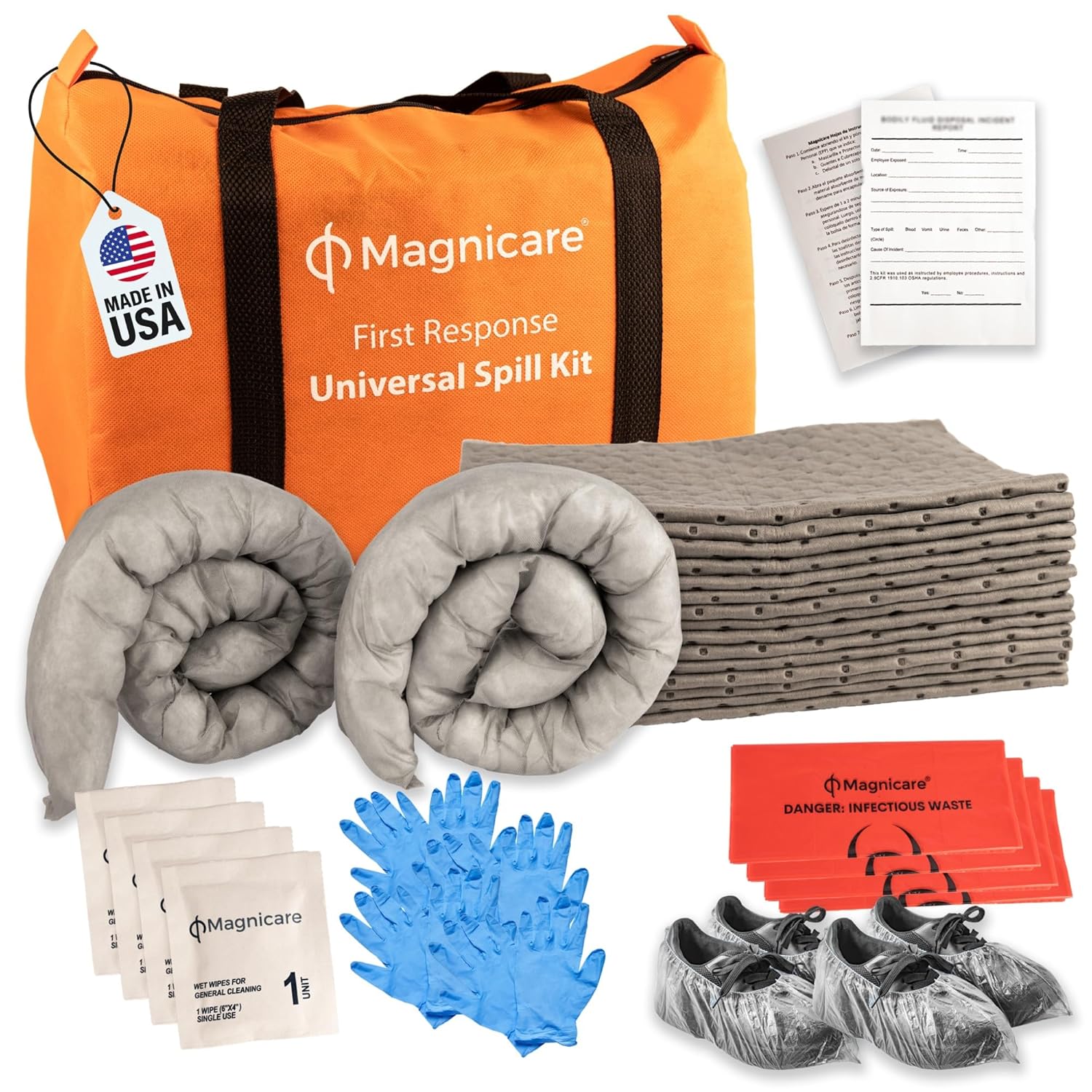
Then equip it properly. The Magnicare Portable Eye Wash Station puts flushing within reach at a bench, a vehicle or a temporary site — wall mount, two 16 oz bottles with eye cups, mirror, emergency sign and fixings, with the solution bought alongside it. Where corrosives are stored, the splash is only half the event, so pair it with the Universal Spill Kit for the floor. And if your site also handles blood or bodily fluids, that is a different standard and a different kit — see the blood and bodily fluid cleanup range.
Do this today: stand where your corrosives are handled, close your eyes, and try to reach the station. That walk tells you more than any specification sheet. See the Magnicare eye wash station →
Published by the Magnicare Safety Team. This article quotes 29 CFR 1910.151(c), 29 CFR 1926.441 and OSHA letters of interpretation directly, and is general guidance rather than legal advice. Requirements vary by jurisdiction, and states operating their own OSHA-approved plans may impose stricter rules. Always work from the current text of the standard.