OSHA does not approve PPE kits. For a bodily fluid cleanup it requires your employer to provide, at no cost, equipment that does not let blood reach your skin or your clothes for as long as you wear it, and to have you take it off before you leave the work area. The paragraph is 29 CFR 1910.1030(d)(3).
That last part is where most workplaces fail. Buying gloves is easy and almost everybody does it. Taking them off in the right place, putting them in the right container and washing your hands before touching a door handle is the part that gets skipped, and it is the part the standard writes down in mandatory language.
This article covers what the regulation actually demands of protective equipment, which standard reaches which item, what fit and sizing obligations exist, and the removal rules that turn a pile of supplies into a procedure. For the item by item list of PPE with the paragraph behind each piece, see our restaurant bodily fluid cleanup kit checklist; this article goes after the lifecycle instead.
Is there such a thing as an OSHA approved PPE kit?
No, and the reason is structural rather than a technicality. OSHA does not approve, certify or endorse commercial products at all, a position the agency has stated in its own letters of interpretation, and we set that argument out in full in is there really an OSHA approved spill kit.
So a phrase like OSHA approved PPE kit describes nothing you can verify. What you can verify is whether the equipment in front of you satisfies the performance test the standard writes down, which is a question about your tasks and not about the packaging.
That makes the next section the only one that matters when you are comparing products.
What does OSHA mean when it calls PPE appropriate?
Paragraph (d)(3)(i) requires the employer to provide appropriate personal protective equipment at no cost to the employee, and then defines the word in the same breath. The definition is a barrier test with three moving parts, and each one does separate work.
| The phrase | What it actually asks |
|---|---|
| Equipment is appropriate only if it “does not permit blood or other potentially infectious materials to pass through to or reach”… | The test is penetration, not appearance. A garment that is intact but soaks through has failed it. |
| …“the employee’s work clothes, street clothes, undergarments, skin, eyes, mouth, or other mucous membranes”… | Reaching your uniform counts, not only reaching your skin. A wet patch on a shirt is a failure of the equipment. |
| …“under normal conditions of use and for the duration of time which the protective equipment will be used” | Normal conditions means kneeling, scrubbing and lifting, and the duration is however long the job takes. Both are measured against the real task. |
The duration clause is the one that catches people out. A thin glove may be entirely appropriate for a thirty second contact and inappropriate for a twenty minute cleanup with a scraper in your hand, and the standard judges it against the job you are actually doing.
Notice what is absent. Across the whole of (d)(3) there is no material named, no thickness and no test method cited. A specification printed on a box is the manufacturer describing how its product performed against a consensus standard we have not read, which is legitimate evidence to weigh when you select equipment and is not a regulatory requirement you can point at during an inspection.

Which standard governs PPE for blood and bodily fluids?
Two bodies of rules look like they apply, and knowing which one reaches which item saves a lot of circular argument. The general PPE standard, 29 CFR 1910.132, sets out the hazard assessment and the training; the bloodborne pathogen standard, 1910.1030(d)(3), sets out the equipment itself for blood and other potentially infectious materials.
The general standard limits its own reach. Paragraph 1910.132(g) states that paragraphs (d) and (f) of that section, which are the hazard assessment and the PPE training requirements, apply only to sections 1910.133, 1910.135, 1910.136, 1910.138 and 1910.140, and that they do not apply to 1910.134 and 1910.137.
Read against a bodily fluid cleanup, that scope paragraph sorts your kit into two groups.
| Item | Subpart I section | Reached by the 1910.132(d) assessment and (f) training? | Covered by 1910.1030(d)(3)? |
|---|---|---|---|
| Disposable or utility gloves | 1910.138, hand protection | Yes | Yes, at (d)(3)(ix) |
| Goggles, glasses with side shields, face shields | 1910.133, eye and face protection | Yes | Yes, at (d)(3)(x) |
| Aprons, gowns, protective body clothing | None | No | Yes, at (d)(3)(xi) |
| Shoe covers, boots, caps and hoods | 1910.136 covers footwear against falling or rolling objects, sole punctures and electrical hazards, not contamination | Not for this hazard | Yes, at (d)(3)(xii) |
The useful conclusion is that the overlap creates no gap. Your apron is not outside the rules because Subpart I has no apron section; it is inside 1910.1030, which requires it, requires the employer to pay for it and requires training on it under the communication paragraph. Two routes, one obligation.
Hand protection has its own short section worth reading. 1910.138(a) requires employers to select and require the use of appropriate hand protection where hands are exposed to hazards including skin absorption of harmful substances, and (b) requires that selection to be based on the performance characteristics of the protection relative to the task, the conditions present, the duration of use and the hazards identified. That is the same four part reasoning the bloodborne standard applies to everything else.
Where a cleanup kit sits relative to a first aid kit, including how OSHA hands blood exposure from one to the other by paragraph number, is covered in OSHA first aid requirements and where a cleanup kit fits. Who has to be trained on any of this, and how often, is a separate question with its own answer.
Does OSHA require PPE to fit, and in what sizes?
Yes, on both counts, and the obligation is on the employer rather than on the person who happens to be on shift. Paragraph (d)(3)(iii), headed Accessibility, requires that appropriate equipment in the appropriate sizes be readily accessible at the worksite or issued to employees.
The same paragraph carries a requirement that almost nobody stocks for: hypoallergenic gloves, glove liners, powderless gloves or other similar alternatives must be readily accessible to employees who are allergic to the gloves normally provided. One latex sensitive member of staff is enough to trigger it.
The general standard reinforces the sizing point from another direction. 1910.132(d)(1)(iii) requires the employer to select PPE that properly fits each affected employee, and 1910.132(c) requires all personal protective equipment to be of safe design and construction for the work to be performed. 1910.132(e) adds the obvious corollary that defective or damaged equipment shall not be used.
Use is mandatory, with one narrow escape hatch. Paragraph (d)(3)(ii) requires the employer to ensure the employee uses appropriate equipment, unless the employer shows that the employee temporarily and briefly declined it under rare and extraordinary circumstances, in that employee’s professional judgment, because using it would have prevented the delivery of health care or public safety services or increased a hazard to somebody.
That exception comes with a bill attached: when an employee makes that judgment, the circumstances shall be investigated and documented in order to determine whether changes can be instituted. In other words you are allowed to skip PPE in an emergency and you are not allowed to let it pass without a record.
In what order should PPE go on?
The regulation does not say. It names the items and the circumstances and leaves the choreography alone, which is why two people in the same business will do it differently and both believe they are right.
CDC fills that gap. Its published sequence for putting on protective equipment is gown first, then mask or respirator, then goggles or face shield, then gloves last. The logic is that gloves go on after everything that requires you to reach behind your head, so your hands are the last thing to become a barrier and the first thing to come off.
This is guidance rather than regulation, and the distinction matters when somebody tells you a sequence is required. What is required, for gloves and eye protection, is training on it: 1910.132(f)(1) lists five subjects, and (f)(1)(iii) is how to properly don, doff, adjust and wear PPE.
- (f)(1)(i) When PPE is necessary
- (f)(1)(ii) What PPE is necessary
- (f)(1)(iii) How to properly don, doff, adjust and wear PPE
- (f)(1)(iv) The limitations of the PPE
- (f)(1)(v) The proper care, maintenance, useful life and disposal of the PPE
Paragraph (f)(2) then requires each affected employee to demonstrate an understanding of that training before being allowed to perform work requiring PPE, and (f)(3) requires retraining when the workplace changes, when the equipment changes, or when what you observe tells you the training did not take.

A four step card in the lid of a box is a useful job aid and it is not a training record. The difference between the two, and what a compliant record has to contain, is set out in our guide to bloodborne pathogen training requirements.
Where does OSHA require PPE to come off?
Here the standard stops being general and gets specific, and these are the three sentences to put on the wall. They are the reason a cleanup either contains the contamination or spreads it.
| Citation | Requirement | What it rules out in practice |
|---|---|---|
| 1910.1030(d)(3)(vi) | If a garment is penetrated by blood or other potentially infectious materials, it shall be removed immediately or as soon as feasible. | Finishing the job in a soaked apron because there is only one apron in the kit. |
| 1910.1030(d)(3)(vii) | “All personal protective equipment shall be removed prior to leaving the work area.” | Walking to a bin in the corridor, or to the dumpster outside, still gloved. |
| 1910.1030(d)(3)(viii) | When equipment is removed it shall be placed in an appropriately designated area or container for storage, washing, decontamination or disposal. | A pile on the floor, or the nearest general waste bin, decided on the spot. |
Paragraph (d)(3)(vii) is thirteen words long and it has a consequence nobody plans for: the designated container in (d)(3)(viii) has to be inside the work area, because the equipment cannot legally travel to it. If your red bag lives in a back corridor, your work area boundary and your waste route are in conflict and the cleanup loses.

CDC again supplies the order OSHA leaves out, and it reverses the donning sequence: gloves first, then goggles or face shield, then gown, then mask or respirator, followed by hand hygiene immediately after all of it is off. Its sequence also tells you to remove everything before exiting the room, with a respirator as the single exception, which lands in the same place as (d)(3)(vii).
Two details from that sequence are worth repeating to staff because they are counter intuitive. The outside of the gloves is contaminated and the inside of the gown is not, so every movement is a matter of touching clean surfaces with bare hands and dirty surfaces only with gloves. And hand hygiene is a step, not an afterthought, which is why the end of a cleanup should be a handwash station rather than a door.
How all of this fits into the clock of a live incident, including what changes when you are the only person on shift, is laid out minute by minute in our step by step blood spill procedure.
What are the rules for gloves specifically?
Gloves get their own sub paragraph because they are the item in constant contact and the item most often reused when it should not be. Paragraph (d)(3)(ix) requires gloves when it can be reasonably anticipated that the employee may have hand contact with blood, other potentially infectious materials, mucous membranes and non-intact skin, when performing vascular access procedures, and “when handling or touching contaminated items or surfaces.”
That last clause does more work than people expect. Touching a contaminated item is enough, so the staff member who carries the sealed bag out or wipes down the scraper afterwards is inside the gloving rule even though the spill itself has gone.
Three lettered rules follow, and the difference between the first two and the third is the difference between a disposable and a reusable.
| Citation | Rule |
|---|---|
| (d)(3)(ix)(A) | Disposable gloves such as surgical or examination gloves shall be replaced as soon as practical when contaminated, or as soon as feasible if torn or punctured or if their ability to function as a barrier is compromised. |
| (d)(3)(ix)(B) | “Disposable (single use) gloves shall not be washed or decontaminated for re-use.” |
| (d)(3)(ix)(C) | “Utility gloves may be decontaminated for re-use if the integrity of the glove is not compromised.” |
Paragraph (A) is the one worth reading twice. It sets two different clocks: as soon as practical for contamination, and as soon as feasible for a breach. A glove that has stopped being a barrier is not a glove, and the standard does not ask you to wait for a convenient moment.
A practical consequence for stocking: if the only gloves on site are single use, then every change of gloves mid job consumes a pair, and a kit with four pairs in it is a kit sized for one event rather than for a shift. Count pairs against the number of glove changes a realistic cleanup needs, not against the number of people.
Who pays for PPE, and who has to launder it?
The employer, and there is no version of this where the cost lands on the person doing the cleanup. The bloodborne standard says so in three places and the general standard says so again for Part 1910 as a whole.
| Obligation | Citation |
|---|---|
| Provide appropriate PPE at no cost to the employee | 1910.1030(d)(3)(i) |
| Clean, launder and dispose of PPE at no cost to the employee | 1910.1030(d)(3)(iv) |
| Repair or replace PPE as needed to maintain its effectiveness, at no cost | 1910.1030(d)(3)(v) |
| Protective equipment used to comply with Part 1910 provided at no cost, subject to listed exceptions | 1910.132(h)(1) |
| Employer must pay for replacement PPE, except where the employee has lost or intentionally damaged it | 1910.132(h)(5) |
The laundering rule is the one with a hidden trap in it. If your aprons are reusable, you have taken on an obligation to launder contaminated garments, which means a route, a container and somebody who has been told how to handle them. Disposable aprons move that cost from a laundry process to a line item, which is usually the simpler answer for a business with four people in it.
The exceptions in 1910.132 are narrow and none of them is about contamination. Paragraph (h)(2) covers non specialty safety toe protective footwear and non specialty prescription safety eyewear, and only where the employer permits such items to be worn off the job site; (h)(6) covers equipment an employee already owns and the employer merely allows them to use. Nothing in that list touches gloves, aprons or face protection for a bodily fluid cleanup.
What PPE is in a Magnicare kit, and what is not?
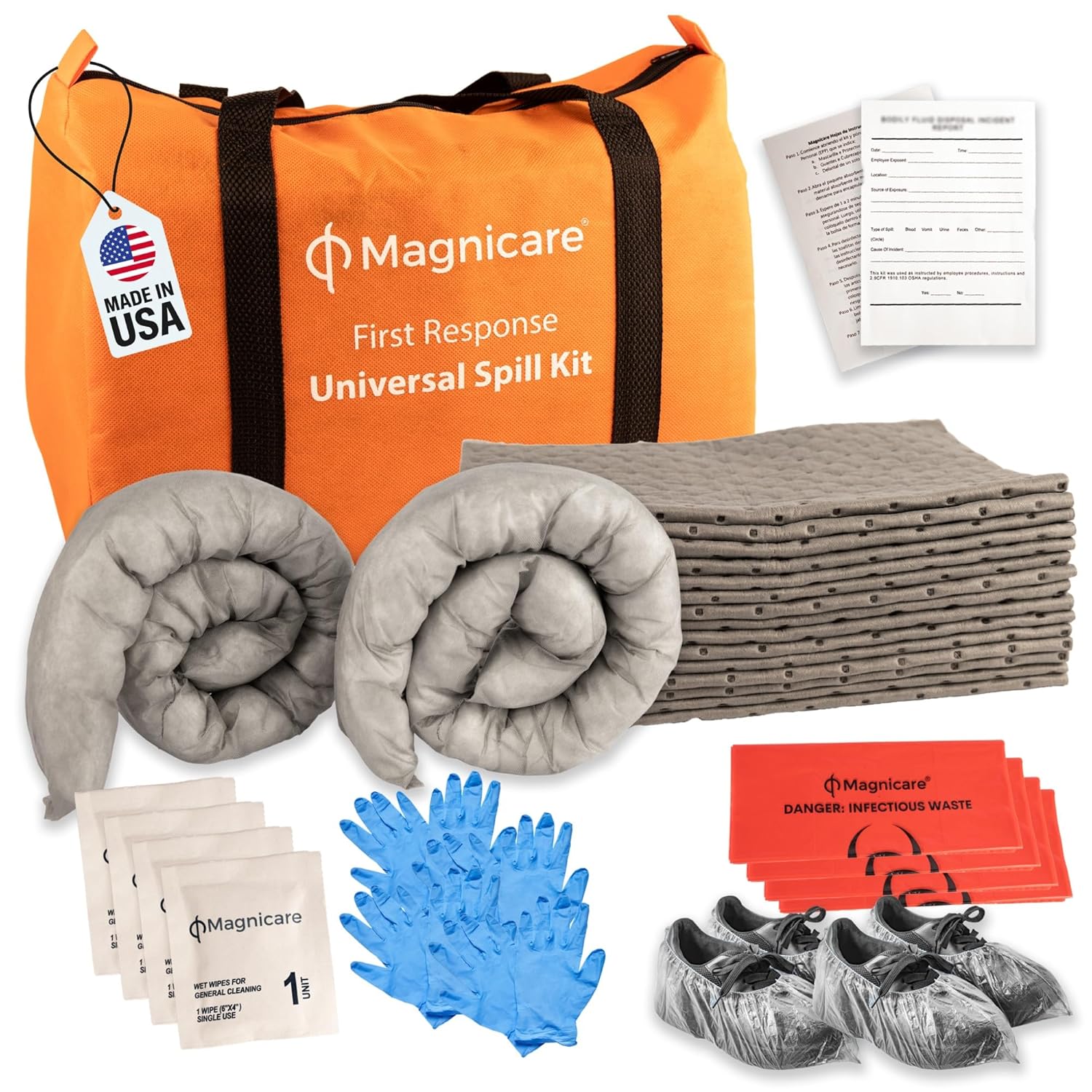
Read from the live listings rather than from memory, because the honest answer to this question is the one that tells you what to buy separately. The two bodily fluid kits are identical in contents; the universal spill kit is a different animal.
| PPE item | Cleanup Kit BAG and BOX | Universal Spill Kit |
|---|---|---|
| Disposable gloves | Listed | Listed, 4 pairs nitrile |
| Face masks with shields | Listed | Not listed |
| Aprons | Listed | Not listed |
| Shoe covers | Listed | Listed, 4 pairs |
| Goggles as a separate item | Not listed | Not listed |
So the Cleanup Kit BAG and the Cleanup Kit BOX each carry a full set for a bodily fluid event: gloves, a face mask with a shield, an apron and shoe covers, alongside absorbent powder, towels or wipes, a scraper, biohazard disposal bags, a bilingual instruction sheet and an incident report form.
The Universal Spill Kit is built for oil, water, coolants and other compatible liquids, and its protective equipment is scoped to that: gloves and shoe covers, no mask and no apron. If you keep one in a vehicle or a workshop and a bodily fluid event happens next to it, the absorbents will help and the PPE set will not be the one this article has been describing. Keep the two kits for the two jobs.
Two things to settle for yourself before an inspector asks. First, whether a face mask with a shield satisfies (d)(3)(x) for your tasks, which depends on whether splash can reasonably be anticipated and is a judgment you should write down either way; our guide to OSHA eyewash station requirements explains why eye protection and eye flushing are two separate duties under two separate standards. Second, where your used equipment goes, because the kit supplies bags and your state decides what may be put in them, which we cover in red bag or trash.
Neither kit is sold with a disinfectant, so confirm your own stock of an EPA registered product with the organism claim you need on its label. The full contents standard for a 1910.1030 kit is set out in our guide to what the standard requires a cleanup kit to contain.
Frequently Asked Questions (FAQ)
Is there such a thing as an OSHA approved PPE kit?
No. OSHA does not approve, certify or endorse any product, including PPE kits. What the agency regulates is performance: the equipment must not let blood or other potentially infectious materials reach your skin or your clothes under normal conditions of use, for as long as you wear it. A kit either meets that test for the work you do or it does not, and no claim on the box answers the question for you.
What PPE does OSHA require for cleaning up blood?
The bloodborne pathogen standard names gloves, gowns and aprons and similar protective body clothing, masks with eye protection or chin length face shields, and caps and shoe covers where gross contamination can reasonably be anticipated. Which of those you actually need depends on the splash and contact you can reasonably anticipate for the task in front of you, not on a fixed packing list.
Where does OSHA require PPE to come off?
Before you leave the work area. That is the whole of 29 CFR 1910.1030(d)(3)(vii), and it is the rule most often broken, usually by somebody walking to a bin in the corridor with contaminated gloves still on. Equipment that has been taken off then goes into an appropriately designated area or container under (d)(3)(viii).
Can disposable gloves be washed and used again?
No. Single use gloves must not be washed or decontaminated for re-use. Heavier utility gloves are treated differently: they may be decontaminated and reused as long as the integrity of the glove is not compromised, which in practice means inspecting them and discarding them once they are cracked, peeling, torn or punctured.
Does OSHA set a glove thickness or a test standard for cleanup PPE?
No. The PPE paragraphs of the bloodborne pathogen standard name no material, no thickness and no test method at all. A specification printed on a glove box is the manufacturer stating how its product performed against a consensus standard, which is useful evidence when you select equipment but is not an OSHA requirement in itself.
In what order should PPE be put on and taken off?
OSHA prescribes no order. CDC publishes one: gown, then mask or respirator, then goggles or face shield, then gloves on the way in, and gloves, then goggles or face shield, then gown, then mask on the way out, with hand hygiene immediately after everything is off. Because 29 CFR 1910.132(f)(1)(iii) makes donning and doffing a required training subject for gloves and eye protection, writing your sequence down is the cheapest way to show that the training happened.
Who pays for cleanup PPE, and who launders it?
The employer, in both cases. PPE is provided at no cost to the employee under 1910.1030(d)(3)(i), the employer cleans, launders and disposes of it at no cost under (d)(3)(iv), and repairs or replaces it under (d)(3)(v). More generally across Part 1910, 1910.132(h)(5) puts replacement on the employer except where the employee has lost or intentionally damaged the equipment.
Does a bodily fluid cleanup kit have to include goggles?
Not as a separate item, and the Magnicare kits do not list goggles separately. They list face masks with shields. Whether that is sufficient turns on whether splashes, spray, spatter or droplets of blood or other potentially infectious materials can reasonably be anticipated in your task, which is the test in 1910.1030(d)(3)(x). Where pressure, height or volume is involved, add dedicated eye protection and record the reason.
Equip the cleanup, then write down how it comes off
Protective equipment is the cheapest part of this standard and the part that fails most visibly. A kit that carries gloves, a face mask with a shield, an apron and shoe covers for every responder, in the sizes your actual staff wear, satisfies the provision rule in one purchase.
The rest costs nothing. Decide where the work area boundary is, put the designated container inside it, write the removal order on a card, and put the handwash station at the end of the sequence instead of the door.

Stock the Cleanup Kit BAG where the mess happens and the Cleanup Kit BOX where it is stored, or browse the full blood and bodily fluid cleanup range to size the right number of responses for your site.
Primary sources used in this article: 29 CFR 1910.1030, 29 CFR 1910.132, 29 CFR 1910.138 and the CDC sequence for putting on and removing personal protective equipment.