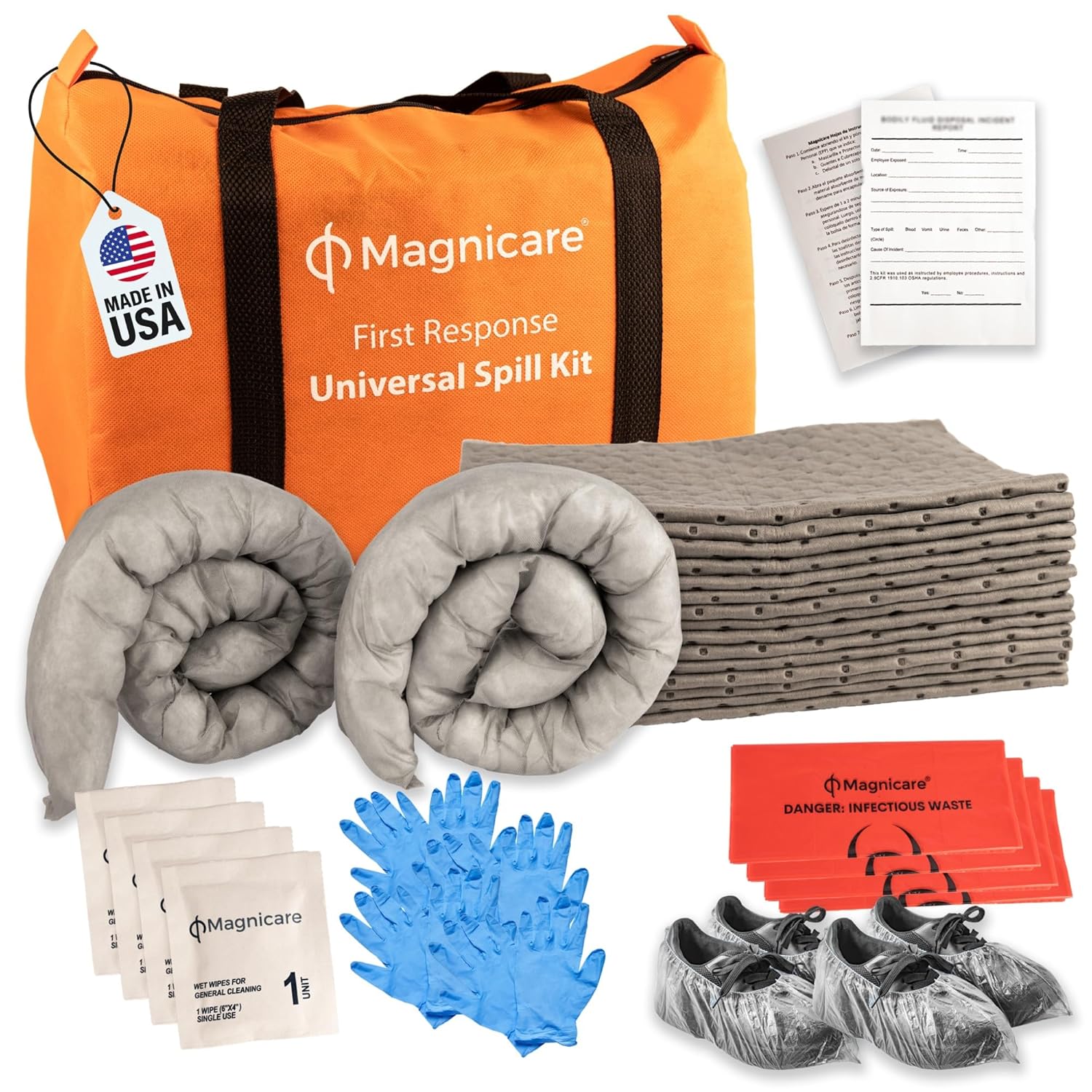
A restaurant bodily fluid cleanup kit must contain, at minimum: disposable gloves, a fluid-resistant gown or apron, a mask with eye protection, an absorbent powder or pad, a scoop and scraper, an EPA-registered disinfectant with a label claim for the pathogen you are worried about, a red biohazard bag, and the written clean-up procedure itself. Everything else is comfort. This page walks the list the way a health inspector walks it — item by item, with the specific rule that puts each one in the box.
The reason the list looks arbitrary until you see the sources is that two different regimes govern the same bucket. The FDA Food Code tells you to have a written procedure and the means to carry it out. OSHA's bloodborne pathogens standard tells you what protective equipment the employee doing the work is owed. A kit that satisfies one and not the other still fails an inspection.
Is a bodily fluid cleanup kit actually required by law?
The kit itself is not named in any federal rule. The capability is, and in practice you cannot demonstrate the capability without the kit.
The FDA Food Code is direct about it. Section 2-501.11 states that "a food establishment shall have written procedures for employees to follow when responding to vomiting or diarrheal events that involve the discharge of vomitus or fecal matter onto surfaces in the food establishment," and that "the procedures shall address the specific actions employees must take to minimize the spread of contamination and the exposure of employees, consumers, food, and surfaces to vomitus or fecal matter."
Read that second sentence carefully. A procedure that says "put on gloves and use the disinfectant" is only a procedure if the gloves and the disinfectant exist. Inspectors treat the written plan and the physical kit as one item, because a plan you cannot execute is not a plan.
The Food Code is a model, not a federal law — states, counties and tribes adopt it, and the edition in force varies by jurisdiction. The current model is the 2022 Food Code, the 10th edition, and it now has a Supplement that materially changes what belongs in your kit. More on that below.
OSHA enters the picture the moment blood is in the mess. Its bloodborne pathogens standard, 29 CFR 1910.1030, applies where employees have reasonably anticipated occupational exposure — and it is the standard that decides who pays for the gloves. We walk that line in detail in our guide to what OSHA actually requires in a cleanup kit.
What does a health inspector actually check?
Inspectors are not auditing your shopping list. They are testing whether a shift lead, at 8pm, alone in the dining room, could contain a mess without spreading it.
That test tends to break down into six questions:
- Does a written procedure exist, and can staff find it? Not "does the manager know" — can the person on shift produce it.
- Is there a kit, and is it complete? Opened, half-used kits are the most common finding.
- Is the disinfectant right for the job? A food-contact sanitizer is not a disinfectant, and the distinction now has its own code section.
- Can staff describe the sequence? Contain, remove, clean, disinfect, dispose — in that order.
- Is the kit reachable from the floor? Locked in an office upstairs is a finding.
- What happens to the waste, and to the food nearby?
The full step-by-step sequence for the event itself lives in our Pillar guide, Vomit Kit for a Restaurant. This page stays on the contents.
Which items are non-negotiable, and which are optional?
Here is the checklist with the rule behind each line. Where a source is listed, that is the specific paragraph an inspector or a compliance officer would point at.
| Item | Why it is in the kit | Source |
|---|---|---|
| Disposable gloves (correct sizes) | PPE the employer must supply at no cost, in appropriate sizes, readily accessible | 1910.1030(d)(3)(i) and (d)(3)(iii) |
| Fluid-resistant gown or apron | "Gowns, aprons, lab coats… or similar outer garments shall be worn in occupational exposure situations" | 1910.1030(d)(3)(xi) |
| Mask plus eye protection, or a chin-length face shield | Required where splashes, spray, spatter or droplets may be generated | 1910.1030(d)(3)(x) |
| Shoe covers | Not federally named; prevents tracking contamination across a dining room floor | Best practice |
| Absorbent powder or pad | Solidifies the liquid so it can be lifted rather than smeared; CDC's method is to wipe the area and bag the towels | CDC norovirus guidance |
| Scoop and scraper | Lets you lift solidified material without hand contact | Practical; see broken glass rule below |
| EPA-registered disinfectant with the right label claim | Disinfection required after contamination with vomitus, fecal matter or blood | Supplement to the 2022 Food Code, § 4-1002.11 |
| Disinfectant test kit or strips | Concentration must be accurately determined with a test kit or other device | Supplement, § 4-501.116 |
| Paper towels / wipes | Cleaning step before and after disinfection | CDC norovirus guidance |
| Red biohazard bag with tie | Red bags may be substituted for biohazard labels; container must be closable and leakproof | 1910.1030(g)(1)(i)(E), (d)(4)(iii)(B)(1) |
| Antiseptic hand wipes | Bridge until the employee reaches a handwashing sink | 1910.1030(d)(2)(iv) |
| Written procedure card | The Food Code requirement itself | Food Code § 2-501.11 |
| Incident report form | Not federally required for a restaurant; the record that proves you responded | Best practice |
| Tongs or a dustpan and brush | Broken glassware that may be contaminated "shall not be picked up directly with the hands" | 1910.1030(d)(4)(ii)(D) |

Our bodily fluid cleanup kit in bag format and the box format both carry the PPE, absorbent, scoop, scraper, red bag and wipes. The absorbent row is the one most operators under-buy, because a single event uses far more than people expect — we work through how absorbent powder actually works and how much of it you need, including why an absorbent is never a substitute for the disinfectant. The disinfectant and the test strips are the two lines most operators have to source deliberately, because the right one depends on your jurisdiction and your surfaces.
Why does the disinfectant matter more than anything else in the box?
Because it is the only item that can be present and still wrong.
Gloves are gloves. A disinfectant that does not carry a label claim against the organism you are worried about is, for that job, water with a smell. And the sanitizer in your three-compartment sink is not a substitute — the Food Code now says so explicitly.
The Supplement to the 2022 Food Code, which responds to recommendations from the 2023 Conference for Food Protection, adds a whole new Part 4-10 on disinfection. Three provisions matter for your kit:
- § 4-1001.11 — equipment, food-contact surfaces, non-food-contact surfaces and utensils shall be disinfected when pathogens of concern are not controlled by available sanitizers.
- § 4-1002.11 — disinfection is required when a surface is contaminated with "vomitus, fecal matter, blood, or any other bodily fluid that can lead to disease transmission," or during a foodborne disease outbreak or imminent health hazard.
- § 4-1003.11 — surfaces shall be disinfected in accordance with the EPA-registered label use directions, and disinfectants applied to a food-contact surface shall be rinsed with potable water unless the label says otherwise.
That last clause is the one that catches people. Spraying a hard-surface disinfectant across a prep table and walking away is now a documented deviation, not just sloppy practice.
The Supplement also gives "disinfection" a formal definition in § 1-201.10: the application of a substance, or mixture of substances, that destroys or irreversibly inactivates bacteria, fungi and viruses, but not necessarily bacterial spores.
Which disinfectant should a restaurant stock?
For vomit and diarrhea, norovirus is the organism that sets the bar — it is hardy, and ordinary quaternary ammonium sanitizers are not reliably effective against it. EPA maintains List G, its register of products with data demonstrating efficacy against norovirus, tested using feline calicivirus as the surrogate.
EPA's own caution is the practical one: contact time is "the time the product must be applied to the treated surface for it to be effective against pathogens," and you should always check that the label carries directions for the relevant pathogen. A product on List G used for 30 seconds when its label says 5 minutes has not disinfected anything.
Chlorine bleach remains the fallback. CDC specifies a solution of 1,000 to 5,000 ppm — 5 to 25 tablespoons of household bleach per gallon of water — left on the affected area for at least 5 minutes, after which the entire area is cleaned again with soap and hot water.
Do you now need a test kit for your disinfectant?
Under the Supplement, yes — and this is the single most-missed item in restaurant kits right now.
§ 4-501.116 as amended reads that the concentration of the sanitizing or disinfecting solution shall be accurately determined by using a test kit or other device, and that the test kit shall be used in accordance with the manufacturer's label instructions. § 4-302.14 was amended in parallel to require a test kit that measures the concentration of disinfecting solution.
Most operators already keep quat or chlorine strips for the sanitizer bucket. The gap is that those strips may not read the range your disinfectant works at. If you mix bleach to 5,000 ppm for a vomit event and your only strips top out at 200 ppm, you cannot demonstrate concentration — which is now a citable finding rather than a nicety.

What PPE belongs in the kit, and when does OSHA's standard apply?
This is where most published checklists get sloppy, so it is worth being precise.
OSHA's bloodborne pathogens standard is triggered by blood and by "other potentially infectious materials" (OPIM). Under the definitions in 1910.1030(b), vomit, urine and feces are not automatically OPIM. They become OPIM when they are visibly contaminated with blood, or in situations where it is difficult or impossible to differentiate between body fluids.
In a restaurant, that qualifier does real work. A norovirus vomit event on a carpet with no visible blood sits outside 1910.1030 — norovirus is not a bloodborne pathogen. A customer who cuts a hand on a broken glass, or a mess where blood and vomit are mixed, sits squarely inside it.
The sensible operational answer is to stock the kit to the OSHA standard regardless, because you cannot triage a mess before you approach it.
| PPE item | What the standard says | Paragraph |
|---|---|---|
| Provision and cost | Employer shall provide appropriate PPE at no cost to the employee — gloves, gowns, face shields or masks and eye protection among them | (d)(3)(i) |
| Sizes and access | Appropriate PPE "in the appropriate sizes" shall be readily accessible at the worksite or issued to employees | (d)(3)(iii) |
| Face and eyes | Masks with eye protection, or chin-length face shields, whenever splashes, spray, spatter or droplets may be generated and eye, nose or mouth contamination can be reasonably anticipated | (d)(3)(x) |
| Body | Gowns, aprons, lab coats, clinic jackets or similar outer garments in occupational exposure situations | (d)(3)(xi) |
| Removal | All PPE removed prior to leaving the work area, and placed in a designated container | (d)(3)(vii) and (d)(3)(viii) |
Note the sizing clause. A kit containing one pair of size-large gloves does not satisfy (d)(3)(iii) in a kitchen where hand sizes vary — and it is the kind of detail a compliance officer notices. Our bloodborne pathogen kit buyer's guide compares what different kits actually include against these paragraphs.

How should the kit handle the waste it generates?
Every cleanup produces a bag of contaminated material, and where that bag goes depends on what is in it.
Under 1910.1030(b), "regulated waste" means liquid or semi-liquid blood or OPIM, contaminated items that would release blood or OPIM in a liquid or semi-liquid state if compressed, items caked with dried blood or OPIM and capable of releasing these materials during handling, contaminated sharps, and pathological and microbiological wastes.
The releasability test is what decides. Towels soaked with blood that would drip if squeezed are regulated waste. Towels used on a norovirus vomit event with no blood present generally are not — though your state or local health department may still require containment, and the tighter rule always wins.
Where the waste is regulated, (d)(4)(iii)(B)(1) requires the container to be closable; constructed to contain all contents and prevent leakage of fluids during handling, storage, transport or shipping; labeled or color-coded; and closed prior to removal. Paragraph (g)(1)(i)(E) then gives you the shortcut most kits rely on: "red bags or red containers may be substituted for labels."
That is why a red biohazard bag in the kit is not decoration — it is the labeling compliance, pre-solved. The full waste-handling sequence, including double-bagging when the outside of a container gets contaminated, is covered in our blood spill kit guide.
What about the food?
Food that was exposed to the event, or to the aerosol from it, is discarded. This is a judgment call your written procedure should make in advance rather than in the moment, because staff under pressure will otherwise try to save product. Uncovered food in the affected radius goes; sealed, intact packaging that can be disinfected on its exterior can usually stay. Your local health department is the authority on where that line sits.
Where should the kit be stored, and how many do you need?
There is no federal number of kits per square foot, and any source that gives you one has invented it.
What there is, for blood exposure, is the "readily accessible" standard in (d)(3)(iii). The practical test that follows from it: from any point where an event is likely — dining room, restrooms, bar, host stand, kitchen — can an employee reach a kit and return without leaving the area unattended for long?
| Venue | Typical kit placement |
|---|---|
| Small café or QSR, single room | One kit at the service counter, one spare in stock |
| Full-service restaurant with restrooms off the dining room | One near the server station, one near the restroom corridor |
| Multi-floor or multi-room venue | One per floor, minimum |
| Bar or nightclub | One behind the bar, one near restrooms — highest event frequency of any venue type |
| Food truck | One, mounted, within arm's reach of the service window |
Two rules override all of this: the kit is not stored above or beside food or food-contact surfaces, and it is not locked in an office that closes before the dining room does.

What paperwork should sit with the kit?
Three documents, and the first is mandatory.
- The written vomiting and diarrheal event procedure. Required by Food Code § 2-501.11. It must address the specific actions employees take to minimize the spread of contamination and exposure to employees, consumers, food and surfaces. Keep a laminated copy in or on the kit, not only in a binder.
- A written Exposure Control Plan, if any employee has reasonably anticipated occupational exposure to blood. 1910.1030(c)(1)(i) requires the employer to establish it in writing, and it must be reviewed and updated at least annually. Our guide to what "OSHA approved" really means covers why no kit can carry that plan for you.
- An incident record. Not federally required for a restaurant, but it is what you produce when a customer claims they got sick on your premises. Date, time, location, who responded, what was used, what was discarded.
One more, looking ahead: the Supplement adds a new § 8-201.15 requiring a written food safety management system within four years of adoption, with exceptions for minimal-risk establishments. Your clean-up procedure will sit inside that system, so writing it properly now is work you will not repeat.
How do you inspect and restock it?
A kit is single-use. The most common inspection finding is not an absent kit — it is a kit that was opened six months ago and never rebuilt.
- After every use: replace the kit, do not top it up. Partial kits fail at the worst moment.
- Monthly: check the seal is intact, check glove sizes match current staff, check disinfectant and test-strip expiry dates.
- Annually: re-read the written procedure against your current layout and staffing, and confirm your disinfectant still holds the label claim you rely on.
- On any menu, layout or staffing change: confirm kit placement still passes the walk test.
Bleach solutions in particular degrade. A jug mixed months ago is not at the concentration written on the label, which is exactly why the test-strip requirement exists.
Bag or box: which format fits a restaurant?
| Bag format | Box format | |
|---|---|---|
| Best for | Front of house, mobile response, tight corridors | Fixed station, back of house, multi-use sites |
| Deployment | Grab and carry in one hand | Open in place, work from the station |
| Storage | Hangs or tucks into a server station | Shelf or wall-mounted |
| Inventory check | Seal is visible at a glance | Contents visible when opened |
Most full-service restaurants end up with both: a bag at the front where speed decides how far the contamination spreads, and a box in back as the restock and the second response. You can see both formats side by side in the cleanup kit collection.
Frequently Asked Questions (FAQ)
Is a bodily fluid cleanup kit required by the FDA Food Code?
The Food Code requires written procedures, not a kit by name. Section 2-501.11 requires a food establishment to have written procedures for employees responding to vomiting or diarrheal events, addressing the specific actions employees must take to minimize the spread of contamination. In practice the kit is how you demonstrate you can follow those procedures.
Can I use my three-compartment sink sanitizer as the disinfectant?
No. The Supplement to the 2022 Food Code separates the two. Section 4-1001.11 requires disinfection when pathogens of concern are not controlled by available sanitizers, and § 4-1002.11 requires it specifically after contamination with vomitus, fecal matter, blood or other bodily fluid that can lead to disease transmission.
Do I have to rinse a disinfectant off a prep table?
Yes, unless the product's label says otherwise. Section 4-1003.11(B) of the Supplement requires disinfectants applied to a food-contact surface to be rinsed with potable water unless the EPA-registered label use directions specify differently.
What bleach concentration does CDC recommend for vomit and diarrhea?
CDC specifies a chlorine bleach solution of 1,000 to 5,000 ppm, which is 5 to 25 tablespoons of household bleach per gallon of water. It should be left on the affected area for at least 5 minutes, and the entire area cleaned again afterwards with soap and hot water.
Does OSHA's bloodborne pathogens standard cover vomit?
Only conditionally. Under the definitions in 1910.1030(b), vomit is other potentially infectious material when it is visibly contaminated with blood, or where it is difficult or impossible to differentiate between body fluids. A norovirus event with no blood present falls outside the standard, because norovirus is not a bloodborne pathogen.
Who pays for the gloves and gowns?
The employer. Paragraph 1910.1030(d)(3)(i) requires the employer to provide appropriate personal protective equipment at no cost to the employee, and (d)(3)(iii) requires it to be available in appropriate sizes and readily accessible at the worksite.
Do I need a test kit for my disinfectant?
Under the Supplement to the 2022 Food Code, yes. Section 4-501.116 requires the concentration of the sanitizing or disinfecting solution to be accurately determined using a test kit or other device, used in accordance with the manufacturer's label instructions, and § 4-302.14 was amended to require a test kit for disinfecting solution concentration.
Do the used towels go in a red biohazard bag?
It depends on whether they meet the regulated waste definition in 1910.1030(b) — broadly, whether they would release blood or other potentially infectious material in a liquid or semi-liquid state if compressed. Where they do, the container must be closable, leakproof, labeled or color-coded and closed before removal under (d)(4)(iii)(B)(1); red bags may be substituted for labels under (g)(1)(i)(E).
How do I clean up broken glass mixed into the spill?
Never with your hands. Paragraph 1910.1030(d)(4)(ii)(D) states that broken glassware which may be contaminated shall not be picked up directly with the hands, and shall be cleaned up using mechanical means such as a brush and dust pan, tongs, or forceps.
How many cleanup kits does a restaurant need?
There is no federal number. The workable standard is the "readily accessible" test in 1910.1030(d)(3)(iii): a kit reachable from each area where an event is plausible — dining room, restrooms, bar, kitchen — without leaving that area unattended for long.
Get the kit that matches the checklist
Most kits sold to restaurants are assembled to a price, not to a paragraph. Ours are built from the list above: correctly sized gloves, a fluid-resistant gown, mask with eye protection, absorbent, scoop and scraper, red biohazard bag and wipes, sealed so you can see at a glance whether the kit is intact.
That seal is the practical argument. An inspector who sees an unbroken kit has nothing to write up; an inspector who sees a half-empty box starts asking when it was last used and what happened. Keep a bag kit at the front of house and a box kit in back, add an EPA-registered disinfectant with the label claim your jurisdiction expects and a test strip that reads its range, and the checklist is closed.
Browse the cleanup kit collection and stock the kit before the shift that needs it.
This article quotes the FDA model Food Code, its Supplement, and 29 CFR 1910.1030 directly. It is not legal advice. The Food Code is a model — the edition in force and any additional requirements are set by your state, county or tribal regulator, and states running their own OSHA-approved plans may impose stricter rules. Always work from the version your jurisdiction has adopted.