OSHA does not publish a required contents list for a workplace first aid kit. The whole rule — 29 CFR 1910.151 — is three sentences, and the only contents list OSHA offers sits in an appendix marked non-mandatory. What the rule does require is trained people, adequate supplies close by, and drenching facilities where corrosives are present.
That surprises most buyers, because osha first aid kit is one of the most-searched safety phrases there is. The phrase describes a shopping category, not a regulatory one.
It matters for a second reason. The first aid kit on your wall and the bodily fluid cleanup kit in your back-of-house answer two different standards, and OSHA's own appendix is the document that draws the line between them.
What does OSHA's first aid standard actually require?
Subpart K of Part 1910 is remarkably short. It contains § 1910.151, a reserved § 1910.152, and one non-mandatory appendix. Nothing else.
Here is the entire operative rule, quoted from the CFR.
“The employer shall ensure the ready availability of medical personnel for advice and consultation on matters of plant health.” — 1910.151(a)
“In the absence of an infirmary, clinic, or hospital in near proximity to the workplace which is used for the treatment of all injured employees, a person or persons shall be adequately trained to render first aid. Adequate first aid supplies shall be readily available.” — 1910.151(b)
“Where the eyes or body of any person may be exposed to injurious corrosive materials, suitable facilities for quick drenching or flushing of the eyes and body shall be provided within the work area for immediate emergency use.” — 1910.151(c)
Three sentences, three duties. Notice what is absent: no item list, no quantities, no inspection interval, no employee-count threshold, and no certification scheme.
The words carrying the weight are adequately trained and adequate supplies. Both are performance language, which means the standard asks you to justify your own judgement rather than match a catalogue.
| Paragraph | Duty it creates | What it does not do |
|---|---|---|
| 1910.151(a) | Medical personnel available for advice and consultation | Does not require a doctor or nurse on site |
| 1910.151(b) | Trained first aiders and adequate supplies, where no clinic or hospital is in near proximity | Does not define near proximity, list contents, or set quantities |
| 1910.151(c) | Quick drenching or flushing facilities where injurious corrosive materials are present | Does not state a flush duration, flow rate, temperature or distance |
| Appendix A | Points to a consensus standard as an example, and routes blood exposure to 1910.1030(d)(3) | Is explicitly non-mandatory |
Is there such a thing as an OSHA approved first aid kit?
No. OSHA does not approve, certify or endorse commercial products, a position the agency has stated in interpretation letters going back decades and one we traced in full in our piece on whether an OSHA approved spill kit exists.
A kit can be built to help you meet 1910.151. It cannot be approved under it, because there is no approval mechanism to be approved by.
The phrase on the box is therefore not a compliance signal. It is a marketing one, and the sellers who lean on it hardest are usually the ones who have read the standard least.
What you can legitimately check is whether a kit is built against a recognised consensus standard. That is where Appendix A comes in, and where most of the confusion starts.
What does Appendix A actually say about kit contents?
Appendix A to § 1910.151 is titled, in the CFR's own words, First aid kits (Non-Mandatory). The parenthesis is doing a lot of work.
The appendix points at a private consensus standard rather than setting out contents itself:
“An example of the minimal contents of a generic first aid kit is described in American National Standard (ANSI) Z308.1-1998 ‘Minimum Requirements for Workplace First-aid Kits.’” — Appendix A to § 1910.151
Two things follow, and both are worth knowing before you buy.
First, the edition named in the CFR is from 1998. The standard has been revised since. The CFR text still names the 1998 edition, so a kit advertised as meeting a newer edition is meeting a document OSHA's appendix does not name, which is neither wrong nor a compliance claim.
We are deliberately not reproducing the ANSI contents list here, in any edition. Z308.1 is a paywalled private document, and we cite only what the CFR itself says about it. Any page that prints its class structure as though it were federal law is quoting a standard it has not read.
Second, the appendix explicitly warns that those contents may not be enough for you.
“The contents of the kit listed in the ANSI standard should be adequate for small worksites.” — Appendix A to § 1910.151
Larger operations, or several operations at one location, are told to determine the need for additional first aid kits, additional types of equipment and supplies, and additional quantities.
The appendix then tells you how to work that out. The employer can use the OSHA 300 log, OSHA 301 log, or other reports to identify these unique problems, and consultation with local fire and rescue services, a medical professional or the local emergency room may help.
That is the genuinely useful instruction in the whole appendix. Your own injury log is the evidence base for your own kit.
What does in near proximity mean in practice?
Paragraph (b) only bites in the absence of an infirmary, clinic, or hospital in near proximity to the workplace. So the phrase decides whether you need a trained first aider on site at all.
OSHA has never put a number of minutes or miles into the regulatory text. We are not going to invent one, and you should be sceptical of any page that quotes a figure without a citation beside it.
What the phrase clearly does is make the answer site-specific. A unit in a business park across the road from an emergency room sits in a different position from a rural warehouse forty minutes from anything.
The practical test most safety managers apply: if professional care cannot reach an injured employee faster than a trained colleague already on site could begin treatment, you need the trained colleague.
Where does a first aid kit stop and a cleanup kit start?
This is the distinction that costs businesses money, because they buy one kit and assume it covers both jobs.
A first aid kit treats the injured person. Dressings, bandages, tape, a splint. Everything in it is designed to go onto a wound.
A bodily fluid cleanup kit treats the surface and the waste. Absorbent to solidify the spill, barrier PPE so the responder never contacts it, a scraper to lift it as a solid, and a labelled bag it can legally leave in.
Those are different objects for different jobs, and the second one is not optional merely because OSHA files it under a different standard.
| First aid kit | Bodily fluid cleanup kit | |
|---|---|---|
| Subject of the response | The injured person | The floor, the surface and the waste |
| Governing standard | 29 CFR 1910.151 and its non-mandatory Appendix A | 29 CFR 1910.1030 |
| Contents list | None required; ANSI Z308.1-1998 cited as an example | None published; the standard sets capabilities instead |
| Typical items | Dressings, bandages, tape, eye pads, cold pack | Absorbent, gloves, mask with face shield, apron, shoe covers, scraper, biohazard bags |
| Where PPE comes from | Routed out to 1910.1030(d)(3) by Appendix A | 1910.1030(d)(3) directly |
| After use | Replace the items consumed | Replace the whole kit; the contents leave with the waste |

The sequence in a real incident makes the split obvious. Someone cuts a hand on broken glass in a dining room. The first aid kit handles the hand. The blood on the floor, the glass, the contaminated gloves and the waste bag are a separate response under a separate standard, and our breakdown of what separates a biohazard kit from a bodily fluid kit maps which regime governs which mess.
Why does Appendix A point straight at the bloodborne pathogens standard?
Because OSHA anticipated exactly this confusion and wrote the handoff into the appendix itself. This is the most useful sentence in the whole of Subpart K:
“If it is reasonably anticipated that employees will be exposed to blood or other potentially infectious materials while using first aid supplies, employers are required to provide appropriate personal protective equipment (PPE) in compliance with the provisions of the Occupational Exposure to Bloodborne Pathogens standard, § 1910.1030(d)(3).” — Appendix A to § 1910.151
Read it slowly. OSHA is saying that the moment a first aider is likely to touch blood, a different standard attaches, and it attaches by paragraph number.
That is not a stretch made by a safety blog. It is OSHA routing you out of its own first aid appendix and into 29 CFR 1910.1030, in its own text.
Paragraph (d)(3) is where appropriate PPE is defined by performance. It is appropriate only if blood cannot pass through to the wearer's skin, work clothes, eyes or mucous membranes under normal conditions of use. Our line-by-line walk through what 1910.1030 requires in a cleanup kit takes that paragraph apart.
The practical consequence is blunt. A first aid kit stocked with adhesive bandages and gauze, and nothing else, does not satisfy this sentence. Gloves are the minimum, and where splashes are foreseeable, eye and face protection come with them.

The Magnicare Bloodborne Pathogen & Vomit Cleanup Kit (BAG) is built around that paragraph: absorbent powder, wipes, disposable gloves, masks with face shields, shoe covers, aprons, a scraper, biohazard bags, an instruction sheet in English and Spanish, and an incident report form. Note what is not on that list. There is no disinfectant, because a disinfectant is an EPA-registered product chosen for the pathogen and stocked separately, as our bloodborne pathogen kit buyer's guide explains.
What does 1910.151(c) require for drenching and flushing?
Paragraph (c) is the third sentence of the standard and the one most often quoted out of context.
The trigger is narrow and specific: the eyes or body of any person may be exposed to injurious corrosive materials. Where that is true, suitable quick-drenching or flushing facilities must be provided within the work area for immediate emergency use.
The phrase that decides whether the rule applies to you is injurious corrosive materials, and the place to answer it is the Safety Data Sheet for whatever you actually store. Our guide to matching a spill kit to the chemicals on your shelves works through the SDS sections family by family.
Two cautions before you go shopping.
The numbers you have heard are not in the CFR. Flush durations, flow rates, travel distances and water temperature ranges all come from a private consensus standard rather than from 1910.151(c), and we have now treated that question properly in a dedicated article on what OSHA's eyewash station requirements actually say — including the one place in federal rules where a real distance figure exists — rather than repeat figures we cannot cite.
Check what actually ships in the box. Flushing solution is frequently sold separately from the station that holds it, so confirm what is included before assuming a portable eye wash station is ready to use on delivery.

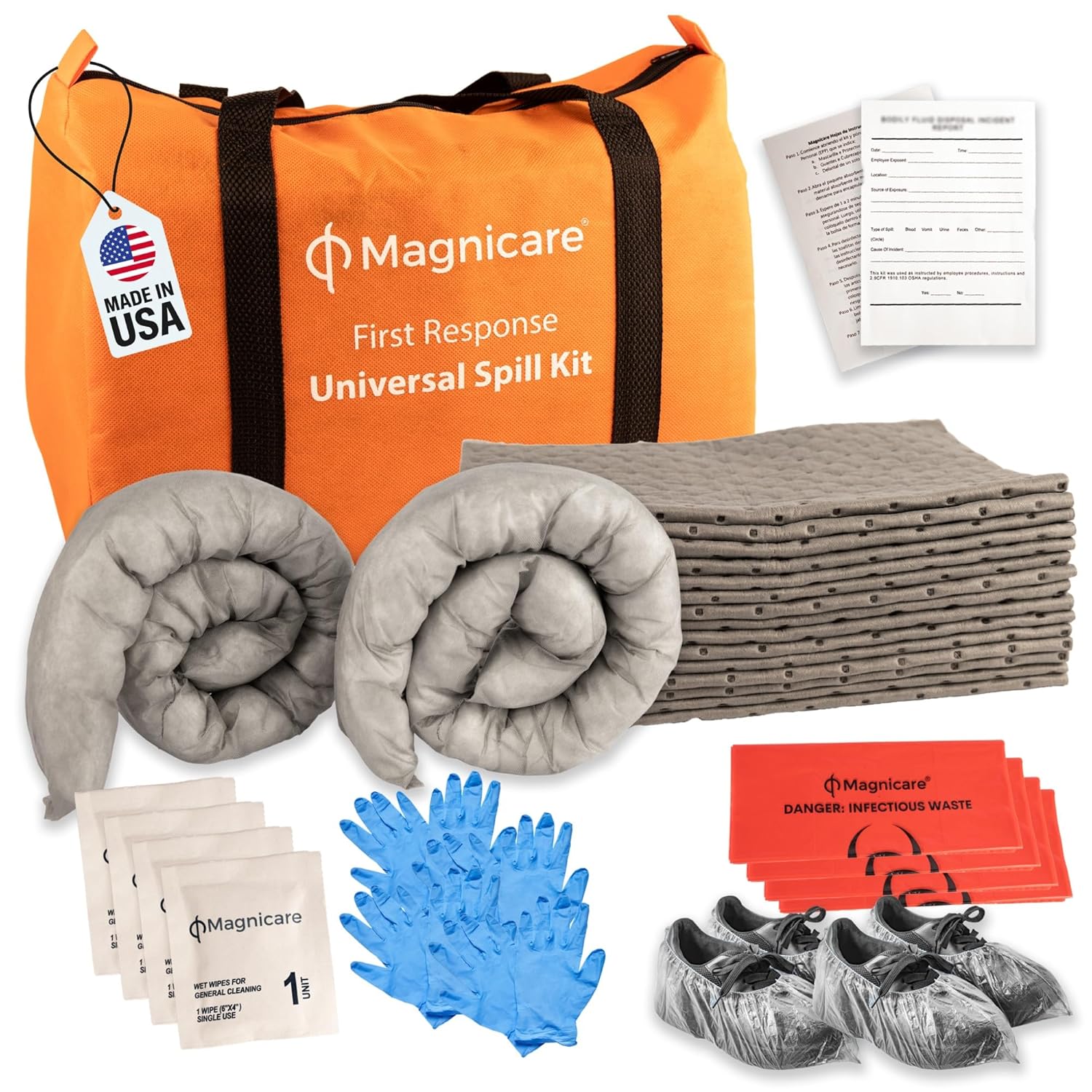
The Universal Spill Kit covers that floor-level half: 15 universal absorbent mats, 2 absorbent socks, nitrile gloves, shoe covers, red biohazard bags, wet wipes, bilingual instructions and a spill report form, in a bright orange duffel.
Does construction follow a different first aid rule?
It follows its own copy of the same rule. Construction work is governed by Part 1926, where § 1926.50 covers medical services and first aid and carries its own non-mandatory first aid kit appendix.
Paragraph 1926.50(g) is word for word identical to 1910.151(c) on drenching and flushing. If you run both general industry and construction operations, you are not learning two different rules. You are applying the same sentence from two places.
How should you stock both kits for your site?
Six steps, in the order that actually works.
- Pull your OSHA 300 and 301 logs. Appendix A names them for this purpose. What has actually injured your people is better evidence than any generic list.
- Answer the near proximity question honestly. If professional care is not genuinely close, you need trained first aiders on every shift, not just a kit.
- Count your operations, not your employees. The appendix tells multi-operation sites to add kits, types and quantities. A single kit for a building with a kitchen, a workshop and a loading dock is under-provisioned.
- Stock the cleanup kit separately. Do not try to make one container serve both purposes. The first aid kit gets raided for plasters; the cleanup kit has to be intact the one time it is opened.
- Check the drenching trigger against your SDSs. If any stored product is an injurious corrosive material, 1910.151(c) applies to the work area where it is used.
- Replace the cleanup kit after every single use. It is consumed by one incident. A used kit put back on the shelf is the most common failure there is.

Frequently Asked Questions (FAQ)
Does OSHA require a first aid kit in every workplace?
Not in those words. 29 CFR 1910.151(b) requires adequately trained first aid personnel and adequate first aid supplies that are readily available, and it applies where there is no infirmary, clinic or hospital in near proximity to the workplace. In practice that describes most workplaces, which is why almost every site keeps a kit.
Is there an OSHA approved first aid kit?
No. OSHA does not approve, certify or endorse commercial products, so no kit can carry an OSHA approval. A kit can be built to help you meet 1910.151, and it can be built against the ANSI consensus standard the CFR appendix names, but neither of those is an OSHA approval.
What does OSHA say a first aid kit must contain?
The standard itself says nothing about contents. Appendix A to 1910.151 is titled First aid kits (Non-Mandatory) and points to ANSI Z308.1-1998 as an example of the minimal contents of a generic kit. Because the appendix is non-mandatory, it is a reference point rather than a required parts list.
How many first aid kits does OSHA require?
No number is given. Appendix A says the ANSI kit contents should be adequate for small worksites, and that larger or multiple operations at one location should determine the need for additional first aid kits, additional types of equipment and supplies, and additional quantities. It suggests using the OSHA 300 and 301 logs to identify site-specific needs.
Does a first aid kit meet OSHA's bloodborne pathogens requirements?
No. Appendix A to 1910.151 states that where exposure to blood or other potentially infectious materials is reasonably anticipated while using first aid supplies, employers must provide appropriate PPE under 29 CFR 1910.1030(d)(3). A kit of dressings and bandages does not satisfy that. Gloves are the minimum, with eye and face protection where splashes are foreseeable.
What does in near proximity mean in OSHA's first aid standard?
OSHA has never defined it as a number of minutes or miles in the regulatory text. It is a site-specific judgement about how quickly professional medical care can reach an injured employee. Treat any specific figure you see quoted as somebody's rule of thumb rather than a requirement.
Which ANSI first aid standard does OSHA reference?
Appendix A to 1910.151 names ANSI Z308.1-1998, Minimum Requirements for Workplace First-aid Kits. Later editions of that standard exist, but the CFR text still names the 1998 edition, and the appendix is non-mandatory either way.
Does OSHA require an eyewash station in every workplace?
No. 1910.151(c) applies where the eyes or body of any person may be exposed to injurious corrosive materials. Where that trigger is met, suitable quick drenching or flushing facilities must be provided within the work area for immediate emergency use. Whether it applies to you is answered by the Safety Data Sheets for what you store.
Put both kits on the shelf, not one
The honest summary of OSHA's first aid rule is that it asks for judgement rather than a shopping list, and it hands you off to a second standard the moment blood is involved.
So provision for both. A first aid kit sized against your own injury log for the injured person, and a bodily fluid cleanup kit that satisfies 1910.1030(d)(3) for everything the injury leaves on the floor.
Magnicare builds the second half. Choose the bag format where somebody has to carry it to the incident, the box format for a fixed station beside the first aid cabinet, and the Universal Spill Kit where chemicals and oil are stored as well.
Do this today: open your first aid cabinet and look for a box of gloves and eye protection. If they are not in there, Appendix A has already been telling you what is missing. Compare Magnicare cleanup kits →
Published by the Magnicare Safety Team. This article quotes 29 CFR 1910.151 and its Appendix A directly and is general guidance, not legal advice. Requirements vary by jurisdiction, and states operating their own OSHA-approved plans may impose stricter rules. Always work from the current text of the standard.